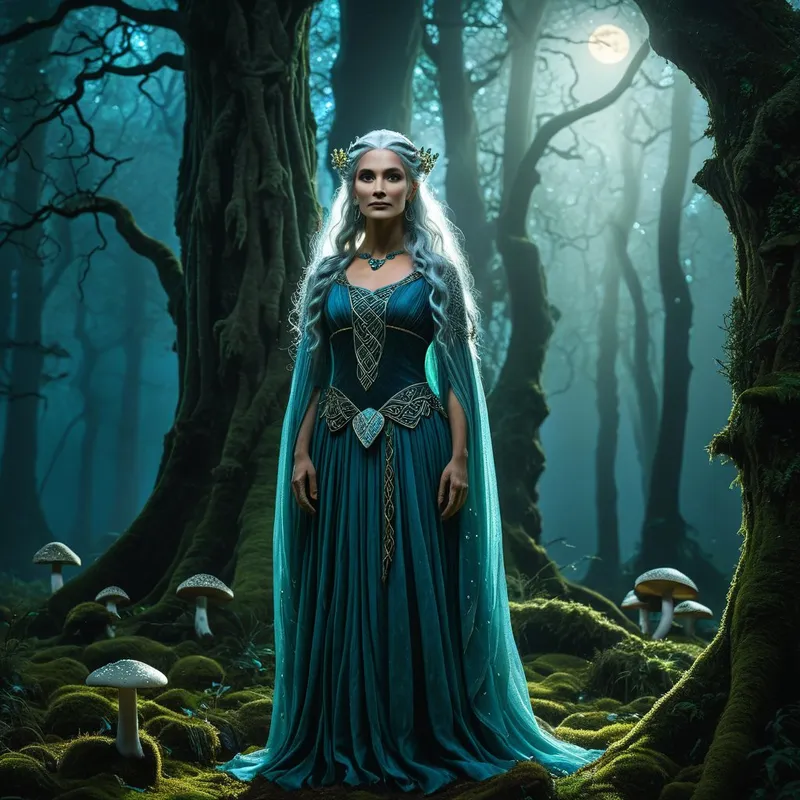
Fairies Myth Meaning & Symbolism
A journey into the liminal realm of the Sidhe, where enchantment and peril reveal the soul's contract with the wild, untamed psyche.
The Tale of Fairies
Listen. The world you know is but one layer of the cloth. Beneath the green mantle of the hill, behind the veil of the waterfall’s mist, in the deep heart of the oldest skeagh, there exists another country. They do not call themselves “fairies.” That is a human word, soft and diminutive. They are the Aos Sí, the People of the Mounds, and they remember when the world was young.
Come with me to the time when the last light of day—the dorchadas—stretches long across the land. A young woman, Aisling, walks the boundary of her father’s fields, where the cultivated land gives way to the wild wood. The air is thick with the scent of damp earth and blooming skeagh. She hears it first: a music that is not of pipe or harp, but the sound of stars singing, of roots drinking deep, of time itself unwinding. It pulls at her blood.
Forgetting the warnings, she follows the melody. It leads her to a ring of mushrooms, vivid and perfect in the gathering gloom. Within the ring, the light is different—softer, older. A figure steps forth. He is tall, his beauty severe and ancient, clothed in greens and greys that shift like the forest floor. His eyes hold the patience of stone and the quickness of a fox. He is a lord of the Sidhe. He offers no name, only a smile that holds both promise and peril. In his hand is a cup, brimming with a liquid that reflects not her face, but a version of her she has never seen—wild, crowned with ivy, her eyes full of storm.
“Drink,” he says, his voice the whisper of leaves. “And see the truth of your heart.”
This is the offer. This is the test. To drink is to step across the threshold, to leave the world of clocks and walls for the timeless, demanding realm of the Tír na nÓg. It is not a journey of distance, but of essence. She hesitates, the weight of her human life—her loves, her duties—a tangible chain. Yet, the vision in the cup calls to a deeper chain, one forged of older metals.
She drinks.
The world dissolves into a symphony of living light. She is in the hall of the sídhe, where feasting lasts a night that stretches for a hundred years in the world above. She dances, learns the language of birds and the secrets of stones. She is enchanted. But enchantment has a price. To stay is to be changed, to become Other. The memory of the sun on her skin, of her mother’s voice, becomes a faint, aching echo. The lord’s beautiful face shows no cruelty, only the implacable nature of his realm: you cannot taste the food of Faerie and remain unchanged.
Her return is not a victory, but a negotiation. The path back is through a labyrinth of her own longing. She must hold the memory of both worlds within her, the human and the Sidhe, without being torn asunder. She emerges not at the fairy ring, but at her own doorstep, as dawn breaks. A single night has passed in her village, but her eyes are centuries old. She carries the silence of the mound within her, a secret wisdom and a sorrow, forever a walker of the threshold.
Cultural Origins & Context
This tale is not from a single book, but from the land itself—whispered in the wind over the bog, encoded in the patterns of standing stones, carried in the blood memory of the fili. The Celtic conception of fairies, the Aos Sí, is profoundly rooted in a pre-Christian, animistic worldview. They are often interpreted as the diminished, folkloric memory of the Tuatha Dé Danann, the divine tribes who, upon being defeated by the mortal Milesians, retreated into the hollow hills, becoming the “People of the Mounds.”
These stories were the connective tissue of the community, told not for mere entertainment but for survival—psychic and physical. They encoded laws: do not cut the skeagh, do not build on a fairy path, leave offerings at the doorstep. The mythos functioned as a cognitive map, teaching respect for the liminal spaces—the dusk, the dawn, the shore, the bog—where the veil between the human world and the Otherworld was thin. The storyteller, the bard, was a mediator between these realms, using the story to remind the people of the contract with the wild, unseen forces that governed fortune, harvest, and fate.
Symbolic Architecture
The fairy myth is the psyche’s own map of its unexplored territories. The Aos Sí represent the autonomous, archetypal complexes of the deep unconscious. They are not personal; they are ancestral, elemental, and utterly other. Their beauty is terrifying because it reflects a part of the soul that exists outside of personal control, social norms, and linear time.
The fairy ring is the mandala of the threshold, a symbol of the psychic point of no return where ego-consciousness meets the numinous power of the Self.
The fairy lord or lady is the personification of the anima or animus in its most potent, divine form. They are the lure and the guide into the depths. The offered cup is the call to individuation—a draught of self-knowledge that is both intoxicating and perilous. To drink is to consent to the dissolution of the provisional personality, the “human” identity, in service of a more authentic, integrated wholeness. The timeless feast in the sídhe symbolizes the ego’s absorption into the unconscious, a state of enchantment where one risks losing connection to the conscious world entirely. The return, fraught and changed, is the critical act of integration—bringing the gold of the unconscious insight back to the daylight world.
The Dreamer's Resonance
When this myth stirs in modern dreams, it announces a profound encounter with the autonomous psyche. Dreaming of following ethereal music into a strange wood, of encountering radiant yet alien beings, or of being lost in a beautiful but endless twilight palace, signals that the dreamer is at a psychic crossroads.
Somatically, this may feel like a humming in the bones, a sense of being “pulled” or enchanted by a new idea, relationship, or creative impulse that feels both thrilling and dangerously destabilizing. Psychologically, it is the process of being “taken” by a complex. The ego is being invited, or compelled, to engage with a powerful archetypal force—perhaps the creative daimon, the transformative trickster, or the deep anima. The peril in the dream mirrors the real peril: the potential for inflation (identifying with the archetype) or for dissociation (becoming lost in the unconscious). The dream is the psyche’s way of staging this critical negotiation between the personal self and the transpersonal Other.
Alchemical Translation
The fairy myth is a precise allegory for the alchemical putrefactio and sublimatio. The journey into the mound is the nigredo, the necessary dissolution in the dark earth. The ego, with its certainties and identities, is broken down by the encounter with the absolute Otherness of the Sidhe.
The triumph is not in refusing the cup, nor in staying forever in the mound, but in drinking, journeying, and returning with the silent knowledge etched upon the soul.
The feast represents the chaotic, fascinating albedo where new psychic contents swirl in a state of potential. But the work is not complete until the rubedo, symbolized by the return at dawn. This is the psychic transmutation: the individual no longer belongs solely to the human collective nor is they swallowed by the unconscious collective. They become the living threshold itself—the walker between worlds, the mediator. For the modern individual, this translates to the capacity to hold profound inner experience (inspiration, grief, numinous insight) without being identified by it or dissociated from the outer world. They carry the enchantment within, not as a spell that binds, but as a wellspring that nourishes, forever mindful of the beauty and the peril of the deep self.
Associated Symbols
Explore related symbols from the CaleaDream lexicon: