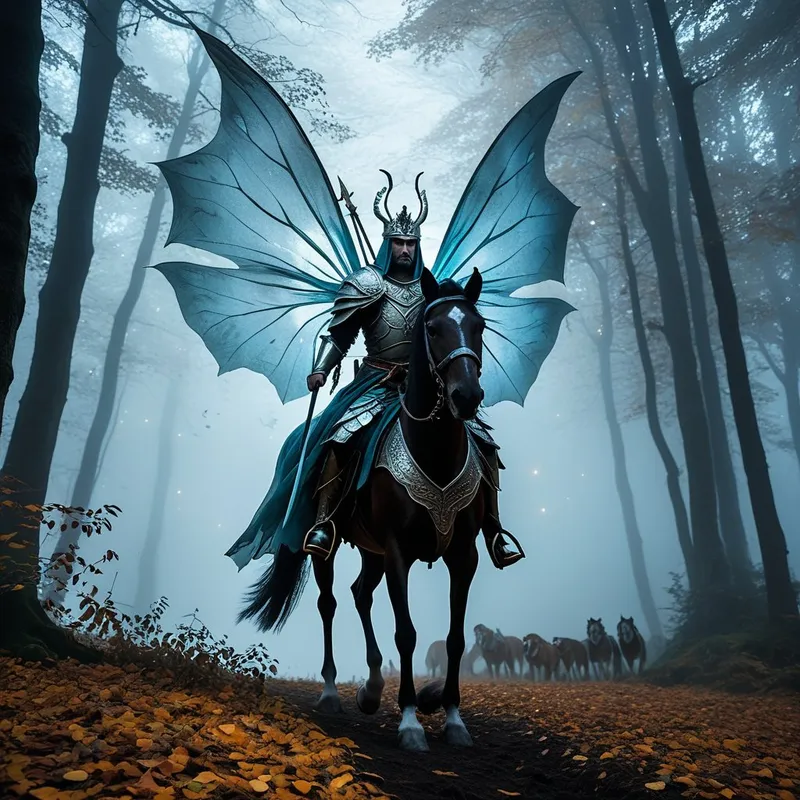
Faerie Rade Myth Meaning & Symbolism
A spectral host rides from the Otherworld, a terrifying and beautiful omen of fate, sovereignty, and the thin veil between worlds.
The Tale of Faerie Rade
Hear now, and listen well, for the tale I tell is not of this sunlit world. It is a tale of the time between times, when the veil that hangs between the land of the living and the Sídhe grows thin as a spider’s silk. It is the hour of the Faerie Rade.
The sun has fled behind the western hills, and the long, blue dusk settles over the land. The wind falls silent. In the deep woods, where the oldest oaks remember the first songs, a chill mist begins to creep from the hollows and the roots of the hawthorn. This is no common fog. It carries the scent of frost and forgotten flowers.
Then, a sound. Distant at first, a vibration in the earth more than a noise—the thunder of countless hooves on no earthly road. It swells, a tide of sound, and with it comes a light, cold and silver, piercing the mist. They are coming.
At their head rides the Sídhe royalty. A king with hair like winter moonlight and eyes holding the depth of starless lakes, or a queen whose beauty is as sharp and perilous as a sword’s edge. They are clad in grey and green, their cloaks seeming woven from shadow and moss, yet they gleam with a terrible, inner majesty. Behind them streams the host: noble warriors on steeds of dappled grey and coal black, their spears tipped with cold fire; hounds with eyes like burning coals, running silent as ghosts; ladies fair and fearsome, their laughter like the ringing of crystal bells that promises joy or madness.
They ride the ancient tracks, the fairy paths that cross hill and stream, invisible to mortal eyes by day. This is the Faerie Rade, the Hosting, the Wild Hunt of the Gael. Their purpose is their own—a journey to a forgotten battlefield, a revel in a hollow hill, the claiming of a soul bound by ancient pact. To see them is an omen. For some, a blessing of inspiration that will birth a poet. For most, a curse, a glimpse of a fate too vast to comprehend, which leaves the viewer fey—touched by the Otherworld, destined for an early grave or a life of haunted longing.
The mortal who is wise, hearing the horn’s blast or the baying of the spectral hounds, will fall face down, eyes shut tight, and pray to be overlooked. To meet the gaze of the Sídhe lord is to be claimed. To step onto their path is to be swept away, perhaps to return a hundred years later, aged in a day, or to never return at all, becoming but a memory and a warning tale told on a winter’s night.
And then, as suddenly as it came, the sound fades. The light dims. The mist retreats. The world is ordinary again, but forever changed for the one who witnessed. The air is colder. The silence is deeper. And the memory of that beautiful, terrifying procession is etched upon the soul, a scar and a secret from the world behind the world.
Cultural Origins & Context
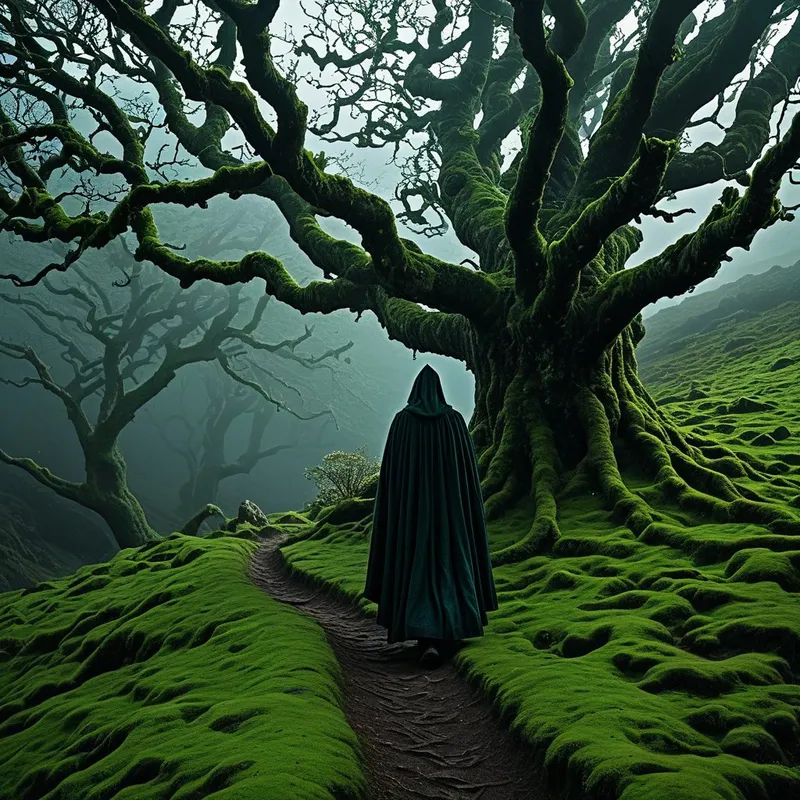
The myth of the Faerie Rade is not a single story but a pervasive folk motif woven through the Gaelic traditions of Ireland, Scotland, and the Isle of Man. Its roots sink deep into the pre-Christian substrate, likely evolving from beliefs about the Tuatha Dé Danann. After their mythical defeat, these divine beings were said to have retreated into the Sídhe (the earthen mounds), becoming the Aos Sí (people of the mounds). The Rade is their periodic emergence, a reminder of their enduring sovereignty over the land.
This lore was kept alive not in formal epics but in oral tradition—by the seanchaí (storytellers) by the hearth and in the fíor (true) accounts shared in whispers. It functioned as both cosmology and social law. It explained strange sounds in the night, sudden illnesses (fairy-struck), and inspired genius. Crucially, it enforced taboos: one did not build on a fairy path, cut a lone hawthorn, or be abroad on certain nights like Samhain, when the veil was thinnest and the Rade most active. The myth mapped the invisible geography of the supernatural onto the physical landscape, teaching respect, caution, and an awareness of forces greater than humankind.
Symbolic Architecture
The Faerie Rade is a master symbol of the autonomous, eruptive unconscious. It represents all that rides forth from the hidden depths of the psyche, unbidden and according to its own inscrutable laws.
The Rade does not ask for permission; it announces its sovereignty. To witness it is to have one’s conscious reality invaded by the numinous and the archetypal.
The Sídhe royalty symbolize the archetypal rulers of the psyche—the Self, in its majestic, often terrifying form. They are not evil, but they are other, operating by a logic of fate, beauty, and primal power that can shatter the ego’s fragile order. The host represents the multitude of complexes, instincts, and ancestral memories that compose our inner world. The hawthorn and the mist mark the limen, the threshold. The Rade itself is the moment of eruption—when repressed creativity, long-buried trauma, or destined life-change bursts through the boundary, demanding acknowledgment.
The mortal’s dilemma—to look or look away—is the core human conflict between consciousness and the unconscious. To look is to risk being claimed: overwhelmed, obsessed, or psychologically dismantled. To look away is to remain safe but stagnant, forever ignorant of the profound, transformative power moving through one’s own soul.
The Dreamer's Resonance
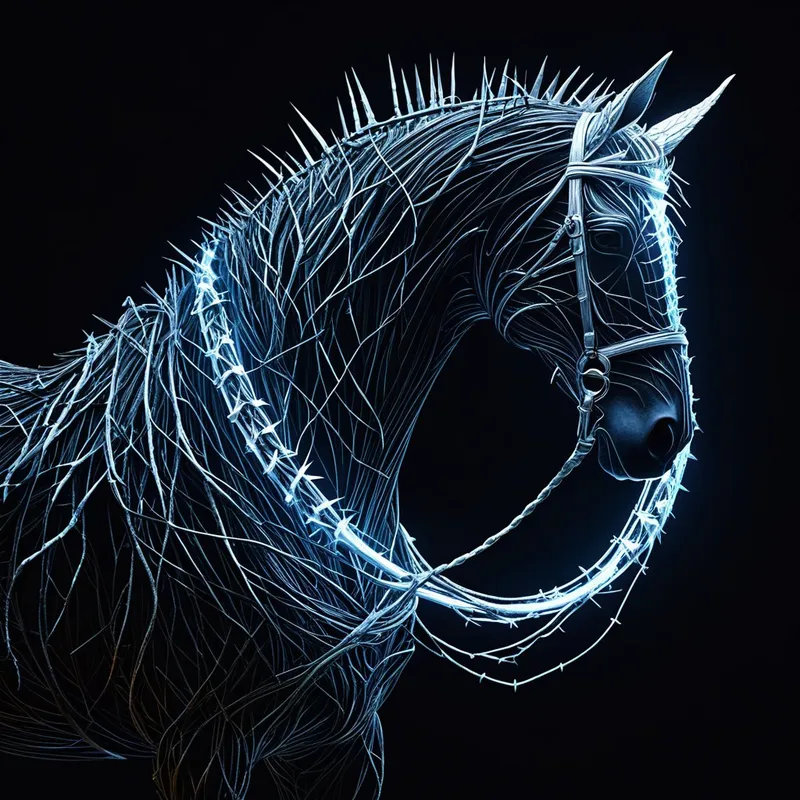
When the imagery of the Faerie Rade gallops through a modern dream, it signals a powerful incursion from the deep psyche. The dreamer is not merely having a fantasy; they are witnessing an internal, archetypal process that has gained immense momentum.
Somatically, this might correlate with feelings of awe, dread, or a chilling vibration—a sense of being in the presence of something vastly greater than oneself. Psychologically, it often appears during periods of fateful transition: the end of a life chapter, a creative breakthrough, or the unsettling approach of a destiny one has tried to avoid. The Rade in a dream is the unconscious presenting its bill, its agenda, its sublime offer. The specific details matter: Is the dreamer hiding? Are they seen? Are they offered a place in the procession? This reveals the ego’s stance toward this eruptive content—whether it is in a state of terrified resistance, curious observation, or readiness for a profound, if daunting, assimilation.
Alchemical Translation
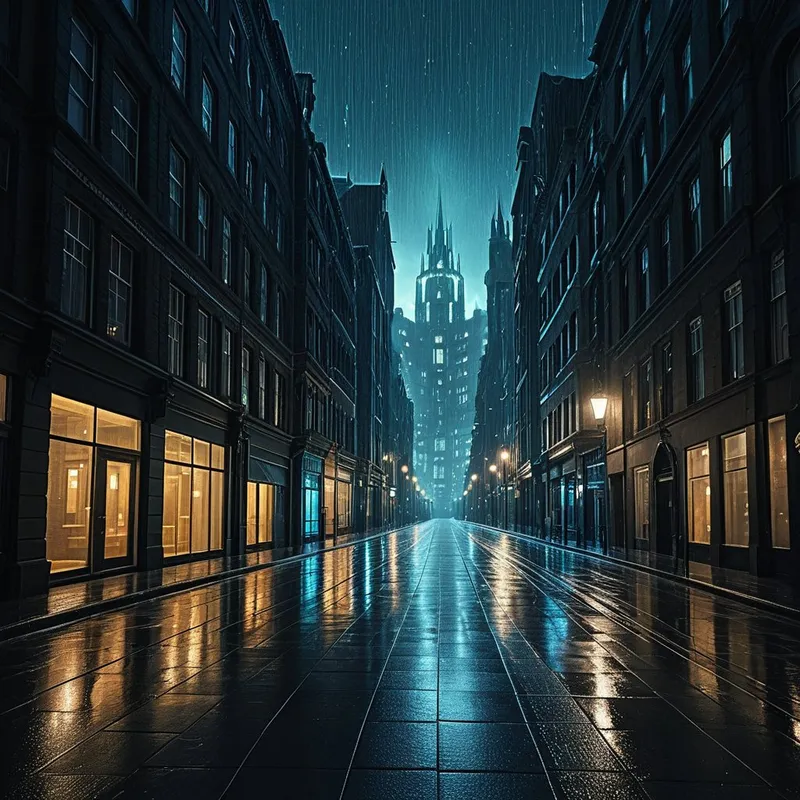
The alchemical journey modeled by the Faerie Rade is not one of heroic conquest, but of humble witness and sacred pact. It is the path of the individuation, where the goal is not to defeat the Otherworld host, but to recognize its sovereignty and establish a conscious relationship with it.
The first stage is Nigredo: the blackening, the encounter with the shadowy host in the mist. This is the shock of realization—that one is not master in one’s own house, that powerful, autonomous forces govern much of one’s life and psyche. The ego’s illusion of control is shattered.
The work is not to stop the Rade, but to learn its routes, to respect its power, and to find the courage to meet its gaze without being annihilated.
The second stage is Albedo: the whitening, the purification that comes from steadfast witnessing. By holding the tension of the encounter—the terror and the beauty—without fleeing into denial or being swept away into psychosis, the ego is refined. It learns its proper role not as tyrant, but as steward and interlocutor with the Self.
The final translation is Rubedo: the reddening, the creation of the philosophical gold. This is the conscious pact. The mortal who survives the encounter with understanding may gain the fey touch—not as a curse, but as a gift. It becomes integrated inspiration, a poetic vision, or a hard-won wisdom that navigates fate. The individual becomes a living threshold, a hawthorn rooted in this world, whose branches touch the Other. They carry the memory of the Rade within, its power now a source of guidance rather than fear, having achieved a sovereignty that acknowledges a greater sovereignty still.
Associated Symbols
Explore related symbols from the CaleaDream lexicon: