Ezili Dantor Myth Meaning & Symbolism
A Vodou lwa of fierce maternal protection, born from ancestral trauma and forged in the fires of resistance, embodying the scarred, unyielding heart of the people.
The Tale of Ezili Dantor
Listen. The story does not begin in a palace of clouds or a garden of delights. It begins in the belly of the ship, in the salt-sting and the darkness, where the groans of the chained became the first prayers. It begins in the heat of the cane field, where the lash kissed flesh and the earth drank sweat and blood. From this crucible of suffering, she was not born—she forged herself.
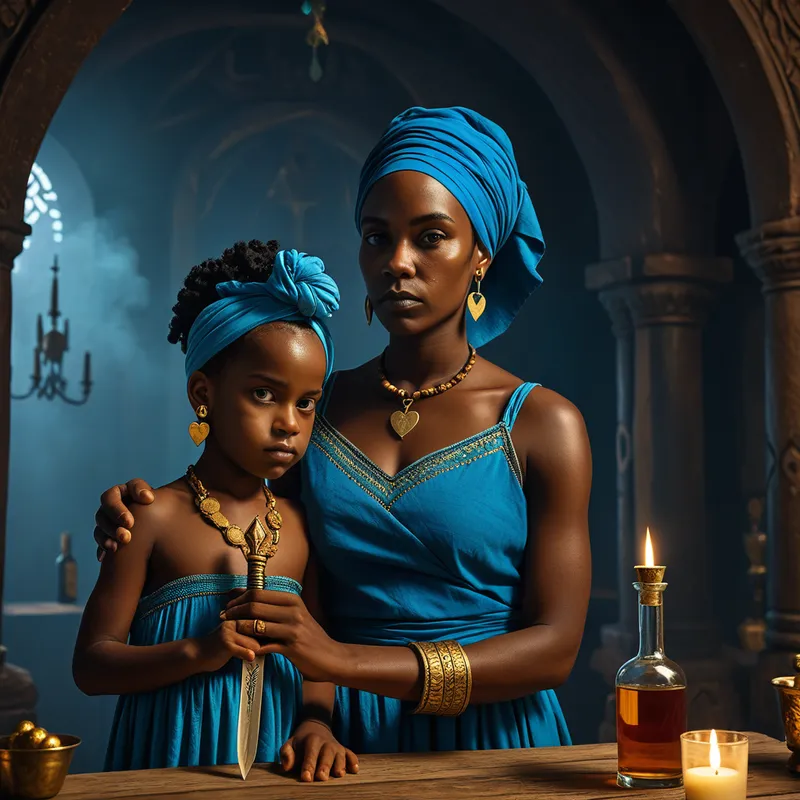
Her name is Ezili Dantor. She is the mother with the scarred cheek, a map of resistance etched into her skin. She wears blue and red, the colors of the Mino, the warrior women of Dahomey whose spirit crossed the water in the hearts of the stolen. She carries a dagger, not for ceremony, but for the swift, sharp work of protection.
She is not the sweet, distant mother of the sky. She is the mother in the barracks, the one who gathers the children when the overseer rides near. Her altar is not gold but clay, holding a pierced heart—hers, and yours—and a bottle of kleren to burn away the weakness. Her sacred child is Ti-Jan Petwo, a figure small and wooden, representing all children under threat, all innocence that must be guarded with ferocity.
They say her most sacred story is one of a great betrayal and a greater love. A time when the community was fractured, when trust was a knife turned inward. In the confusion, the children were vulnerable, scattered like seeds in a storm. It was Dantor who, with a roar that silenced the chaos, gathered them to her. She stood her ground, a solitary bastion against the coming fury. The conflict was not with a monster from a tale, but with the cold, relentless machinery of oppression and the poison of despair. The rising action was the beat of her own heart, steady and furious, as she made her stand not on a battlefield, but in the spiritual center of her people’s need.
The resolution was not a victory sung in halls, but a quiet, enduring truth. She took the wound—the scar that would forever mark her—so the children would not. She absorbed the violence meant for the future. And from that sacrifice, she did not diminish; she became essential. She became the promise whispered in the dark: You are not alone. I am here. I am scarred, and I am standing.
Cultural Origins & Context
The spirit of Ezili Dantor is a profound creation of the African Diaspora, specifically emerging from the syncretic crucible of Haitian Vodou. Her roots are traced to the Dahomey and Kongo nations, but she is not a direct transplant. She is a response. She coalesced in the brutal reality of the French colony of Saint-Domingue, where enslaved Africans from diverse traditions forged a new spiritual language of survival and rebellion.
She was passed down not in scrolls, but in rituals, songs (chante lwa), and the embodied knowledge of mambos and houngans. Her myth was lived before it was narrated. Her societal function was, and remains, multifaceted: a protector of children and single mothers, a patron of those who must fight with cunning and grit for their family’s survival, and a fierce, martial energy invoked for justice. She is the spiritual embodiment of the Haitian Revolution’s fighting spirit—a mother who does not just weep for her children, but arms herself for their liberation.
Symbolic Architecture
Ezili Dantor is the archetype of the Scarred Caregiver. She represents a form of love that is not soft, but formidable; a protection born not from pristine power, but from endured violation.
The most potent protection often wears the face of the wound it survived.
Her scar is her central symbol. It is not a flaw, but a testament—a permanent record of sacrifice and a shield forged in that fire. It signifies that the caregiver has faced the darkness and carries its mark, making her vigilance eternal and her compassion fierce, not naive. The dagger symbolizes proactive, sharp, sometimes ruthless defense. It is the cutting of toxic bonds, the swift action taken before the threat lands. Ti-Jan Petwo, her child, represents the vulnerable, creative, and often rebellious inner child that requires fierce guardianship, not smothering, within both the individual and the community.
Psychologically, Dantor embodies the part of the psyche that says, “Enough.” She is the maternal instinct transformed into a warrior ethic when the nest is under siege. She integrates the capacity for rage into the function of love, challenging the notion that true care must always be gentle.

The Dreamer's Resonance
To dream of Ezili Dantor is to feel the psyche mobilizing its deepest defenses around a core vulnerability. It often occurs when the dreamer feels their "inner child" or a cherished, fragile aspect of their life (a relationship, a creative project, a newfound hope) is under existential threat—whether from external criticism, internal shame, or life circumstances.
Somatically, one might awaken with a clenched jaw, a protective hunch in the shoulders, or a fierce heat in the chest—the body preparing to stand its ground. The dream landscape may feature besieged homes, the need to hide or protect a small animal or child, or the sudden, clear knowledge of a "line in the sand" that must not be crossed. The dreamer is not fleeing; they are turning to face the threat, often discovering a previously untapped reservoir of defiant strength. The process is one of psychic fortification, where love transmutes into the unyielding will to preserve what is loved.

Alchemical Translation
The alchemical journey modeled by Ezili Dantor is not about turning lead into gold in a distant tower. It is the alchemy of the hearth and the battlefield, the transmutation of victimhood into guardianship, and pain into an unbreakable boundary.
The prima materia (base material) is the raw experience of violation, betrayal, or profound vulnerability—the "scar." The process begins with nigredo, the blackening: fully acknowledging this wound, not as a source of shame, but as a fact of one’s history. Dantor does not hide her scar; she bears it as her identity.
The scar becomes the seal of authority, the proof that one has met the darkness and now knows how to guard the light.
The albedo, or whitening, is the crystallization of intent from that pain: “This will not happen again. I will protect what is mine.” This is where the “dagger” is forged—a clear, sharp principle of self-defense and boundary-setting. The final stage, the rubedo or reddening, is the embodied integration. The wounded one becomes the protector. The care they give is now imbued with the wisdom of survival; it is discerning, potent, and capable of righteous fury. The pierced heart on the altar is the symbol of this completion: a heart that has been wounded yet beats more fiercely, more lovingly, and more protectively than ever before. The individual achieves a form of individuation where vulnerability and strength are not opposites, but the twin pillars of a sovereign, caring self.
Associated Symbols
Explore related symbols from the CaleaDream lexicon:
- Mother — The central archetype Ezili Dantor embodies, but in its most fierce, protective, and sacrificially scarred manifestation, redefining maternal strength.
- Child — Represented by Ti-Jan Petwo, the sacred vulnerable core—whether literal children, inner creativity, or nascent hope—that demands and justifies fierce protection.
- Wound — The scar on Dantor's cheek, transformed from a mark of victimization into a badge of honor, a source of authority, and a permanent reminder of the cost of care.
- Dagger — The active principle of protection; not passive shielding, but the clear, sharp ability to cut threats, set boundaries, and engage in necessary conflict.
- Heart — The pierced heart on her altar, symbolizing a love that has been wounded yet remains vital, beating fiercely in service of what it guards.
- Blood — The lineage, sacrifice, and visceral life-force of the people; the shared history of suffering and survival that Dantor embodies and protects.
- Earth — Her grounded, practical nature; she is not an ethereal spirit but one of the Petwo lwa, connected to the soil, struggle, and raw power of the land.
- Fire — The transformative, purifying, and martial energy of her Petwo aspect, representing righteous anger and the spiritual heat of resistance.
- Altar — The humble, personal space where she is honored, reflecting that her power is accessed through practical devotion, remembrance, and the offering of one's own struggles.
- Spirit — The indomitable, ancestral will that survived the Middle Passage and coalesced into her form, representing the intangible force of cultural and personal resilience.