Ezekiel's Wheel Vision
A prophet's bewildering vision of celestial wheels within wheels, interpreted as divine chariot, cosmic blueprint, or mystical revelation of God's glory.
The Tale of Ezekiel's Wheel Vision
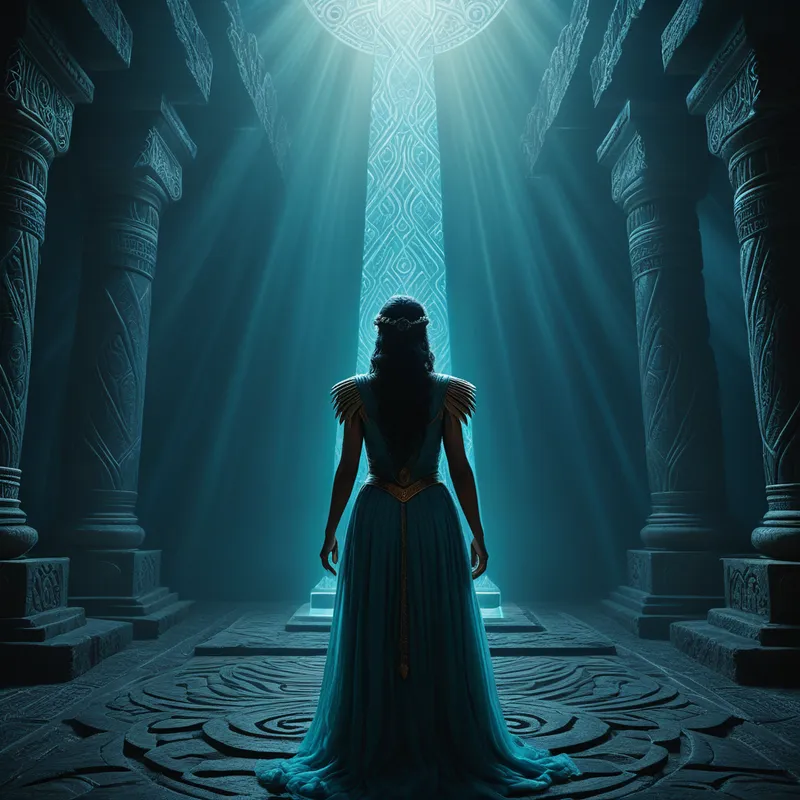
The air by the river Chebar was thick with exile, heavy with the dust of a displaced people. It was here, in the land of the Chaldeans, that the priest Ezekiel found himself, a man of the Temple now dwelling by a foreign canal. The heavens did not merely open; they were torn asunder. From this rent in the fabric of the sky came a scorching wind from the north, and within it, a fire that took form. This was no ordinary flame, but a great cloud flashing with lightning, its core glowing like molten metal.
From the midst of this incandescent storm emerged four living creatures. They were not of earth, but of vision, each with four faces and four wings. Their legs were straight, and the soles of their feet sparkled like burnished bronze. They moved as one, a terrifying symphony of purpose, their wings touching, their motion a flash of lightning. And beside each creature stood a wheel, a construction that defied mortal geometry.
The wheels were the color of beryl, a deep, oceanic gemstone. Their appearance was like a wheel intersecting a wheel, a tesseract rendered in prophetic sight. They could move in any of the four directions without turning, their rims full of eyes, all-seeing, unblinking. Where the spirit of the living creatures went, the wheels went beside them, for the spirit of the living creatures was in the wheels. Their motion was a sound like the roar of rushing waters, like the voice of the Almighty, like the tumult of an army.
Above the heads of the creatures was an expanse, shining like awe-inspiring crystal. And above this expanse was a throne, of lapis lazuli, the color of the deep night sky. Seated upon it was a figure with the appearance of a man, yet glowing from the waist up like gleaming metal, and from the waist down like fire surrounded by radiance. This was the likeness of the glory of the Lord. When Ezekiel saw it, he fell upon his face.
And a voice spoke. It did not come from the man-like figure, but from the glory itself, addressing him as “son of man,” a title that anchored his humanity even as he beheld the divine machinery. The wheels were part of the chariot of God, the Merkabah, the terrifying vehicle of a deity who was not confined to a ruined Temple in Jerusalem, but whose throne-room was mobile, whose presence could find his people even in the depths of Babylonian captivity.
Cultural Origins & Context
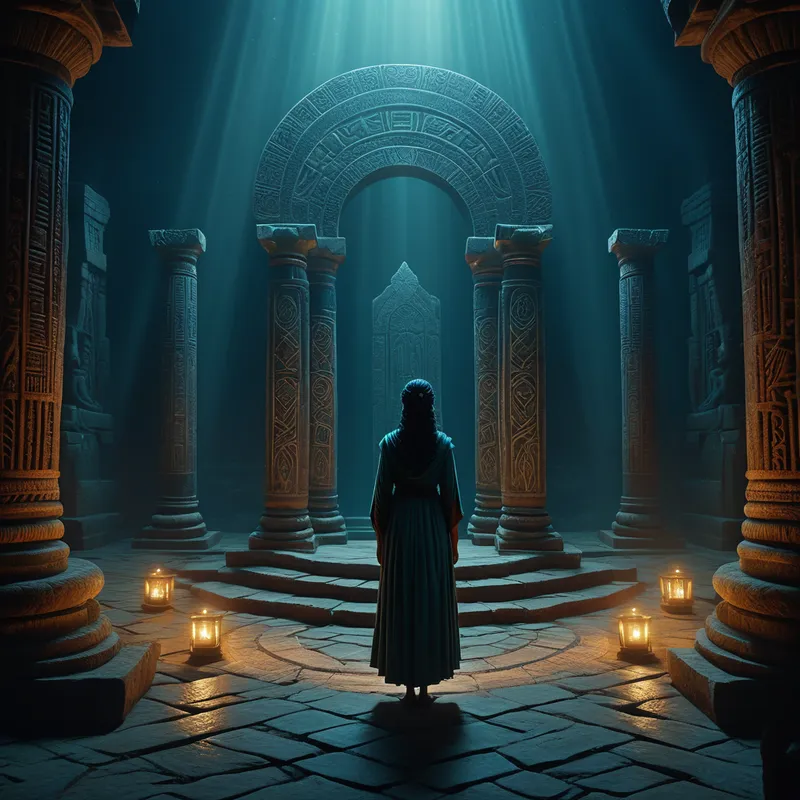
Ezekiel was both a priest and a prophet, a man torn between two worlds. His priestly soul was oriented towards the cosmic order and sacred architecture of the Temple in Jerusalem—the fixed dwelling place of God. His prophetic calling was thrust into the chaos of national catastrophe: the destruction of that Temple and the exile of Judah’s elite to Babylon in 597 BCE. The vision by the Chebar is the explosive collision of these two identities.
This vision is not a retreat from history but a profound engagement with it. The God of Israel, traditionally enthroned above the cherubim in the Holy of Holies, is here revealed as utterly transcendent and terrifyingly mobile. The wheels signify divine omnipresence and sovereignty; God’s chariot can traverse any plane, its eyes seeing all. For a people who believed their God was territorially tied to Zion, this was a shattering and necessary revelation. The divine glory had not been captured by Nebuchadnezzar’s armies; it had departed the Temple (as Ezekiel later visions show) and was now manifest in the heart of the empire that sought to crush them. The vision is a theological lifeline, asserting that the structure of the cosmos and the throne of the Creator remain intact, even when every earthly structure has failed.
Symbolic Architecture
The vision is a meticulously structured hallucination, a symbolic architecture built to convey the ineffable. Every detail is a loaded glyph in a divine language.
The “wheel within a wheel” is not a mechanical diagram but a multidimensional symbol. It represents the intersection of heavenly and earthly realms, the spiritual mechanics underlying physical reality. Its ability to move in any direction without turning signifies a divine consciousness unbounded by linear time or spatial orientation.
The four living creatures—with faces of a man, a lion, an ox, and an eagle—become the archetypal symbols of the four gospels in Christian tradition, but in their origin, they likely represent the pinnacle of creation (humanity, wild beasts, cattle, and birds) or celestial attendants. Their fourfold nature mirrors the four directions, emphasizing cosmic totality. The eyes upon the wheels are a profound motif of omniscience; nothing is hidden from this moving throne. The storm cloud, fire, and gleaming metal speak of a holiness that is both generative and utterly consuming, a fusion of power, judgment, and purity.
The entire vision operates on a principle of concentric holiness: from the storm cloud, to the creatures, to the wheels, to the crystalline expanse, to the lapis throne, to the human-like figure of glory. It is a visionary map of approaching the Absolute, a ladder of perception where each stage is guarded by awe.
The Dreamer's Resonance
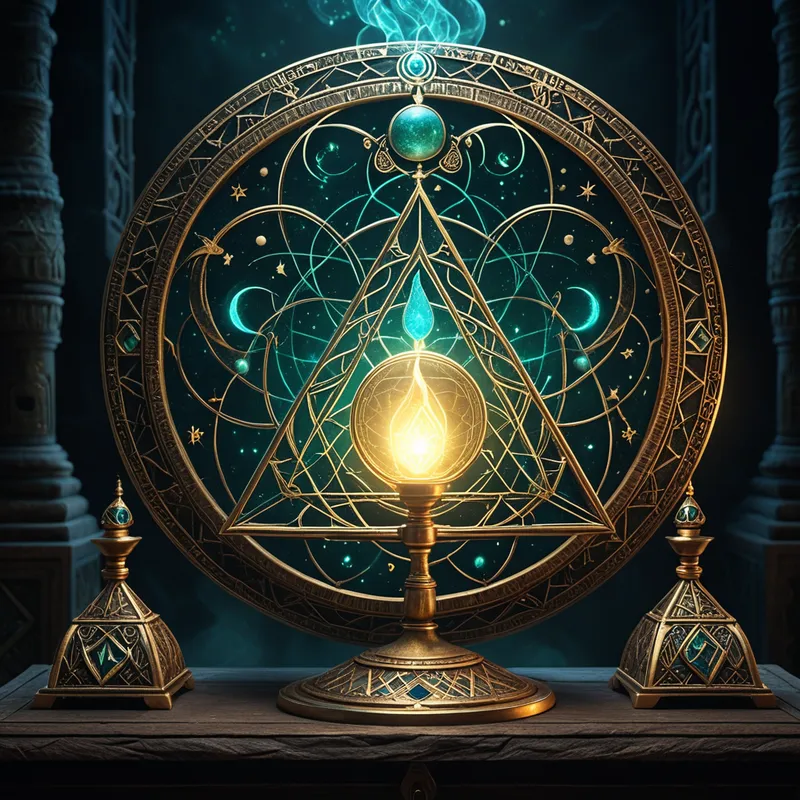
To encounter Ezekiel’s vision psychologically is to stand at the brink of a psychic revolution. It is the ultimate “big dream,” one that shatters the dreamer’s existing worldview and imposes a new, more complex order. Ezekiel, the priest, had his inner Temple—his structured, orderly understanding of God and his place in the cosmos—utterly demolished by history. In the psychic void of exile, his unconscious produces this staggering compensation.
The wheels within wheels represent a nascent, more sophisticated psychic structure struggling to be born. It is the Self (the divine center) announcing its sovereignty in a form the rational mind can barely comprehend. The terror of the vision is not incidental; it is the necessary terror of the ego confronted by the overwhelming power and intelligence of the total psyche. Ezekiel’s prostration—“I fell upon my face”—is the only appropriate ego response. The vision does not comfort him; it reorganizes him. It tells him that the center holds, even if it is a center of terrifying, eye-studded wheels and coals of fire. For any individual in a state of profound disorientation—exiled from one’s homeland, one’s identity, one’s former life—the vision offers a paradoxical solace: the ground of being is not static but dynamic, a chariot, and it is moving precisely through the heart of your chaos.
Alchemical Translation
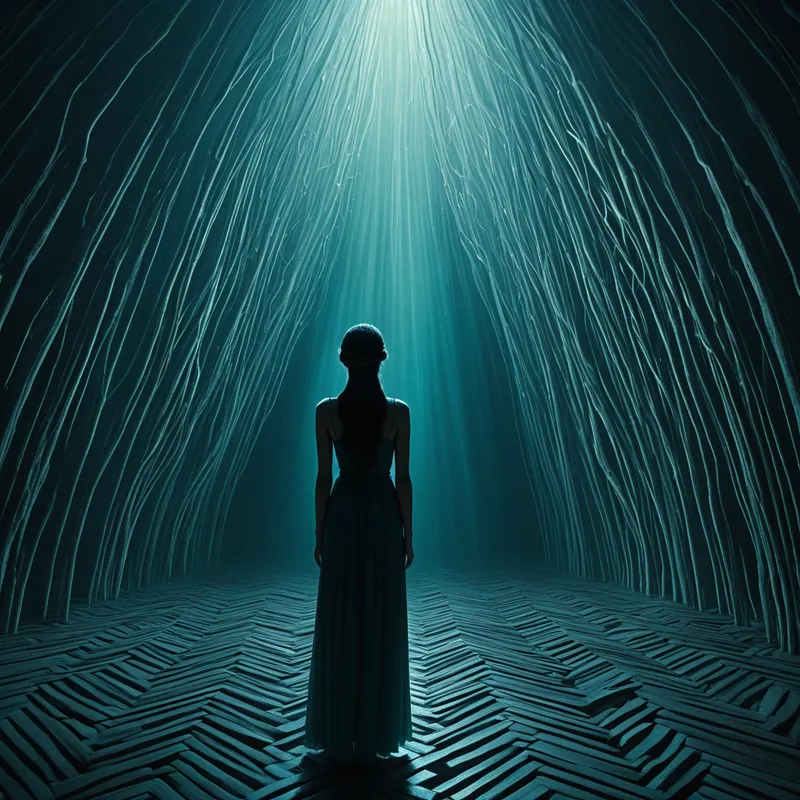
In the alchemical opus, the goal is the creation of the lapis philosophorum, the philosopher’s stone, through a process of dissolution and coagulation. Ezekiel’s vision is a spontaneous, divinely-inflicted alchemical revelation. The prophet himself is the prima materia, the base material of a priest in exile. The “whirlwind from the north” is the nigredo, the initial blackening, the chaotic dissolution of all his certainties.
The fiery cloud and gleaming metal represent the albedo and citrinitas—the whitening and yellowing—stages where divine light and fiery judgment purify the substance. The final stage, the rubedo or reddening, is seen in the figure like glowing metal and fire: the emergence of the divine-human coniunctio, the glimpse of the glorified body, the Self in its ultimate form.
The wheels are the rotatio, the endless circular process of the opus. Their eyes signify the attainment of universal insight, the omniscientia granted to the stone. The entire Merkabah is a vision of the completed opus alchymicum: a perfected, autonomous, and luminous psychic totality—the divine chariot-body—that can traverse all levels of reality. Ezekiel is not just shown God; he is shown the potential end-state of the human soul reconciled with its divine source, a blueprint for the ultimate integration of spirit and matter.
Associated Symbols
Explore related symbols from the CaleaDream lexicon:
- Wheel — The primordial symbol of cosmic order, cyclical time, and spiritual law, representing the dynamic, rotating structure of reality and destiny.
- Throne — The seat of sovereignty, divine authority, and the established center of cosmic order, from which judgment and grace emanate.
- Chariot — A vehicle of ascension and triumphant movement, representing the controlled harnessing of powerful, often opposing forces to transcend one’s current state.
- Eye — The organ of perception, omniscience, and divine witness, symbolizing consciousness, enlightenment, and the unsettling gaze of truth.
- Storm — A violent, cleansing force of chaos and revelation that breaks apart stagnant orders, often preceding a moment of profound insight or divine encounter.
- Crystal — Symbol of clarified consciousness, perfect order, and the transcendent realm; the frozen, geometric light of the spirit.
- Fire — The element of transformation, divine presence, and purifying judgment, capable of both destroying the dross and illuminating the essence.
- Voice — The audible manifestation of the unseen, carrying command, prophecy, and the foundational word that shapes reality from the void.
- Expanse — The firmament or vault separating heavenly and earthly waters, representing the boundary between the divine and the mundane, the known and the infinite.
- Living Creatures — Composite beings guarding the thresholds of the sacred, embodying the totality of creation and the animated intelligence of the cosmos.