Eye of Ra Myth Meaning & Symbolism
The story of Ra's daughter, sent as his wrathful Eye, who becomes a lioness goddess of destruction and must be pacified to restore cosmic balance.
The Tale of Eye of Ra
Hear now a story from the time when the world was young, and the sun was not just a star, but a king. The air over the Two Lands shimmered with the heat of Ra's gaze, a gaze grown weary. For though he ruled from his celestial barque, sailing the sky by day and the terrifying Duat by night, a murmuring had begun among the humans below. They had grown old, they had grown numerous, and in their hearts, a seed of rebellion sprouted. They whispered against the aging god, plotting in the shadows he had created.
Ra, from his throne of light, heard these whispers. They were not words, but a poison in the harmony of Maat. A cold fury, older than time itself, settled in his heart. He did not shout. He did not command his armies. Instead, he turned his face to the great council of the gods. "Behold," his voice echoed, a sound like stone grinding beneath the earth. "Mankind, the children of my tears, now sharpens knives against their father."
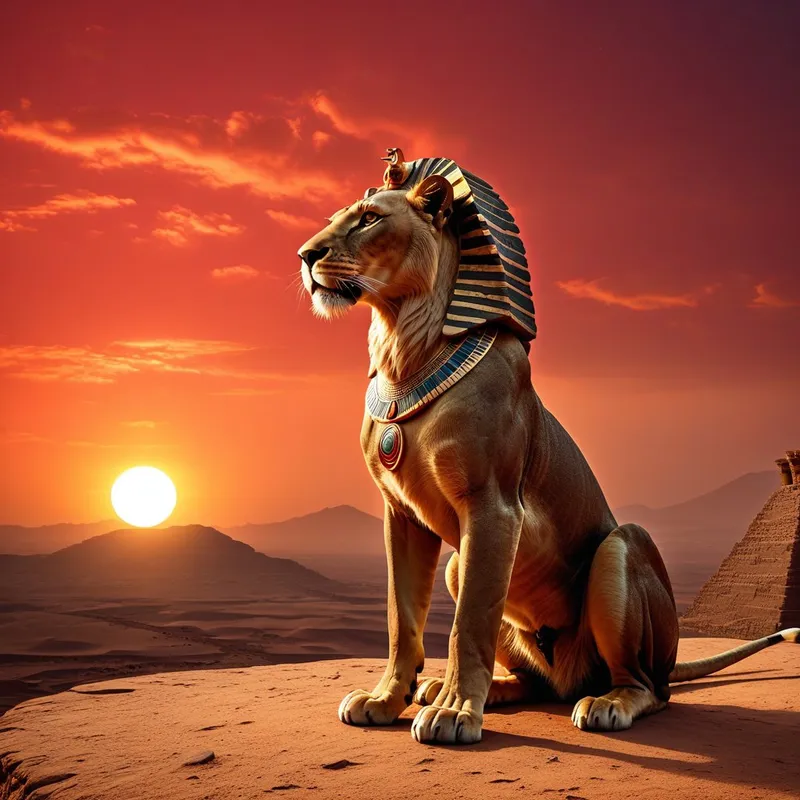
From the silence of the gods, a presence stirred. It was his own power, his own sovereign fury, made manifest. He called to his Eye. And she came. She stepped forth not as a beam of light, but as a separate, terrifying goddess. Some say she was Sekhmet, the Powerful One. Her form was that of a woman with the head of a lioness, but she was more than an image. She was the heat of the desert at noon, the fever that burns the flesh, the instinct to hunt and rend. The sun disk and uraeus upon her head blazed with a light that promised not life, but cleansing fire.
"Go," said Ra, and his word was law.
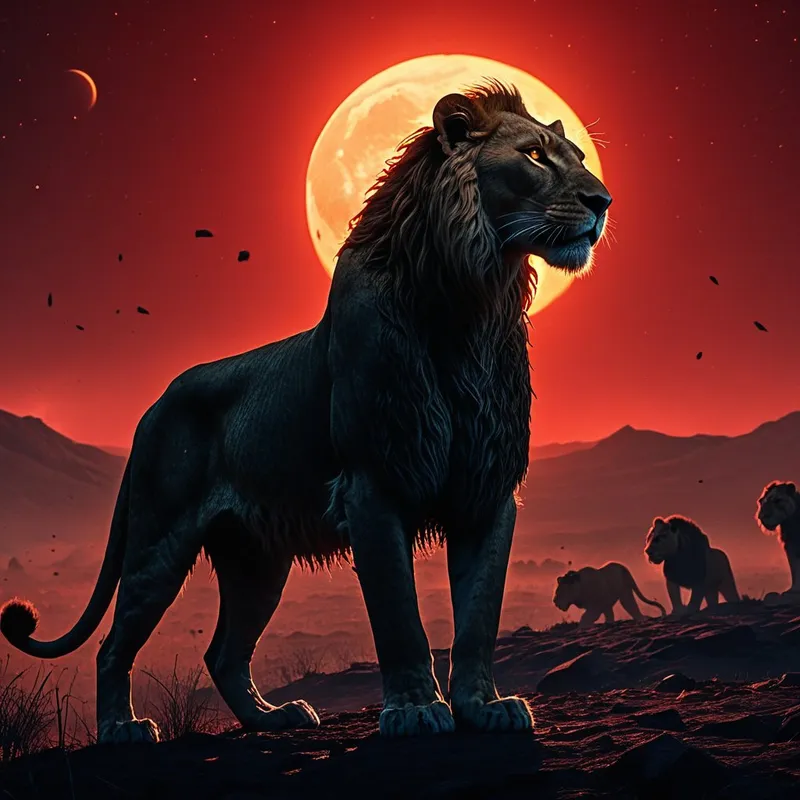
The Eye descended. She did not walk upon the earth so much as she became a plague upon it. A red haze settled over the land—the haze of her rage. She moved through the cities and the fields not as a warrior, but as a force of nature. Her passage was a sandstorm of claws and teeth. She did not fight mankind; she harvested them. The whispers of rebellion were drowned in screams, and the screams were soon silenced. The Nile, it was said, ran red not with sunset, but with the proof of her work. She reveled in it. The slaughter was not a duty; it was her nature, her ecstasy. She was the unleashed, untamed aspect of the sun itself, and she would burn the world to cinders to satisfy her father's will.
But as the land grew quiet, too quiet, a change came over Ra. The cold fury in his heart thawed, replaced by a dawning horror. His creation was being unmade. The balance had tipped from justice into annihilation. The Eye, drunk on blood and power, would not stop. She had become a separate will, a self-sustaining storm of destruction that even he could not simply recall.
A cunning was needed, a trick of the heart. The gods devised a plan. While Sekhmet prowled the distant deserts, they flooded the fields of Thebes with thousands of jars of beer, stained red with ochre and pomegranate juice to resemble a lake of blood. As the night deepened, the lioness returned, her jaws still hungry. She saw the vast, crimson lake and roared in triumph. She bent her head and drank, and drank, and drank, thinking to consume the last of her enemies.
But it was not blood. It was the deep, soporific draught of beer. Her movements slowed. The fire in her eyes dimmed to a sleepy glow. The relentless huntress stumbled, then lay down upon the bank. Her fierce lioness form softened, melted. When she awoke, the rage was gone, drowned in the red beer. She had been transformed. No longer Sekhmet the Destroyer, she was Bastet, the gentle cat, the protector of the home. She returned to Ra, not as his wrathful weapon, but as his pacified, protective daughter. The world was saved from total destruction, and the Eye was restored to its place on the brow of the sun god, a reminder of power that must be held in check.
Cultural Origins & Context
This myth is not a single, canonical text, but a fluid narrative woven from fragments in Pyramid Texts, Coffin Texts, and later temple inscriptions. It was a living story, told and retold to explain the very fabric of reality to the ancient Egyptians. It functioned as a divine charter for the pharaoh's power—he was the son of Ra, wielder of the Eye's terrible might against Egypt's enemies, yet also the guarantor of its pacification to ensure domestic peace.
The myth was likely enacted in rituals and festivals. The "Festival of Drunkenness," linked to Hathor, involved communal drinking, perhaps a symbolic re-enactment of the pacification, a societal pressure valve to release and then soothe collective aggression. It explained natural phenomena: the scorching, deadly heat of the sun was Sekhmet's breath; epidemics were her wandering presence; the benign warmth was Bastet's purr. It was a story told by priests to the people, a profound lesson in the duality of cosmic power: the same force that nurtures the crop can burn the field to ash.
Symbolic Architecture
At its core, the myth of the Eye of Ra is a masterful depiction of psychic forces pushed beyond their lawful boundaries. The Eye is not merely a tool, but an autonomous psychic complex—a bundle of thoughts, feelings, and energies that splits off from the central ruling consciousness (Ra).
The Eye is the archetypal power of discernment turned to pure, unmediated judgment. It is the critical faculty severed from wisdom, the instinct for justice divorced from mercy.
Ra represents the ruling principle, the ego or dominant conscious attitude that believes it can delegate its shadow work—its rage, its capacity for violence—and remain untouched. The Eye's journey into the world symbolizes the projection of this repressed fury onto the "other" (rebellious humanity). But the projection takes on a life of its own. Sekhmet is that moment when repressed anger becomes autonomous rage, when a justified grievance transforms into a consuming identity of vengeance. The red beer is the brilliant symbol of the necessary trick, the pharmakon (both poison and cure). It is the intoxicating, symbolic container—therapy, ritual, art, dialogue—that allows the furious complex to ingest itself, to become so saturated with its own single-minded emotion that it collapses into its opposite: integrated, protective energy.
The Dreamer's Resonance
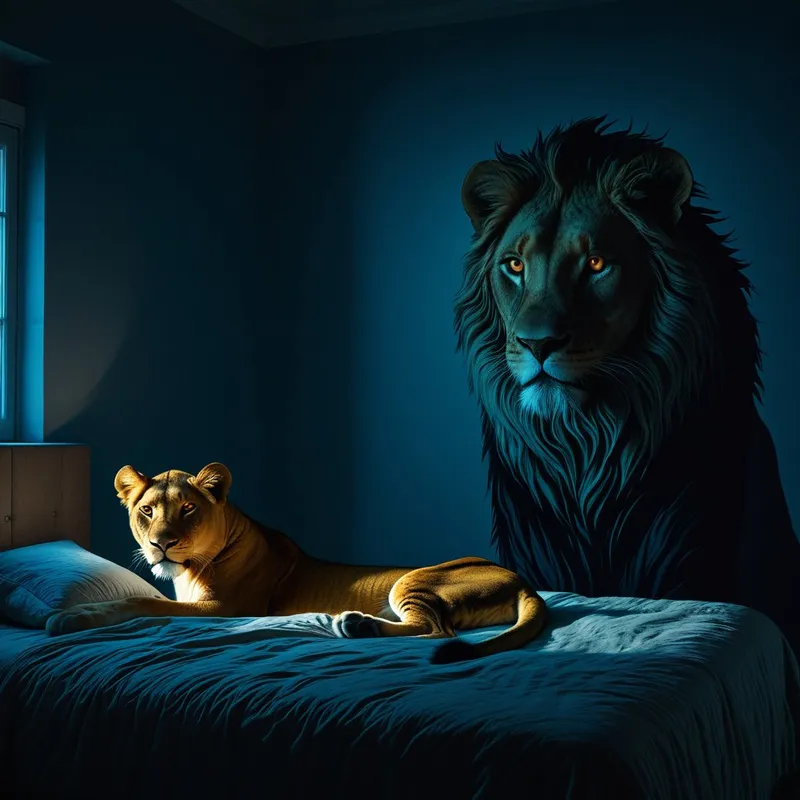
When this myth stirs in the modern unconscious, it rarely appears as an Egyptian tableau. Instead, a dreamer may find themselves pursued by a relentless, unstoppable animal—a lion, a wolf, a burning shadow. They may dream of starting a justified argument that escalates into a screaming fit they cannot control, or of a machine they built for a simple task that runs amok and destroys everything.
Somatically, this is the process of an autonomic nervous system tipping from mobilized stress (fight/flight) into a dysregulated, "stuck" state of hyper-arousal or collapse. Psychologically, it is the experience of being possessed by a mood or an impulse: a fury that feels righteous but leaves ash in its wake, a critical inner voice that ceases to be constructive and becomes purely annihilating. The dream is signaling that a powerful psychic force has been unleashed from the governance of the conscious self. The task is not to destroy the lioness, but to find the "red beer"—the creative, containing act that can transform the energy before it destroys the dreamer's inner or outer world.
Alchemical Translation
The alchemical journey mirrored here is the solve et coagula: dissolve and coagulate. First, the integrated self (Ra-ego) must solve—allow a part of itself to separate and see its own hidden, destructive potential (send the Eye). This is a dangerous but necessary stage of acknowledging one's full capacity, one's shadow.
The triumph is not in the unleashing, but in the sacred recall. Individuation requires we own our Sekhmet, but dare not become her.
The climax of the myth is the coagula, the re-integration at a higher level. The Eye does not return as she left. She returns as Bastet, carrying the memory of her power but tempered by the experience of its consequences. For the modern individual, this models the process of integrating fierce, instinctual energies—righteous anger, passionate conviction, the will to set boundaries—not by repressing them (which creates the autonomous complex), nor by letting them rule (which is destruction), but by transforming them. We must find our own "red beer": the compassionate container, the humorous perspective, the creative outlet that allows the raw, destructive force to become a protective, nurturing strength. The once-wild lioness, now a hearth-side cat, remains a potent guardian, but her claws are sheathed unless the true enemy—the threat to the soul's integrity—appears. The reconciled Eye on Ra's brow symbolizes a consciousness that has looked into its own capacity for wrath and, by mastering it, has become truly sovereign.
Associated Symbols
Explore related symbols from the CaleaDream lexicon: