
Excalibur's Tip Myth Meaning & Symbolism
The myth of the broken sword tip, a hidden wound that holds the key to Arthur's sovereignty and the kingdom's ultimate fate.
The Tale of Excalibur's Tip
Listen. The tale does not end at the crowning, nor in the glory of the Round Table’s fellowship. It ends in the mud, in the silence after the clamor of steel has faded. It ends at the place called Camlann.
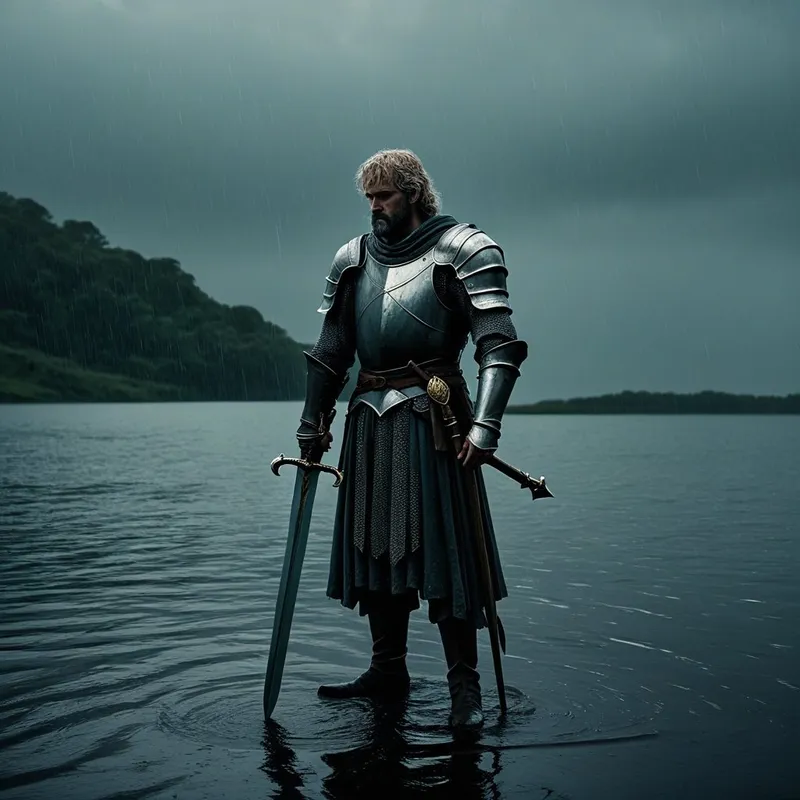
The sky wept a cold, grey rain upon the field. The once-green earth was churned to a bloody mire, littered with the fallen, the proud banners of Camelot trampled and torn. And in the center of this desolation knelt the Pendragon, Arthur. His armor was rent, his breath came in ragged gasps. The glorious sword Excalibur, which had shone with the light of sovereignty, was dark with gore. And it was broken.
Not shattered, not ruined—but wounded. In the final, desperate clash with the traitor Mordred, a piece of the sacred blade’s tip had sheared away. A small thing, perhaps, to a blacksmith. But to a king, it was the fracturing of the world. The pain in his side from Mordred’s spear was a fire, but the sight of the broken sword was a colder, deeper ache. The symbol of his right to rule, the gift from the Lady of the Lake, was imperfect. The kingdom and the king were one, and both were now incomplete.
With his dying strength, Arthur called his last loyal knight, Bedivere, to his side. His voice was a whisper against the wind. “Take Excalibur,” he said, his gaze fixed on the distant, mist-shrouded waters. “Go to the lake. Cast it in.”
Bedivere, his heart heavy with grief, took the sword. He journeyed to the shore, but the beauty of the hilt, the jewels that caught the dying light, stayed his hand. Twice he returned, lying that he had done the deed. Twice, the king, his eyes seeing beyond the veil of pain, said, “What did you see?” And hearing no tale of wonder, knew the truth. “What is a sword without its king?” Arthur murmured. “What is a king without his word? Go. Fulfill it.”
The third time, Bedivere’s loyalty overcame his awe. He drew back his arm and flung the broken sword far out over the still, dark water. As it flew, a marvel occurred. A hand, clad in white samite, mystic and beautiful, rose from the deep. It caught the hilt mid-air, brandished the blade three times, and then drew it down beneath the surface, into the realm from whence it came.
But the story whispers of what was left behind. As the hand descended, a single, shimmering fragment—the lost tip of Excalibur—fell from the joining point, a droplet of solidified light. It did not sink. It hovered for a moment at the water’s liminal surface, a glint of impossible metal, before the waters themselves seemed to embrace it, drawing it not down, but in, into the secret heart of the lake. The sword was returned, but its wound, its missing piece, remained within the world, a sacred secret held in the keeping of the Lady. Only then did Bedivere see the barge appear, bearing three queens in black to carry the wounded king to Avalon. The king departed, but the tip remained. A promise. A debt. A seed.
Cultural Origins & Context
The motif of Excalibur’s broken tip is not the centerpiece of Arthurian literature, but a haunting coda found in the deepest strata of the mythos, particularly in the seminal Le Morte d’Arthur by Sir Thomas Malory. It emerges from the Celtic narrative tradition, where sovereignty over the land is not a political contract but a mystical marriage. The king is the land. His wholeness ensures its fertility; his wounding brings forth the waste land.
This fragment of the tale was passed down not in grand chronicles first, but in the oral traditions of the Welsh and Breton bards—the cyfarwydd—who understood that true power always carries a flaw, a vulnerability that is also its point of connection to the otherworld. The societal function was profound: it transformed a tale of military defeat into a mystery of sacred kingship. It taught that even the ultimate symbol of authority and divine right (Excalibur) is not immune to fracture, and that the fate of a nation is tied not to unassailable perfection, but to the honorable handling of that fracture. The broken tip is the paradox of rule: the acknowledgment that to hold power is to be wounded by it, and that relinquishing power is the final, sacred duty.
Symbolic Architecture
The myth constructs a powerful symbolic architecture around the concepts of wholeness, sacrifice, and the hidden source of legitimacy.
The king and the sword are one. The fracture in the blade is the wound in the side; both are the price of the dream of Camelot.
Excalibur itself is the symbol of sovereignty, of conscious will and ordained power. Its tip—the point of contact, the part that pierces, defines boundaries, and executes intention—represents the focused application of that sovereignty. To lose the tip is to lose precision, direction, and the penetrating quality of the will. Psychologically, it represents the moment when the conscious ego (Arthur), in its heroic project of building order (Camelot), encounters an unconscious shadow element (Mordred) so potent it damages the very tool of consciousness.
The Lady of the Lake, the feminine, watery consciousness of the unconscious itself, receives the broken weapon. She does not repair it. She accepts it as it is, and in doing so, she secretly retains the missing fragment. This is the core of the symbolism: the wound, the missing piece, is not discarded or healed in the conventional sense. It is sacralized. It is taken into the depths, becoming part of the unconscious’s own treasure.
The wholeness we seek is not a return to an unbroken state, but the reconciliation with the piece that is forever kept in the dark waters of the soul.
The Dreamer's Resonance
When this mythic pattern stirs in the modern dreamer, it often manifests not as a medieval drama, but through potent, somatic imagery. To dream of a broken tool upon which you depend—a pen that won’t write, a key that snaps in a lock, a phone with a cracked screen—especially in a moment of critical need, can echo the Excalibur’s Tip motif. The feeling is one of profound inadequacy at the point of application: “I have the role (the hilt), but I lack the precise ability (the tip) to fulfill it.”
More directly, one might dream of a cherished object missing a small, vital piece, or of trying to return something to a body of water while holding back a fragment. The psychological process here is one of confronting a sacred flaw—a limitation or wound that feels intrinsic to one’s identity and purpose. The dream asks: What part of your power, your capability, do you feel is missing? And more crucially, can you, like Arthur, command that it be given back to the source, trusting that the missing piece is not lost but transformed into a mystery held by the deeper self?

Alchemical Translation
The alchemical process modeled here is the rubedo, not through a triumph of fire, but through the acceptance of the flaw. The individuation journey often follows the Arthurian arc: the ego, armed with a gifted talent or conscious attitude (Excalibur), sets out to build a kingdom of the personality. It inevitably meets its Mordred—the repressed complex, the neglected shadow—in a battle that wounds both the ego and its primary tool.
The alchemical translation is in the three commands to Bedivere. The first two castings are failures of surrender; the ego cannot bear to relinquish the beautiful, identified symbol of its power, even broken. The third casting is the sacrificium intellectus—the sacrifice of the attachment to the form. This is the moment of psychic transmutation.
The broken sword thrown into the lake is the conscious attitude surrendered to the unconscious. The tip retained by the Lady is the prima materia of the new being.
The conscious mind does not get the tip back. It gets something else: the vision of the three queens and the passage to Avalon, the promise of healing in a realm beyond the ego’s comprehension. The “tip” remains in the unconscious, where it undergoes a sea-change. It becomes the latent seed of a new kind of power—no longer the penetrating, dividing power of the sword’s point, but the integrative, encompassing power of the vessel that holds it. The modern individual undergoing this process must surrender their identification with their “broken” capability. In doing so, they do not become less, but make room for the psyche’s deeper, more mysterious governance. The wound becomes the vessel, and what was lost to the conscious will is gained as a hidden, guiding integrity within the soul’s own depths.
Associated Symbols
Explore related symbols from the CaleaDream lexicon: