Excalibur Myth Meaning & Symbolism
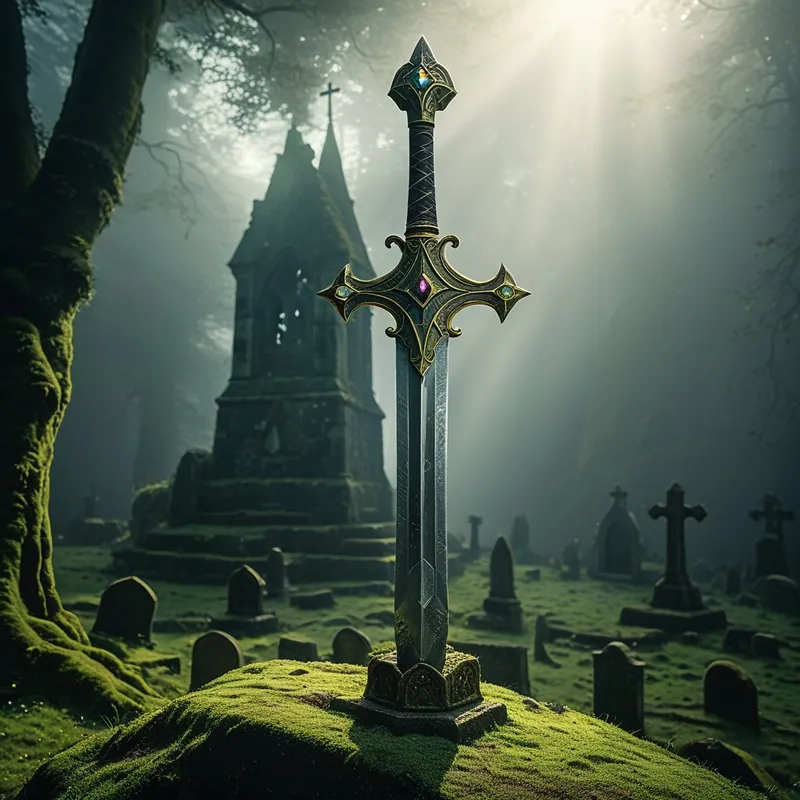
A sword lodged in stone awaits the true king. Its drawing is not a feat of strength, but a sacred act of recognition between destiny and the worthy soul.
The Tale of Excalibur
Listen, and hear a tale of a land shrouded in mist and longing. After the great Uther Pendragon fell, the realm of Logres was left kingless, a ship adrift on a stormy sea. The nobles squabbled, the old magic waned, and a deep winter settled upon the hearts of men.
It was in this time of bleak twilight that a wonder appeared. In the greatest churchyard of London, before the altar of all saints, a massive stone manifested—some say it was borne by the hidden hands of the land itself. And from that stone, thrust through a great iron anvil, protruded the hilt of a sword. Its grip was wound with gold wire, its pommel held gems that caught the weak sun like frozen tears. And upon the anvil, in letters of fire and ice, was written: WHOSO PULLETH OUT THIS SWORD OF THIS STONE AND ANVIL, IS RIGHTWISE KING BORN OF ALL ENGLAND.
Word spread like wildfire. Lords and knights, mighty of arm and proud of heart, came from every corner. At the great tournament called to find this king, they grasped the hilt. They strained until veins stood out on their brows and their muscles screamed. They wrapped both hands around it and set their feet against the stone. But the sword did not budge. It was as if its roots went down to the very bones of the island. One by one, they departed, humbled and confused.
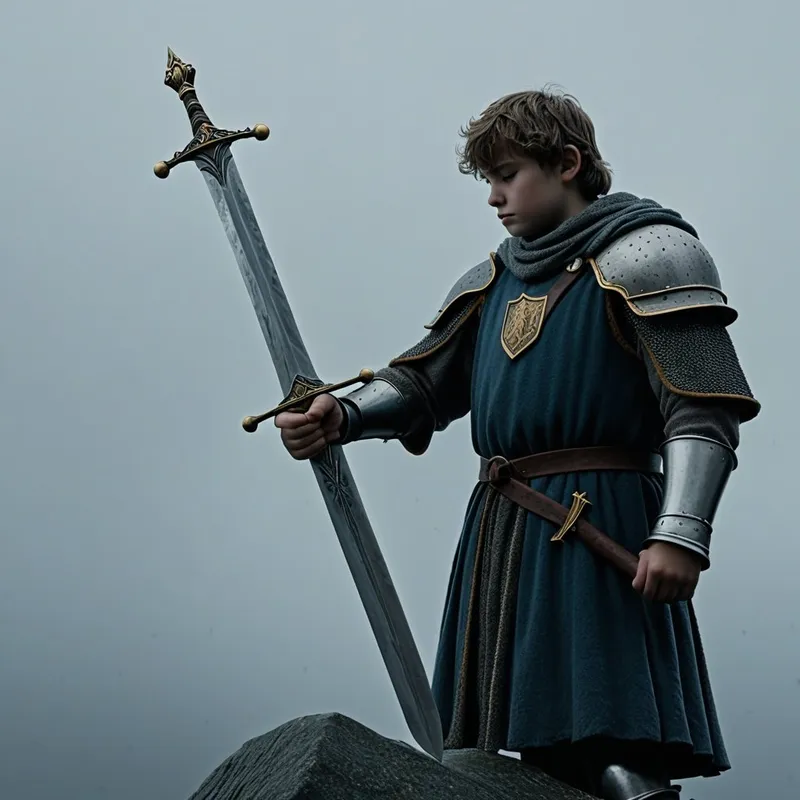
Now, there was a boy, Arthur, a ward of the good knight Sir Ector. He was not a competitor, but a squire to his foster-brother Kay. When Kay’s own sword was forgotten, Arthur, in his frantic loyalty, rode to the churchyard. He saw the sword in the stone, gleaming in the empty silence. Knowing nothing of the prophecy, thinking only of his duty, he took the hilt. There was no great strain. There was only a rightness, a click in the order of things. The sword slid forth as if it had been waiting for his touch, the metal singing a note so pure it silenced the wind.
He presented it to Kay, and the truth unraveled. The lords disbelieved, demanded it be returned. Twice more, before all the gathered might of the realm, Arthur placed the blade back into its stone prison. And twice more, while the strongest men in the land failed, he drew it forth with the ease of a man picking up his own scepter. It was not strength that freed the sword, but a quality of being. A sacred recognition passed between the metal and the boy’s soul. The mist parted. The people knelt. The land itself breathed a sigh of relief, for its true king, its rightful sovereign, had been revealed not by conquest, but by destiny’s gentle, irrevocable pull.
Cultural Origins & Context
The tale of the Sword in the Stone is a cornerstone of the vast, ever-evolving tapestry of Arthurian legend. Its most famous and cohesive telling comes from Sir Thomas Malory’s 15th-century compilation, Le Morte d'Arthur, but its roots are far older, woven from Celtic sovereignty myths, medieval chivalric romance, and political allegory.
In its earliest forms, the sword—later named Excalibur—was a separate artifact, given to Arthur by the Lady of the Lake. The motif of the sword in the stone, as a test of kingship, was solidified by the French poet Robert de Boron in the 13th century. This was not merely a story for entertainment; it served a crucial societal function. In a feudal world obsessed with lineage and divine right, the myth presented a more mystical, land-based legitimacy. The true king is not just born of noble blood (though Arthur is Uther’s son), but is chosen by a power greater than any human lineage—the spirit of the land itself, often mediated through Christian symbolism (the churchyard). It was a story told by bards and written by clerks to justify authority, to offer hope for a just ruler, and to explore the terrifying and awesome question: what makes a person truly sovereign?
Symbolic Architecture
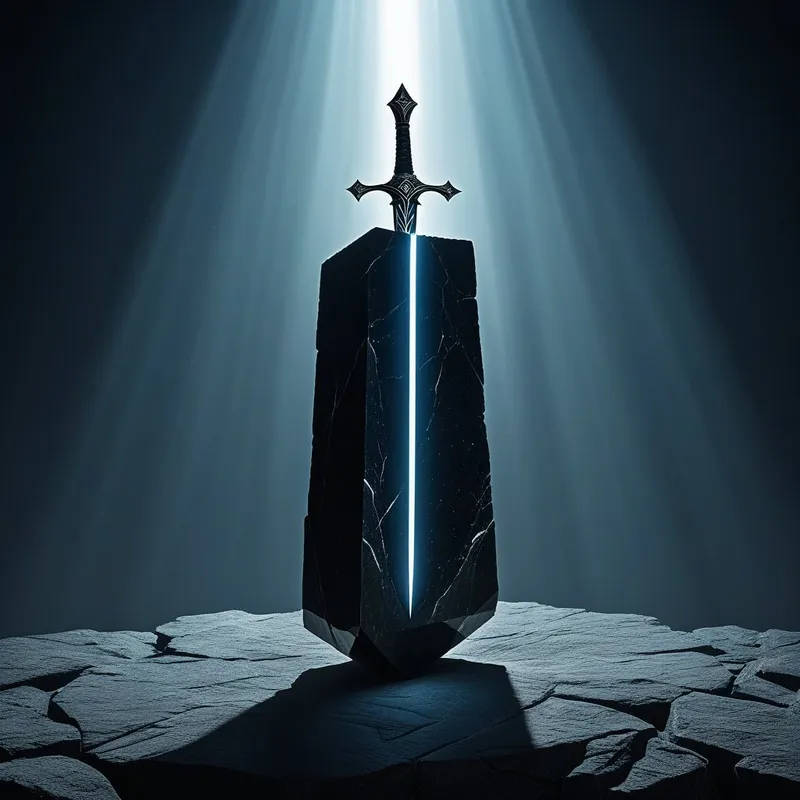
The myth is a masterclass in symbolic psychology. The stone is not just an obstacle; it is the unyielding, material world, the collective order frozen in conflict and decay. The anvil upon it signifies the forge of destiny, the place where raw matter is shaped by will and spirit. Together, they represent the hardened, petrified state of a kingdom—or a psyche—awaiting transformation.
The sword in the stone is the archetypal Self, the core of authentic identity and power, waiting within the hardened shell of the persona and the collective unconscious.
The sword itself is a multiplex symbol. It is divine right, spiritual authority, and the penetrating power of truth and discrimination (the logos that cuts through illusion). Its effortless drawing by Arthur, while others fail, dismantles the ego’s notion that sovereignty is won through brute force, cunning, or inherited status. It is claimed through recognition, an alignment of the individual soul with a transpersonal destiny. Arthur does not conquer the stone; he is recognized by the sword within it. This is the mythic expression of the moment one’s true calling, one’s innate and unique authority, is acknowledged from within, rendering external validation secondary.
The Dreamer's Resonance
When this myth stirs in the modern dreamscape, it often signals a profound crossroads in the dreamer’s psychological development. To dream of the sword in the stone is to encounter the archetype of the Self presenting itself as a latent power trapped in a seemingly immovable situation.
The dreamer may find themselves before the stone in a familiar yet alien place—a childhood backyard turned mythic, or a corporate lobby housing the ancient artifact. The somatic feeling is key: a magnetic pull towards the hilt, coupled with a deep, sinking certainty that they must try, even amidst a crowd of shadowy, judging figures (the internalized collective). The struggle to pull the sword is rarely physical; it is a struggle of worthiness, of overcoming the inner critic that whispers, "You are not the rightwise one." Success in the dream brings not triumph, but a humbling awe and a heavy responsibility—the sword is now theirs to wield. Failure often leads not to despair, but to a curious, unresolved tension, a knowing that the task is not yet complete, that some inner alignment is still required. This dream pattern maps the psyche’s process of confronting and integrating its own latent sovereignty, moving from a state of identification with the "foster-sibling" or servant to claiming one’s own kingly, authoritative center.
Alchemical Translation
The alchemical journey mirrored in the Excalibur myth is the opus of Individuation—the process of becoming the unique, integrated individual one is destined to be. The initial state is the nigredo, the blackening: the kingdom in chaos, the psyche adrift, a sense of falseness and petrification (the stone).
The act of drawing the sword is the pivotal moment of separatio and solutio. It is the separation of the essential Self (the sword) from the compacted mass of unconscious identification with family, society, and personal history (the stone). It is also a dissolution of the old ego-structure that believed power came from the outside. The sword’s emergence is the albedo, the whitening: the revelation of the true, shining essence.
To claim Excalibur is to undergo the alchemical marriage of the human and the divine, where personal will surrenders to and becomes the instrument of a transpersonal destiny.
But the work does not end with the drawing. The true alchemy is in the wielding. The sword, now named Excalibur, must be used to establish order (Camelot), to defend the weak (the knightly quests), and ultimately, to be returned to the Lady of the Lake at the end of Arthur’s life. This completes the cycle: the power, once integrated and used in service to the greater whole, is consciously released back to the unconscious (the lake) from whence it came. For the modern individual, this translates to the lifelong task of wielding one’s authentic authority, one’s "sword" of discernment and action, not for personal glory, but in service to one’s inner kingdom—the integrated psyche—and the wider world, with the ultimate wisdom of knowing that this power is a sacred trust, not a possession.
Associated Symbols
Explore related symbols from the CaleaDream lexicon:
- Equipment
- Took
- Sharp
- Weapon
- Weapons (Sword/Axe)
- Laser Cutter
- Swinging Sword
- Kyanite Blade
- Tungsten Blade
- Molybdenum Blade
- Steel Blade
- Stone of Power
- Scepter of Authority
- Treasure Key
- Legendary Sword
- Tennis Racket
- Cricket Bat
- Fencing Gear
- Fencing Sword
- Charmed Sword
- Coco Chanel's Suit
- Samurai Sword
- Crusader's Sword
- Iron Gauntlet
- Veiled Wire Cutter
- Pocket Knife
- Cleaver
- Wooden Skewers
- Cutlery Set
- Can Opener
- Paring Knife
- Stainless Steel Utensils
- Steak Knife
- Classic Car
- Confusing Remote Control
- Staple Remover
- Laser Tag Gun
- Abandoned Exploration Tools
- Slice
- Ceremonial Dagger
- Unearthed Artifact
- Battle Sword
- Animus's Sword
- Diploma
- Laser