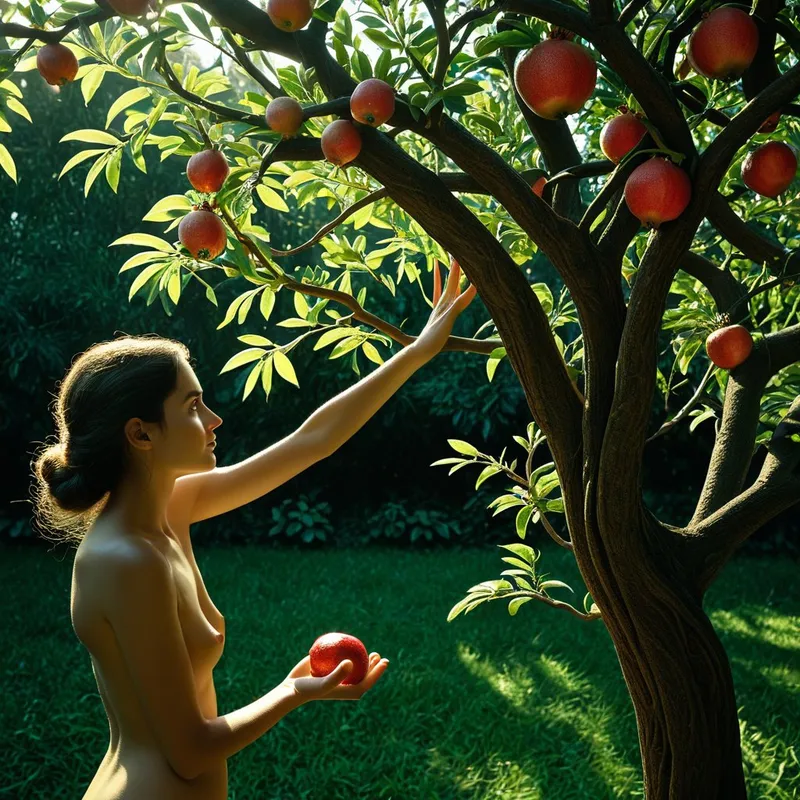
Eve and the Forbidden Fruit Myth Meaning & Symbolism
The foundational story of humanity's first choice, a transgression that shattered innocence and birthed self-awareness, knowledge, and mortality.
The Tale of Eve and the Forbidden Fruit
In the beginning, there was a garden. Not a garden as we know it, tangled and wild, but a place of perfect, breathing order. The air hummed with the scent of damp soil and blooming things, and light fell not from a sun, but from the very presence that walked there in the cool of the day. This was Eden, and within it, the first humans dwelled: Adam and Eve. They were naked and felt no shame, for they knew nothing of it. Their world was one of immediate communion—with the earth, the animals, and with Yahweh Himself, whose voice was the wind in the leaves.
But in the center of this perfection grew two trees, set apart. The Tree of Life. And the Tree of the Knowledge of Good and Evil. Of this second tree, Yahweh had given one command, clear and absolute: “You shall not eat of it, for in the day that you eat of it, you shall surely die.”
Now, the serpent was more crafty than any other beast of the field. It found Eve alone, her gaze perhaps already lingering on the tree’s strange, compelling fruit. “Did God really say you shall not eat of any tree in the garden?” it whispered, its voice a sly rustle. Eve, defending the command, replied, “We may eat of the trees, but of the fruit of the tree in the midst of the garden, God said, ‘You shall not eat of it, neither shall you touch it, lest you die.’”
The serpent coiled, its eyes holding a glint of terrible insight. “You will not surely die. For God knows that when you eat of it, your eyes will be opened, and you will be like God, knowing good and evil.”
The words hung in the perfumed air. Like God. To know. The fruit, which had seemed merely forbidden, now glowed with a promise. It was not just a fruit; it was a threshold. Eve looked upon it—its beauty, its promise of a wisdom withheld—and she saw that it was good for food, a delight to the eyes, and desirable to make one wise. The desire was not base hunger; it was a yearning of the soul. She reached out. She took. She ate. And she gave some to Adam, who was with her, and he ate.
In that moment, the hum of the garden changed pitch. The light grew sharp, casting unfamiliar shadows. Their eyes were opened, but the first thing they knew was not divine wisdom—it was their own nakedness. A cold, searing shame flooded them, a knowledge of exposure they had never conceived. They scrambled for fig leaves, stitching together crude garments, hiding from each other and from the approaching sound of Yahweh walking in the garden.
“Where are you?” called the voice that had once been comfort.
And Adam, from his hiding place among the trees, voice trembling, replied, “I heard the sound of you in the garden, and I was afraid, because I was naked, and I hid.”
The question that followed echoed with a sorrow deeper than any wrath: “Who told you that you were naked? Have you eaten of the tree of which I commanded you not to eat?”
The blame began to flow, a bitter new fruit of their new knowledge. The man blamed the woman. The woman blamed the serpent. But the deed was done. The garden’s gates, both literal and metaphysical, were now closed to them. Curses were spoken—toil for the man, pain for the woman, enmity with the serpent—and they were sent out, east of Eden, into a world of thorns and sweat, of birth-pangs and mortality. An angel with a flaming sword was placed to guard the way back to the Tree of Life. They had chosen knowledge, and in doing so, they had chosen the world we know.
Cultural Origins & Context
This story forms the opening chapters of the book of Genesis, a foundational text composed and redacted over centuries, likely during the Babylonian Exile (6th century BCE) and the subsequent Persian period. It is not a historical record but a profound etiological narrative—a story explaining origins. It answers the perennial human questions: Why do we toil? Why do we feel shame? Why do we die? Why is childbirth painful? Why is there strife between humanity and the natural world?
Told and retold in priestly circles and around family fires, it served as the bedrock of the Israelite worldview, establishing a cosmology of a purposeful creation, a divine moral order, and humanity’s fraught place within it. The myth functioned to explain the human condition not as a cosmic accident, but as the consequence of a primordial choice, embedding a sense of moral responsibility and the reality of exile from a state of pure grace. It framed all subsequent biblical history as a long, winding journey seeking reconciliation with that lost divine intimacy.
Symbolic Architecture
The myth is a dense symbolic map of the birth of human consciousness. The Garden represents the unconscious unity of infancy and primal existence, a state of being where the self is undifferentiated from its environment and its source. The command is the first imposition of a boundary, the “Thou Shalt Not” that creates the possibility of choice, and therefore, of self.
The fruit is not evil; it is the catalyst of consciousness. To eat is to ingest duality, to internalize the capacity for judgment, separating the world into ‘good’ and ‘evil,’ ‘self’ and ‘other.’
The serpent is the trickster, the necessary agent of disruption that stirs the stagnant waters of paradise. It represents the questioning voice, the lure of potential, the chaotic urge toward differentiation that forces growth. Eve is not a villain, but the protagonist of awakening. She is the one who engages with the question, who reaches for the horizon of knowing. Adam’s passive compliance underscores the collective nature of this step; consciousness, once born, becomes the condition of the species.
The immediate consequence—shame at nakedness—is brilliantly precise. It symbolizes the dawn of self-reflection, the painful awareness of the self as an object that can be seen, judged, and found lacking. The fig leaves are our first artifacts, our attempts to craft an identity, a persona, to hide the vulnerable, exposed self we have just discovered. Expulsion from Eden is not a punishment, but an inevitable outcome. You cannot un-know what you know. The conscious ego cannot return to the unconscious womb.
The Dreamer’s Resonance
When this myth stirs in modern dreams, it signals a critical juncture in the dreamer’s psychological development. Dreaming of a forbidden, tantalizing object or action often points to an encounter with a repressed part of the self or a taboo knowledge the psyche is ready to integrate. The “fruit” could be a new relationship, a career change, a creative impulse, or a painful truth about one’s family or past.
The somatic feeling is one of simultaneous dread and irresistible attraction—a tightness in the chest, a quickening pulse. The dreamer stands at their own personal Tree. The “serpent” may appear as a sly friend, a stranger with compelling advice, or simply an intuitive, inner voice that challenges the dreamer’s ingrained rules. The aftermath in the dream—a sense of exposure, scrambling to hide, or finding oneself in a strange new landscape—mirrors the anxiety that accompanies any real psychological growth. The dream is asking: What knowledge are you ready to consume, even if it shatters your current paradise of ignorance or comfort? What part of your innocent self must “fall” to make room for a more complex, conscious adulthood?

Alchemical Translation
In the alchemy of the soul, the myth of the Fall is the nigredo, the necessary darkening that begins the work of individuation. Paradise is the prima materia, the undifferentiated state. The command creates tension, the coniunctio oppositorum (union of opposites) between obedience and desire.
The act of eating is the supreme act of incarnation. Spirit chooses to know itself through matter, through experience, through the bitter and the sweet. The ego is born in the rupture.
The expulsion is the beginning of the heroic journey, the long albedo and rubedo of a lifetime spent reconciling the knowing ego with the lost divine ground. We spend our lives stitching together not fig leaves, but a coherent self, while yearning for the wholeness we intuit we have lost. The flaming sword guards not against our return, but against a regression. We cannot go back to unconscious unity; we must move forward toward a conscious unity, earned through the trials of the human experience.
Thus, Eve is not the cause of a curse, but the mother of our humanity. Her “sin” is the original act of courage—to choose consciousness over blissful ignorance, to embrace the terrifying gift of knowing oneself, even if that knowledge exiles us, and sets us on the long, hard, and sacred road back to a God we can now only meet eye-to-eye, not as innocent children in a garden, but as conscious souls forged in the fires of the world.
Associated Symbols
Explore related symbols from the CaleaDream lexicon: