Eucharist Myth Meaning & Symbolism
A ritual of remembrance where bread and wine become the body and blood of a sacrificed god, forging a mystical covenant between the divine and the human.
The Tale of Eucharist
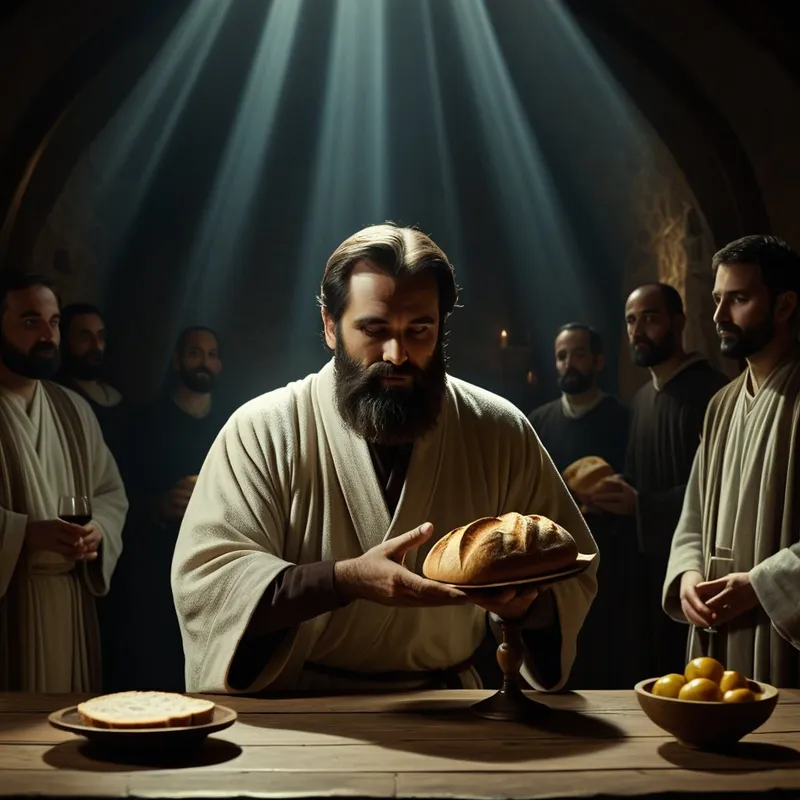
The air in the upper room was thick with the scent of roasted lamb, bitter herbs, and the oil of the lamps. Shadows danced on the walls, thrown by the flickering flames, as thirteen men reclined around a low table. It was the night of the Passover, a night for remembering an ancient liberation. But a heavier memory was being made.
The teacher, Jesus of Nazareth, moved with a gravity that stilled the usual chatter. His eyes, often alight with a challenging fire or deep compassion, now held a profound sorrow, a knowledge of a closing circle. The supper proceeded, the story of the Exodus told, but a new story was pressing to be born from the heart of the old.
He took a loaf of the unleavened bread, holding it in his work-worn hands. He gave thanks, his voice a low murmur that seemed to vibrate in the very stones of the room. Then he broke it. The sound was sharp, final—a crack that echoed more deeply than any word. “Take, eat,” he said, his gaze holding each of them. “This is my body, broken for you.”
The words hung in the air, impossible, terrifying. The bread in their hands was no longer mere sustenance. It had become a token of a life about to be shattered. They ate, the taste of the dry bread now carrying the metallic tang of impending sacrifice.
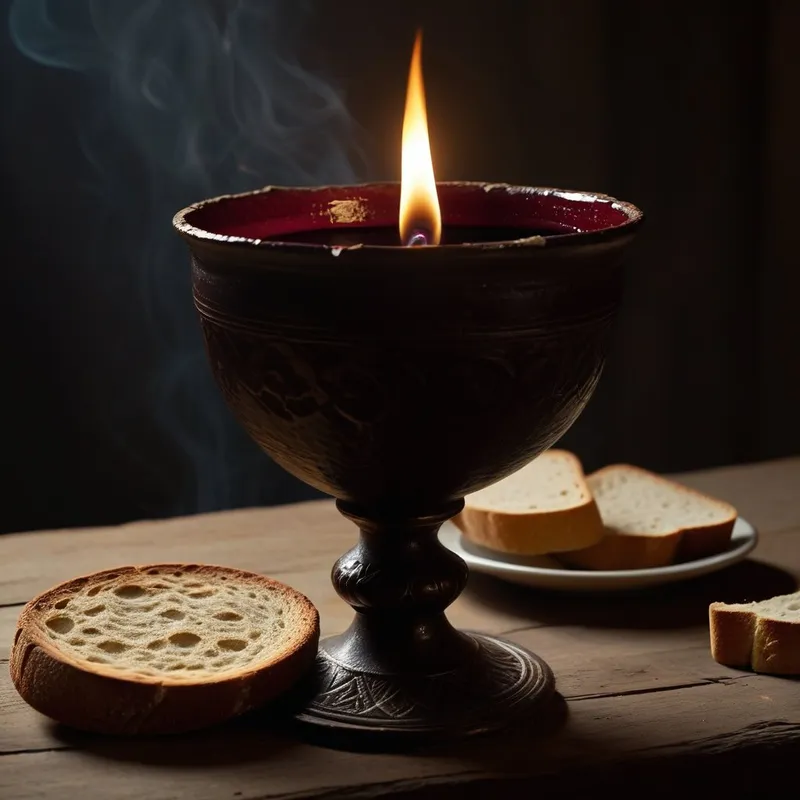
Then he took the cup. The wine, dark as blood in the clay vessel, caught the lamplight. Again, he gave thanks and passed it among them. “Drink from it, all of you,” he instructed. “This is my blood of the covenant, which is poured out for many for the forgiveness of sins.”
To drink the blood was an abomination under the old law, a line never to be crossed. Yet here he was, commanding them to cross it, to internalize the very essence of his life, his impending death. It was an act of shocking intimacy and terrifying transformation. “Do this,” he whispered, the command now a plea, a legacy, “in remembrance of me.”
The meal ended not in fullness, but in a sacred, hollowed-out space. The ritual was set. The god would be broken and poured out. And his followers, from that night forward, would remember by consuming the mystery, making the sacrifice not just a historical event, but an eternal, internal reality.
Cultural Origins & Context
This mythic moment is rooted in the historical context of 1st-century Judea under Roman occupation. It emerges from the Jewish tradition of the Passover Seder, a ritual meal recounting the liberation from Egypt, where the blood of a lamb marked the houses saved from death. Jesus and his disciples were observant Jews, and he deliberately layered his new meaning upon this ancient template.
The story was not written down as a formal liturgy immediately. It was lived, performed, and recounted orally within the early Christian communities, likely as part of their regular “love feasts” or agape meals. The apostle Paul provides the earliest written account in his First Letter to the Corinthians, circa 54 CE, emphasizing he “received from the Lord” what he passed on, highlighting its sacred, revelatory origin. The Gospels later inscribed the narrative into the foundational story of Jesus’s passion.
Its societal function was multifaceted. For a persecuted minority, it was an act of defiant identity and solidarity—a secret supper that bound them to their Lord and to each other more powerfully than blood. It served as the central cultic act, distinguishing them from both Judaism and pagan mystery religions, while fulfilling and transforming prophetic and priestly motifs from the Hebrew scriptures. It was the engine of community, the seal of the new covenant, and the promise of participation in divine life.
Symbolic Architecture
At its core, the Eucharist is a profound symbol of participation mystique—the mystical participation of the believer in the divine. It transforms the archetypal themes of sacrifice and communion into a direct, somatic experience.
The most profound magic is not in changing water into wine, but in transforming the act of eating into an act of remembering the future.
The Bread and Wine are universal symbols of sustenance, the fruits of human labor (wheat harvested, grapes crushed) transformed by culture (baked, fermented). In the myth, they become the Body and Blood, the most intimate physical substances of a person. This symbolizes the total self-gift of the divine, offering not just teachings or power, but its very substance. Psychologically, it represents the offering of the integrated Self—the totality of the psyche—to the conscious ego.
The Breaking and Pouring Out is the necessary dissolution. The whole loaf must be broken to be shared; the wine must be poured to be drunk. This is the symbol of the sacrifice that precedes new life, the deconstruction of the old, rigid form (the literal body, the old covenant) to release its life-giving essence for all.
To consume the symbol of sacrifice is to admit that transformation requires the digestion of something broken.
The act of Eating and Drinking is the human side of the covenant. It is the active reception and internalization of the divine gift. This is not passive belief but metabolic faith—taking the archetype of the Self into the very fabric of one’s being, where it can nourish and transform from within. It symbolizes the ego’s conscious alignment with and dependence on the greater psychic totality.
The Dreamer's Resonance
When this mythic pattern stirs in the modern unconscious, it rarely appears as a literal church service. Instead, the dreamer may encounter powerful images of sacred meals, forbidden consumption, or transformative substances.
A person might dream of eating a food that glows with inner light, tasting of both profound sorrow and ecstatic joy, and feeling it integrate into their body, healing old wounds. This somatic dream points to a process of assimilating a painful but necessary truth or memory—a “bitter pill” that ultimately nourishes the soul. It is the psyche’s way of enacting the Eucharist: taking in a broken piece of one’s own history or shadow and transmuting it into personal substance.
Another may dream of drinking from a communal cup in a non-religious setting—a boardroom, a family gathering, a forest clearing. The liquid may change properties, becoming thick like blood or effervescent like light. This signals a deep, often unconscious, process of entering into a covenant or profound commitment, pledging one’s vital essence (blood) to a relationship, a community, or a creative project. The anxiety or awe in the dream mirrors the tension of the original supper.
These dreams indicate a pivotal moment of psychic metabolism. The ego is being asked to consciously receive and integrate a content from the Self that feels both sacred and terrifying—perhaps a new level of responsibility, a forgiven guilt, or the acceptance of a profound loss as part of one’s wholeness.
Alchemical Translation
The alchemical opus has a clear parallel in the Eucharistic myth: the solve et coagula—dissolve and coagulate. The journey of individuation requires the same sacrificial breaking and reconstituting.
First, the Nigredo, the blackening. This is the moment in the upper room, the dark night of the soul where the conscious attitude (the “whole” Jesus as known by the disciples) accepts its impending dissolution. For the individual, this is the painful but necessary deconstruction of a long-held identity, a cherished ideal, or a foundational belief. The “body” of who we thought we were must be broken.
The goal is not to avoid the breaking, but to become the bread that is broken consciously, for a purpose beyond the self.
Then, the Albedo, the whitening. The substances (bread/wine) are blessed, given thanks for. This is the conscious recognition of the value in the sacrifice. In psychological terms, it is finding the meaning in the suffering, seeing the shadow not as waste but as potential nourishment. The ego stops resisting the process and offers it up to the greater Self.
Finally, the Rubedo, the reddening. The consumption. This is the coagulation of the new substance. The digested sacrifice becomes the vital life-force of a new, more expansive consciousness. The individual does not simply “get over” a loss or integrate a complex; they are fundamentally changed by it. Their very “blood”—their passion, vitality, and deepest commitments—is now of a different order, informed by the sacrifice. They have, in a symbolic sense, become what they have consumed: a being capable of both profound rupture and deeper, more inclusive unity.
The ritual injunction, “Do this in remembrance of me,” thus translates to a psychological imperative: Regularly consciously engage in the process of breaking open your hardened positions, bless the fragments, and internalize their meaning. In doing so, you continually renew your covenant with the Self, forging wholeness not through perfection, but through sacred, transformative communion with all that is broken and poured out within you.
Associated Symbols
Explore related symbols from the CaleaDream lexicon: