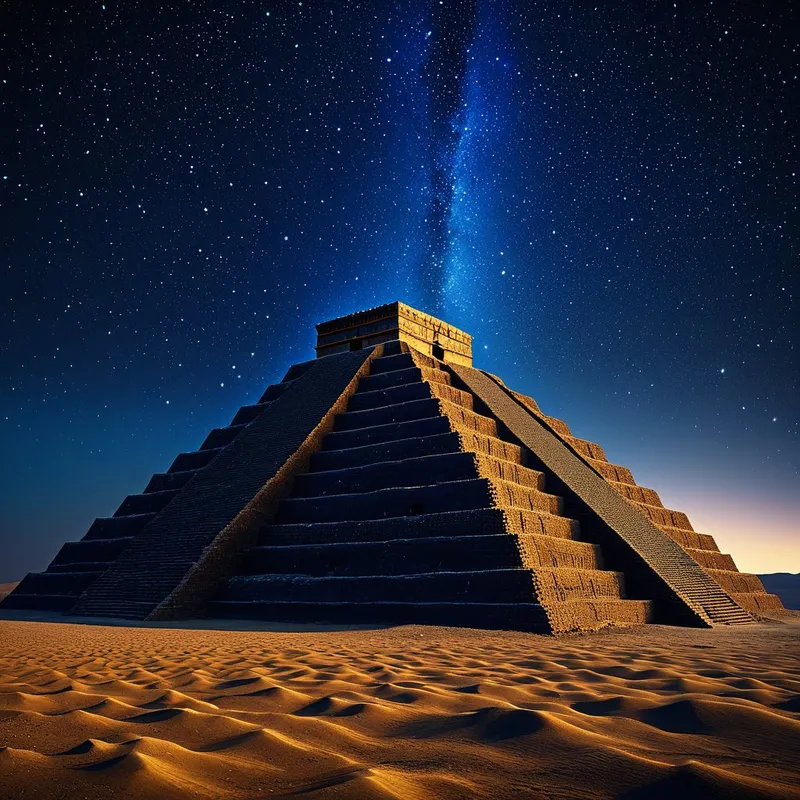
Etemenanki Ziggurat Myth Meaning & Symbolism
The myth of the celestial ziggurat, a cosmic axis where heaven and earth meet, built by gods and kings to anchor divine order in the human world.
The Tale of Etemenanki Ziggurat
Hear now of the Etemenanki, the axis of the world. In the time when the gods walked the silt-rich earth between the twin rivers, the great Marduk surveyed his celestial domain. Below, the world of men was a formless murmur, a chaos of voices and ambitions without a center. A divine discontent stirred in his heart. "Let there be a bond," he decreed, his voice the rumble of distant thunder over the plain. "A bond between my high house and the low house of humanity. Let it be a mountain not of rock, but of ambition and baked earth, a ladder whose foot is in the Apsu and whose head brushes the gates of the Igigi."
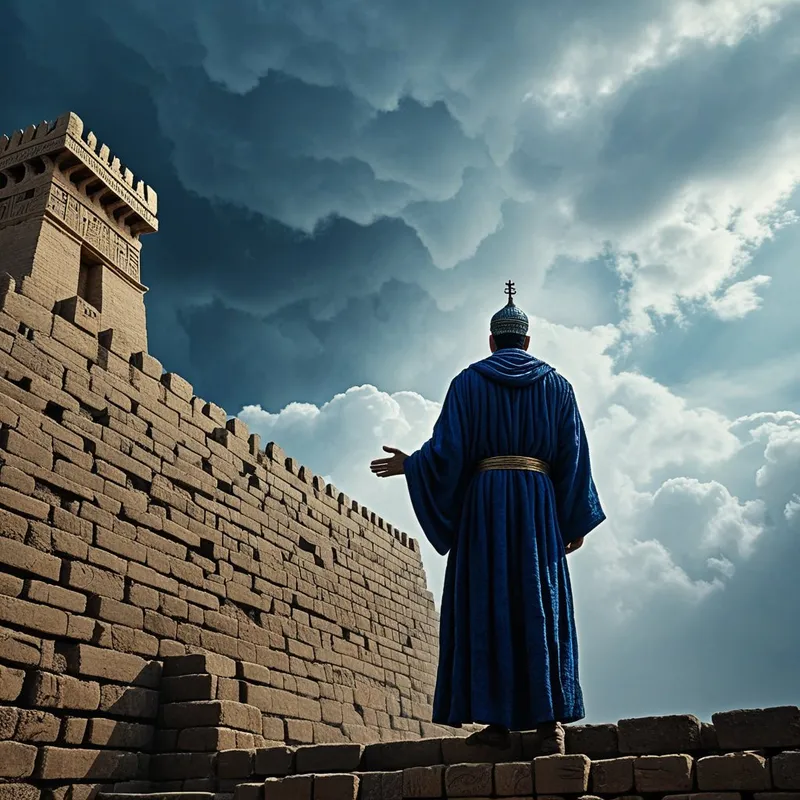
The command went forth, and the very soil of Babylon trembled with purpose. From the royal court came the shepherd of the people, the king, anointed by the god. His was not the power to command the stars, but to command the labor of ten thousand hands. The air grew thick with the dust of pulverized straw and the rich, damp scent of clay from the riverbank. Under a sun like molten copper, bricks were formed—countless bricks, each one pressed into a wooden mold, each one stamped with the king's own name and baked in roaring kilns until they were the color of dried blood.
Tier by tier, the mountain rose. The first platform was a vast square, a new foundation for the earth itself. Upon it, another, slightly smaller, and another, and another, seven in all, each painted with the color of a wandering star. The scent of cedar resin from Lebanon filled the air as massive beams were hauled up earthen ramps that coiled around the structure like a sleeping serpent. The clamor was a symphony of creation: the slap of wet mortar, the grunt of oxen, the chants of priests, the crack of overseers' whips. The people looked up, their necks aching, as their city was crowned with a stairway to heaven.
At last, the final tier was laid. Upon its summit, small as a jewel from the ground, they built the Ésagila, the "House that Lifts its Head." Its walls were sheathed in gold that caught the first and last light of the day, and its inner chamber was a darkness so profound it held the silence of before-time. Here, in the papāḫu, the statue of Marduk was installed, and for a moment, as the incense smoke rose in a straight column to the vault of heaven, the bond was complete. The cosmic order, the Me, flowed down its stepped sides and into the world. The ziggurat stood—not as a challenge to the gods, but as an invitation, a sacred knot tying the fate of the city to the will of the cosmos.
Cultural Origins & Context
The myth of Etemenanki is not a single narrative poem like the Enūma Eliš, but a foundational truth woven into the very identity of Babylon. It was a living myth, enacted annually in the Akitu festival, where the king would take the hand of the statue of Marduk and lead him in a procession, reaffirming the sacred bond between the god, his temple-house, and the king who served as his earthly steward. The story was told in royal inscriptions, on cylinder seals, and in the meticulous measurements preserved by the ummânu.
Its primary function was cosmological and political. It explained Babylon’s preeminent place in the world as the literal "navel of the world," the axis mundi. The ziggurat’s construction—always a work in progress, rebuilt by successive kings—was the ultimate act of pious kingship, a duty to maintain the cosmic connection that ensured fertility, justice, and victory. The myth served as a divine blueprint, justifying the immense social effort and resources required. It told every brickmaker and porter that their labor was not merely construction, but participation in upholding the universe's fundamental order.
Symbolic Architecture
The ziggurat is a supreme symbol of the axis mundi, the world center. Its seven tiers correspond to the seven known celestial bodies (the Sun, Moon, and five visible planets) and the seven heavens of Mesopotamian cosmology. It is a geometric prayer, a mandala in baked brick, mapping the descent of the divine into the material and the potential for human consciousness to ascend toward the source.
The ziggurat does not deny the earth to reach heaven; it transforms the earth into a receptacle for heaven.
Psychologically, it represents the structured ego, built piece by piece from the "clay" of our personal history and cultural conditioning, aspiring to connect with the transcendent Self (symbolized by Marduk in his high temple). The arduous, communal construction mirrors the lifelong process of building a coherent personality. The shrine at the summit is the temenos, the sacred inner sanctuary where the individual encounters the numinous, the core of one’s being that is both personal and transpersonal. The entire structure embodies the paradox of sacred space: it is a human-made object that points beyond human making.
The Dreamer's Resonance
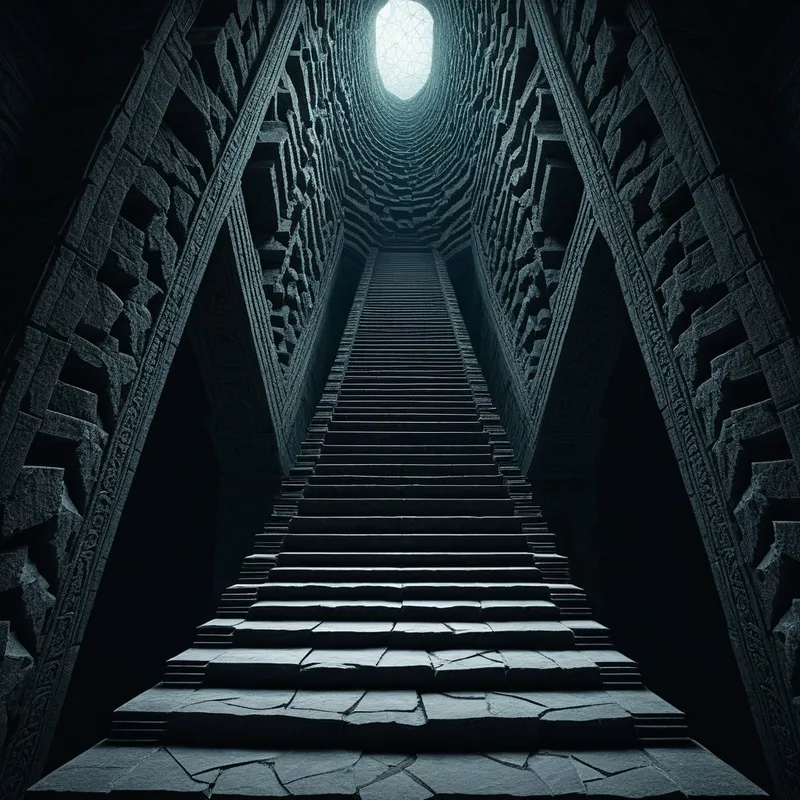
When the image of the ziggurat arises in the modern dreamscape, it often signals a profound process of psychological restructuring. The dreamer may be climbing its endless, steep stairs, feeling both awe and exhaustion. This is the somatic sensation of "building up" the psyche, integrating new complexes or insights into a stable structure. Alternatively, one might dream of a ruined or incomplete ziggurat, reflecting a feeling that one’s life structure or worldview is unstable, fragmented, or lacking a connection to meaning (the missing shrine).
The dream may emphasize the ascent—the struggle toward consciousness, insight, or a higher perspective. Or it may focus on the foundation—an examination of the "bricks" of one's identity: Are they sound? Are they truly one's own, or merely stamped with the names of others (parents, society)? The ziggurat in a dream asks the dreamer: What are you building your life upon? Toward what summit are you laboring? Is your inner sanctuary occupied by a living spirit, or is it empty?
Alchemical Translation
In the alchemy of individuation, the myth of Etemenanki models the process of coagulatio—the making solid, the formation of the Philosopher's Stone from base matter. The "base matter" is the chaotic floodplain of the unconscious, the prima materia of unexamined instincts and potentials. The divine decree of Marduk is the initial call from the Self, the imperative to begin the work.
The king who builds is the ego in service to the Self. His labor is the conscious dedication to the work of becoming whole.
Each brick, stamped with the king's name, represents a conscious act of self-definition, a commitment integrated into the growing structure of the personality. The seven levels are the stages of the opus, each requiring a death and rebirth, a shedding of old perspectives. The winding construction ramp signifies the necessary indirect, spiraling path of psychological development; we cannot assault the heights of consciousness directly.
The final achievement is not the ego becoming god-like in the shrine, but the ego creating a stable, worthy vessel—a temenos—within which the transcendent function, the symbolic "Marduk," can reside and be acknowledged. The completed ziggurat is the individuated psyche: a structured, embodied consciousness that maintains a living, dynamic connection with the deep, ordering principles of the unconscious. It is the realization that one's personal life is a sacred precinct, a foundation of heaven and earth.
Associated Symbols
Explore related symbols from the CaleaDream lexicon: