Etana's Flight Myth Meaning & Symbolism
A Sumerian king, aided by an eagle, ascends to heaven to secure a divine plant for an heir, only to fall back to earth in terror.
The Tale of Etana's Flight
Hear now the tale of Etana, the shepherd-king of Kish, who ruled with justice but whose throne stood on a foundation of silence. No cry of an heir echoed in his palace halls. His lineage, like a river in the desert, threatened to vanish into the sands of time. In his despair, Etana turned his face to the gods. He poured libations, offered sacrifices, and his prayers rose like incense to the firmament, seeking the Plant of Birth.
His plea was heard, but the answer came not from the high heavens, but from a place of darkness and betrayal. For in a distant plain, a great drama had unfolded. A mighty eagle and a wise serpent had sworn an oath of friendship before the sun god Shamash. They built their homes together, one in the crown of a poplar tree, the other in its roots, and raised their young in peace. But the eagle’s heart grew corrupt. Tempted by the serpent’s plump offspring, he broke the sacred oath. He swooped down and devoured the serpent’s children.
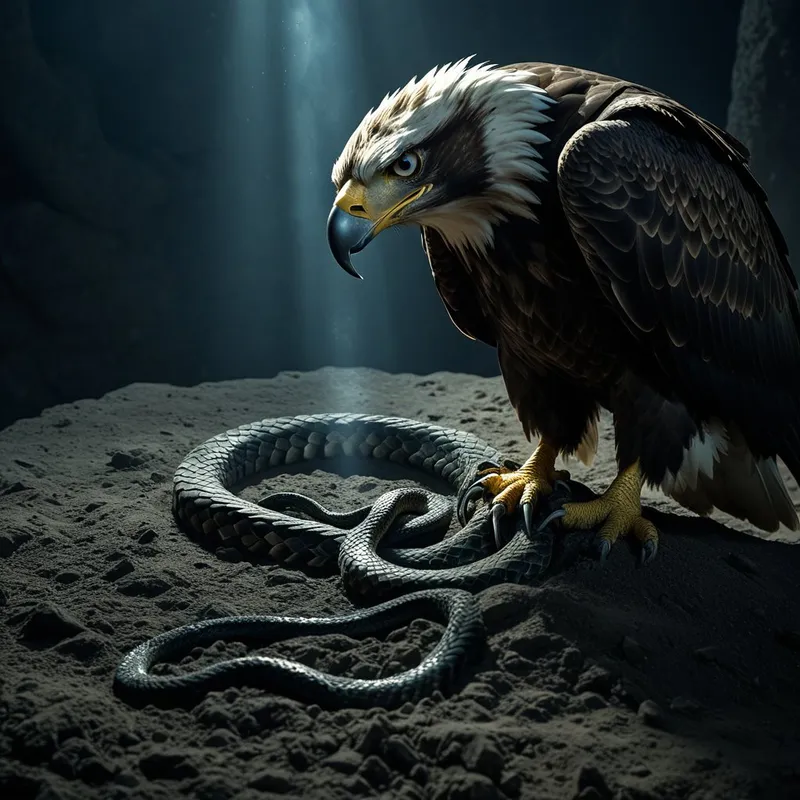
The serpent, writhing in grief, sought justice from Shamash. The sun god, keeper of oaths, showed the serpent a path to vengeance. “Hide in the carcass of a wild bull,” Shamash instructed. “When the eagle comes to feed, you shall strike.” And so it happened. The eagle, drawn by the feast, was seized by the serpent, who tore his wings and cast him into a deep, sunless pit to die a slow death of thirst and shame.
It was here, in this pit of broken oaths, that the paths of king and outcast crossed. Shamash, orchestrating a deeper redemption, guided Etana to the eagle’s prison. The king, moved by the majestic bird’s suffering, nursed it for months, feeding it meat and water until its wings grew strong. Grateful, the eagle pledged his life to Etana. And the king spoke his heart’s desire: to ascend to the very throne of Anu, to secure the divine Plant of Birth and ensure his dynasty.
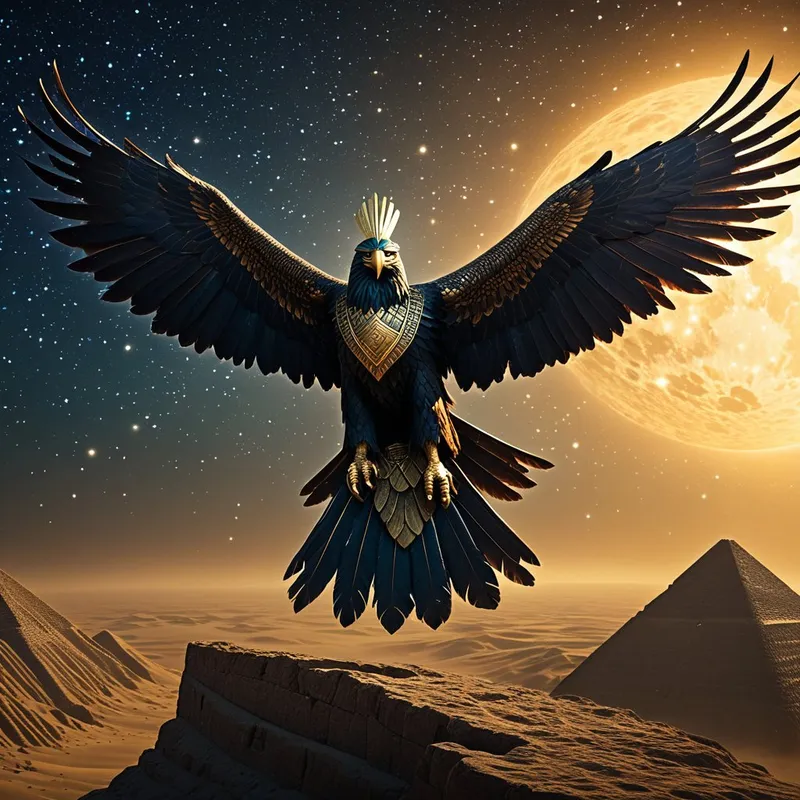
The eagle agreed. Etana mounted its broad back, and they launched into the sky. The first flight was a wonder. The earth shrank beneath them; the great city of Kish became a mere speck, the wide river a thread of silver. They landed on the heaven of Anu, but the plant was not there. “We must go higher,” said the eagle, “to the heaven of Ishtar.”
They ascended a second time. Now the world vanished entirely. The blue dome of the sky darkened into the black of space. The sea that encircles the earth was a mere bowl of water. Etana, his courage holding, urged the eagle onward. But on the third and final ascent, toward the most distant and terrible heights, the king’s mortal heart failed him. He looked down. There was no earth, no sea, no horizon—only a terrifying, bottomless abyss. The supporting world was gone. A primal terror seized him. His grip faltered. “My friend, turn back!” he cried. “I can go no further!” And in that moment of absolute dread, they fell. The eagle, burdened by the king’s broken spirit, could not hold the ascent. Together, king and eagle tumbled from the zenith of ambition, back toward the waiting, solid earth.
Cultural Origins & Context
The myth of Etana is one of the world’s oldest recorded narratives, found on fragmented cuneiform tablets dating to the Old Babylonian period (c. 1900-1600 BCE), though its origins are undoubtedly Sumerian. It was not mere entertainment but a foundational text, likely recited by court scribes or ritual specialists. Its function was multifaceted: it served as an etiological tale for the dynasty of Kish, explained the divine right (and peril) of kingship, and explored the limits placed upon humanity by the gods.
The story exists in the tense space between the earthly and the divine, a core Sumerian concern. Kings were seen as intermediaries, but the myth starkly illustrates that some thresholds—like the direct acquisition of immortality or divine generative power—are forbidden. The narrative also reinforces the cosmic importance of oaths (witness the eagle’s punishment) and the possibility of redemption through service (the eagle saving Etana). It is a story told not to celebrate easy triumph, but to contemplate the profound and often tragic nature of human aspiration within a divinely ordained order.
Symbolic Architecture
At its heart, Etana’s Flight is a myth of the vertical axis—the axis mundi that connects the underworld, the earth, and the heavens. Etana’s journey maps the soul’s ascent from the pit of despair (the eagle’s prison) to the zenith of aspiration (Ishtar’s heaven).
The eagle is the soaring spirit, the intellect, and ambition itself—a force that can betray (the serpent) but can also be redeemed through compassion and directed toward a noble, if impossible, goal.
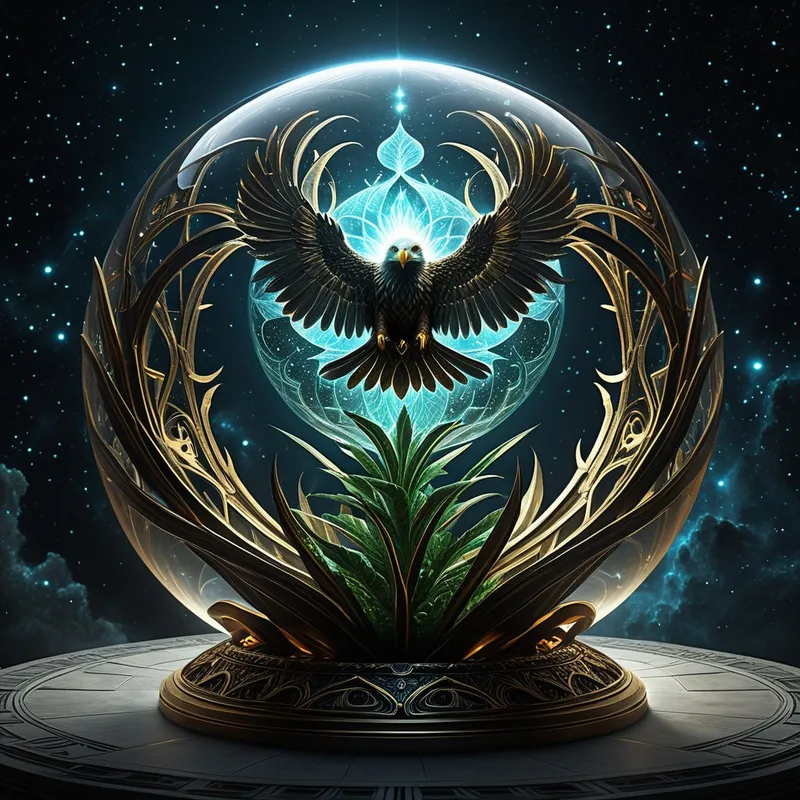
The serpent represents chthonic wisdom, the earthly lineage, and the consequences of broken covenants. Etana’s healing of the eagle is the first, crucial act of psychic integration: the conscious ego (the king) must rescue and ally with its own wounded, ambitious spirit to begin any great quest. The Plant of Birth is the ultimate symbol of wholeness and continuity—not just of a physical heir, but of a completed Self.
The terrifying void Etana sees is the ultimate symbolic truth. To reach the divine, one must pass through the annihilation of all earthly reference points. The failure is not in the falling, but in the inability to endure the dissolution of the known world. The myth suggests that absolute transcendence may be a psychological state too vast for the unaided, fear-bound ego to contain.
The Dreamer's Resonance
When this myth stirs in the modern unconscious, it often manifests as dreams of spectacular, perilous ascent. You may dream of climbing a ladder that reaches into storm clouds, flying unaided but with growing anxiety, or being carried by a powerful but unstable force toward an urgent, unclear goal. The somatic signature is one of vertigo, a clutching in the chest, and the chilling dread of the void below.
This dream pattern signals a psyche engaged in a radical expansion. The dreamer is likely attempting to integrate a powerful new capacity (the eagle)—perhaps a professional ambition, a spiritual insight, or a creative vision—that promises to elevate their life. The terror of the fall represents the ego’s resistance to the necessary death of an old identity. The dream asks: What “Plant of Birth”—what new life, project, or state of being—are you seeking? And are you prepared for the disorienting, groundless void you must cross to claim it? The dream is a diagnostic of ambition’s ceiling, set not by the gods, but by one’s own capacity for existential courage.

Alchemical Translation
The alchemical process mirrored in Etana’s Flight is the sublimatio—the spiritualization of matter, the attempt to raise the base elements of the psyche to a higher level. Etana begins in the nigredo, the blackness of barrenness and despair (his lack of an heir, the eagle in the pit). The caring for the eagle is the albedo, the washing and purification, creating a conscious alliance between the ruling principle (the king) and the dynamic, instinctual spirit (the eagle).
The flight itself is the rubedo, the fiery and dangerous operation of ascent. The failure at the zenith is not the end of the work, but its most critical phase.
For the modern individual pursuing individuation, the myth models a crucial lesson: the goal (the divine plant, the perfected Self) may be unreachable in a single, heroic effort. The transformative value lies in the attempt itself—in the expansion of perspective, the confrontation with absolute terror, and the humbling return. The fall is a mortificatio, a necessary death of the inflationary fantasy of easy transcendence. One returns to earth, to the solid ground of the personal and the possible, but forever changed. The true “heir” secured is not a son, but a more profound understanding: that our highest flights are always tethered to, and must ultimately serve, our earthly existence. The work continues not in the heavens, but in the integrated, grounded life, with the wisdom of the abyss now held within.
Associated Symbols
Explore related symbols from the CaleaDream lexicon: