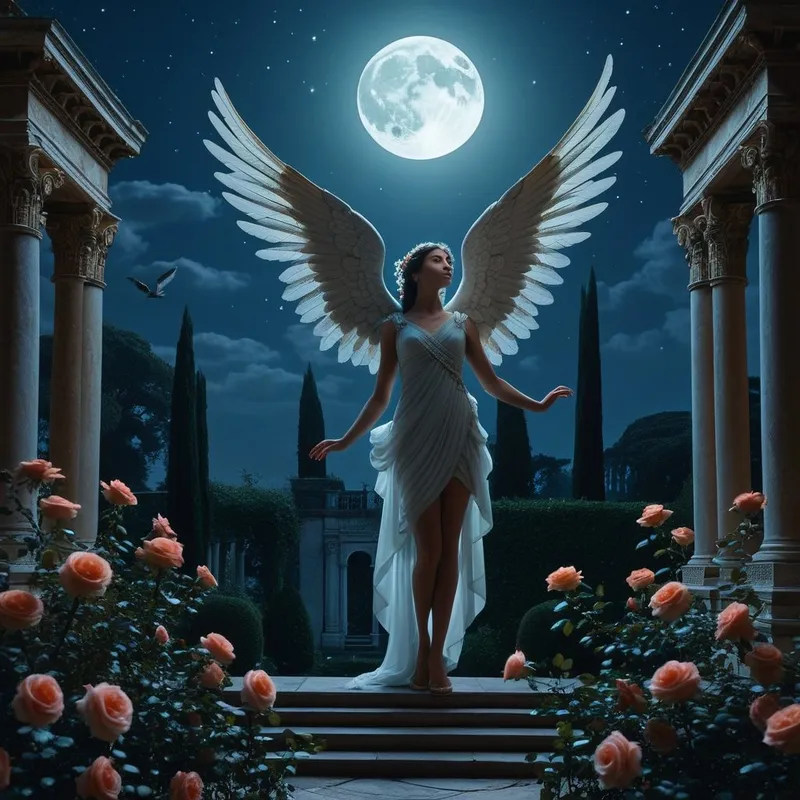
Eros and Psyche from Roman myt Myth Meaning & Symbolism
A mortal soul, Psyche, must endure impossible trials to reunite with divine Love, Eros, in a story of trust, betrayal, and ultimate transcendence.
The Tale of Eros and Psyche from Roman myt
Listen, and hear a tale not of stone and empire, but of soul and flame. In a time when gods walked just beyond the edge of sight, there lived a mortal princess named Psyche. Her beauty was so profound it became a curse; men worshipped her as a new Aphrodite, abandoning the true goddess’s altars. Enraged, the divine Queen of Love summoned her son, Eros. “Make her fall in love,” she commanded, “with the most vile, wretched creature you can find.”
But when Eros beheld Psyche, the arrow meant for her heart pierced his own. A divine wound bloomed within him. He could not obey. Through the oracle of Apollo, Psyche’s fate was sealed: she was to be abandoned on a mountain peak, bride to a monstrous, unseen husband. Her family wept as the west wind, Zephyrus, carried her not to death, but to a hidden valley and a palace wrought of light and dream. Here, invisible servants attended her. Here, in the profound darkness of night, her husband came to her. He was gentle, passionate, and loving, but his condition was absolute: she must never seek to see his face. “If you look upon me,” his voice, like honeyed shadows, warned, “you will lose me forever.”
For a time, soul dwelt in blissful ignorance. But visiting sisters, seeded with envy and doubt, whispered poison. “Your husband is a serpent,” they hissed. “He waits for the child in your womb to be born so he may devour you both.” Tormented, Psyche took a lamp and a dagger one night. The golden light fell not on a monster, but on the most beautiful of gods, Eros himself, asleep with his bow at his side. A drop of scalding oil fell on his shoulder. He awoke, his eyes holding the betrayal. Without a word, he spread his wings and fled, and the palace of dreams dissolved into mist.
Psyche was cast out, alone. To win back her love, she had to face the wrath of Aphrodite. The goddess set four impossible labors. First, sort a mountain of mixed grains before nightfall; ants took pity and helped. Second, gather golden wool from the fierce, sun-grazing sheep; a reed by the river whispered to collect the wool caught on brambles. Third, fill a crystal vial with water from the source of the rivers Styx and Cocytus, guarded by sleepless dragons; the eagle of Zeus itself performed the task. The final labor was a descent into the underworld itself. Psyche was to retrieve a casket of beauty from Persephone. Guided by a talking tower, she navigated the land of the dead, refusing all distractions, and returned with the casket.
But curiosity, her old flaw, surfaced once more. She opened the casket, hoping for a drop of divine beauty to win back Eros. Instead, a deathlike sleep of Hades seized her. It was Eros, his wound healed by longing, who found her. He flew to Olympus and pleaded their case before Zeus. The king of gods granted immortality to Psyche. Aphrodite was appeased. And in the celestial halls, Eros and Psyche were wed, their union birthing a daughter named Voluptas—Joy.

Cultural Origins & Context
This myth comes to us from the Latin novel Metamorphoses (also known as The Golden Ass) by Apuleius, written in the 2nd century CE. While the characters are Greek in name (Psyche, Eros), the narrative is a product of the late Roman Imperial world, a time of syncretism and deep philosophical inquiry. Apuleius was a Platonic philosopher, and his telling is far more than a simple folktale; it is a sophisticated allegory composed in a literary, novelistic form. It was likely intended for an educated, cosmopolitan audience familiar with mystery cults and philosophical ideas about the soul’s journey. The myth’s function was multifaceted: as entertaining literature, as a moral fable about curiosity and trust, and most profoundly, as a veiled map of the soul’s (Psyche) ascent toward the divine through trials and suffering, a concept resonant with both Platonic thought and emerging mystical traditions.
Symbolic Architecture
At its core, this is the myth of the human condition. Psyche is not just a character; she is the principle of the human soul itself—mortal, beautiful, curious, and prone to error. Eros represents not trivial romance, but the transcendent, animating force of Love or Desire that connects the mortal to the divine. Their separation is the fundamental wound of existence: the soul feels abandoned by the divine, lost in a world of tasks and suffering.
The soul cannot behold the divine directly in its raw, unconscious state; the light of consciousness, when applied prematurely, burns and causes flight.
The four labors are alchemical processes of the soul: discrimination (sorting seeds), harnessing fierce instincts (collecting wool), integrating the waters of the deep unconscious (the Stygian waters), and finally, the necessary descent into the underworld—the confrontation with death, shadow, and the repressed contents of the psyche. The final failure with the beauty casket is crucial; it signifies that the soul’s own striving is insufficient for final union. Divine intervention (Eros’s return) is required. Their marriage on Olympus symbolizes the hieros gamos, the sacred marriage of conscious and unconscious, human and divine, resulting in Voluptas—the true, enduring joy that is the fruit of a soul made whole.

The Dreamer’s Resonance
When this myth stirs in modern dreams, it signals a profound process of psychic differentiation and longing. Dreaming of a radiant but unseen lover points to an awakening connection with the anima or animus—the deep, guiding image of the other within. It is the soul yearning for its missing half. Dreams of impossible, meticulous tasks (sorting, collecting, fetching) often correlate with a feeling of being burdened by life’s demands while on a vague but urgent spiritual quest. The somatic feeling is one of weight, of a laborious journey.
A dream of opening a forbidden box or seeing something one was commanded not to see reflects a critical juncture in psychological development: the imperative to move from blind trust to conscious seeing, even at the risk of great loss. This is the birth of the observing ego. Finally, dreams of flight, falling from a great height, or being rescued by a winged being can mirror the moment where the ego’s efforts collapse and the Self, the central archetype of wholeness, intervenes to guide the process to completion.
Alchemical Translation
The myth of Psyche and Eros is a perfect model for individuation. It begins in a state of unconscious identity: Psyche is content in the dark, unaware of who her lover truly is. This is the initial, naive stage of life or a relationship. The lamp represents the light of consciousness; its application, though painful and causing a rupture, is necessary. The beloved “god” flees into the psyche, becoming an internal complex to be pursued.
The trials are not punishments, but the prescribed curriculum for a soul learning to become itself.
The four labors map onto the alchemical stages: separatio (sorting the mixed seeds of one’s nature), calcinatio (facing the fiery, ram-like aggression of the sun/sheep), solutio (descending to the watery, chaotic sources of the unconscious), and nigredo (the dark night of the soul in the underworld). The final, failed attempt to steal “beauty” signifies that the ego cannot, by will alone, claim the treasure of wholeness. It must surrender. The sleep of Psyche is this surrender, the death of the ego’s final ambition.
Only then does Eros—the transformative, unifying power of the Self—return to lift her. The divine marriage is the coniunctio, the union of opposites within the individual. The child, Voluptas, is the new, sustainable vitality and creative joy that emerges from this completed work. For the modern individual, the myth instructs: your deepest longing is for your own wholeness. The path requires both diligent labor on yourself and the ultimate trust to let go, allowing the greater pattern within to complete the union you cannot force.
Associated Symbols
Explore related symbols from the CaleaDream lexicon: