Eros and Psyche from Greek myt Myth Meaning & Symbolism
A mortal woman's love for a god leads her through impossible trials, forging her soul into an immortal through the alchemy of devotion and suffering.
The Tale of Eros and Psyche from Greek myt
In a time when the breath of the gods still warmed the marble of mortal cities, there lived a princess whose beauty was a curse. Her name was Psyche, and her face was so radiant that men ceased worshipping Aphrodite at her altars, turning instead to adore a living, breathing idol. This divine jealousy is a wind that sows storms. Aphrodite, her heart a hive of wounded pride, summoned her son, Eros, and commanded him to pierce the girl with a golden arrow, making her fall in love with the most vile, wretched creature he could find.
But destiny is a tapestry woven on a loom the gods themselves do not fully control. When Eros beheld Psyche, the arrow meant for her heart turned in his own hand and pricked him. The god of love was wounded by love itself—a secret, consuming fire.
Psyche’s earthly beauty brought her no suitors, only awe and isolation. An oracle, speaking with Aphrodite’s venom, declared she must be dressed for a funeral and left on a lonely mountain peak to wed a monstrous, serpentine bridegroom. Her family wept as the wind carried her away. But on that peak, no monster came. Instead, the gentle West Wind, Zephyrus, lifted her and bore her softly down into a hidden valley, to a palace wrought by divine hands. Walls of polished jasper, fountains of nectar, and a voice on the air welcomed her. This was her husband’s domain. He came to her only in the utter blackness of night, a presence of warmth and whispered tenderness. “You must never seek to see my face,” he pleaded. “In the darkness, we have everything. In the light, you will lose it all.”
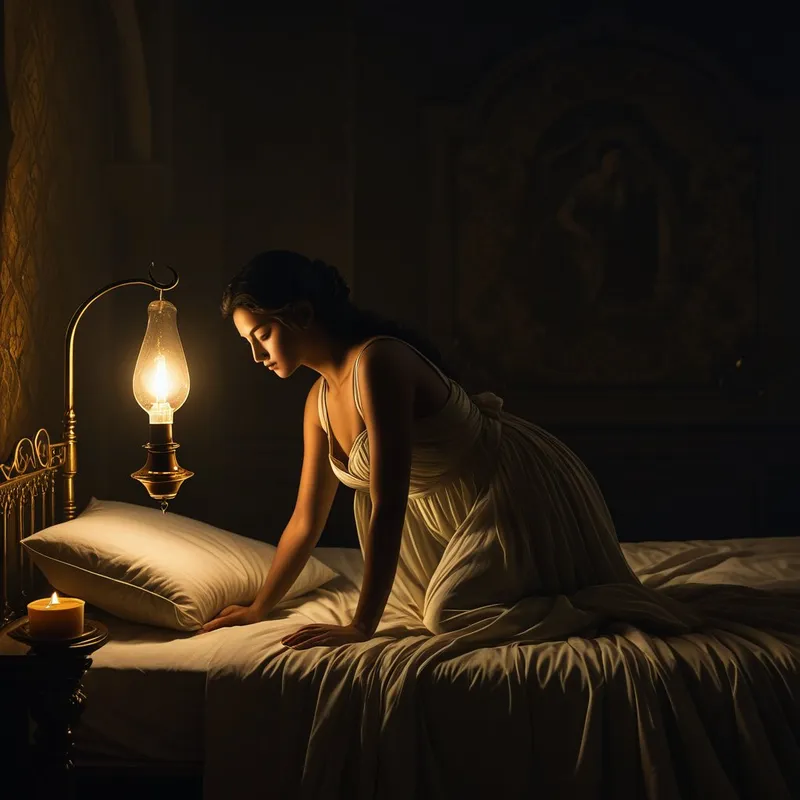
For a time, Psyche dwelt in blissful shadow. But solitude and the whispers of her visiting sisters seeded a terrible doubt. “Your husband is the serpent of the oracle,” they hissed. “He waits only to devour you.” Tormented, Psyche took a razor and an oil lamp one fateful night. As her divine lover slept, she raised the light. And there was no monster. The glow fell upon the most beautiful being imaginable: Eros himself, his golden hair spilled on the pillow, his silver wings folded in sleep. In her shock, a drop of scalding oil fell upon his shoulder.
The god awoke. The betrayal in his eyes was more terrible than any monster’s gaze. “Love cannot live where there is no trust,” he said, his voice breaking the world. And he was gone. The palace, the gardens, the singing voices—all vanished like mist, leaving Psyche alone on the cold riverbank of the mortal world.
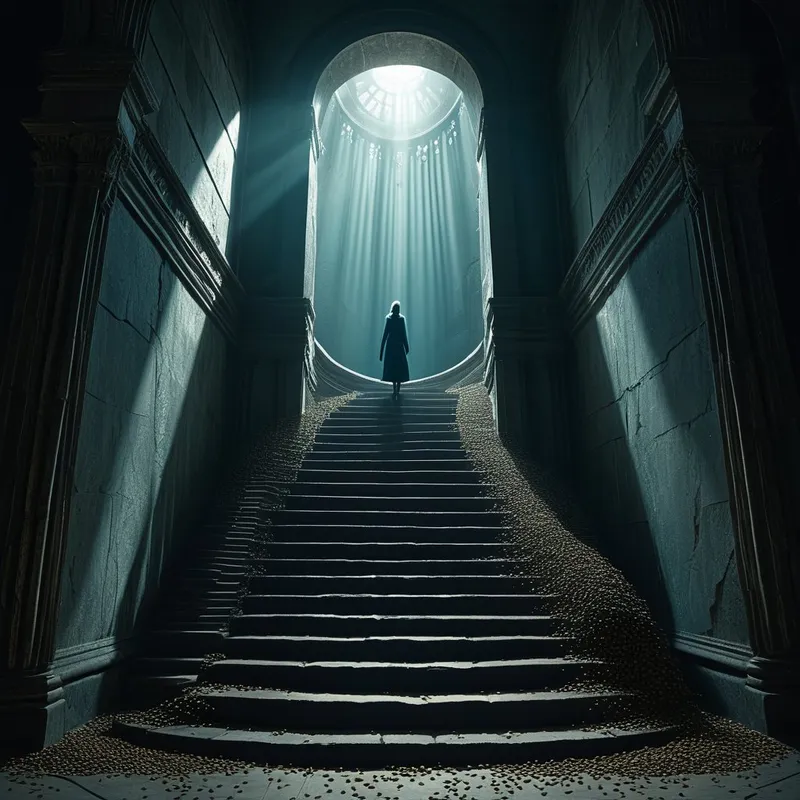
Her journey through the valley of loss had only begun. To win back her love, she had to face the very source of her suffering: Aphrodite. The goddess, triumphant in her spite, set forth four impossible tasks. Psyche must sort a colossal mound of mixed grains—wheat, barley, millet, poppy—before nightfall. An army of ants took pity and performed the labor. She must gather golden wool from the fierce, sun-gilded sheep by a deadly river. A reed whispered the secret: gather the wool caught on thorns at twilight. She must fill a crystal flask with water from the source of the rivers Styx and Cocytus, guarded by sleepless dragons. The eagle of Zeus itself swooped down to aid her.
The final task was a descent into death itself. Aphrodite demanded a box of beauty cream from Persephone, goddess of the underworld. Guided by a talking tower, Psyche walked the path to Hades, navigated its dread shades, and received the box. But on her return, a mortal weakness overcame her. Thinking to take a drop of divine beauty for herself, she opened the lid. No cream lay within, only the sleep of death, which poured out and struck her down.
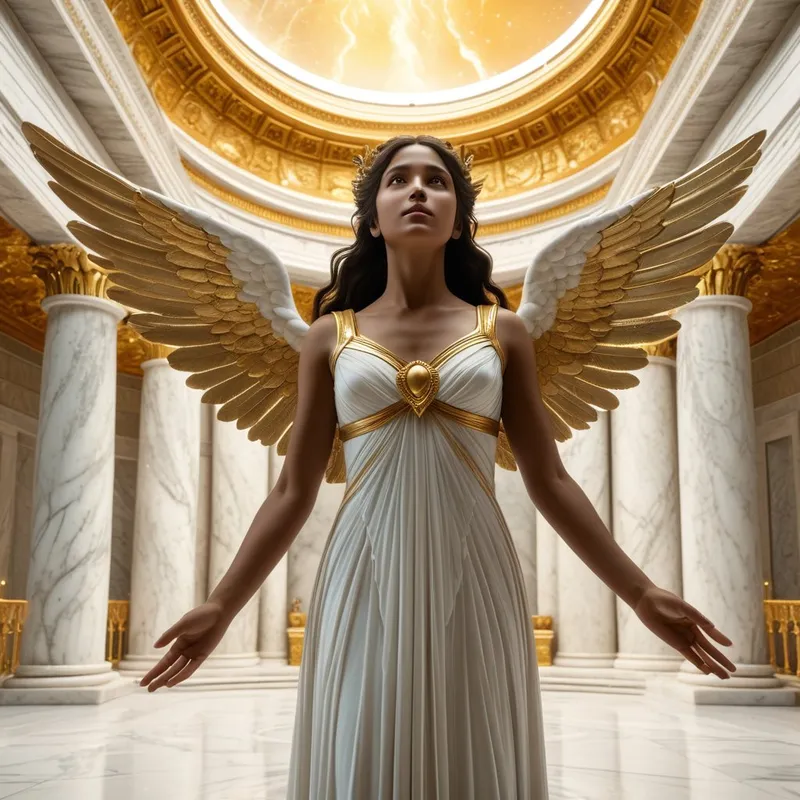
Here, love intervened at last. Eros, his wound healed by longing, flew to her lifeless form. He wiped the death-sleep from her face and returned it to the box. Then, with a resolve born of suffering, he ascended to Olympus. He pleaded before Zeus, who smiled upon the union of god and steadfast mortal. Psyche was given ambrosia, the drink of immortality. She was transformed, no longer a mortal princess, but an eternal goddess of the soul. And from their union was born a daughter named Voluptas—Joy.
Cultural Origins & Context
The myth of Eros and Psyche is not found in the epic cycles of Homer or the theatrical tragedies of the classical age. Its most complete and lyrical telling comes from the later Roman period, in the novel Metamorphoses (also known as The Golden Ass) by Apuleius. Written in the 2nd century CE, this work sits at a fascinating crossroads: it is a Latin novel infused with Greek mythological motifs, Neoplatonic philosophy, and the mystery cult sensibilities of its time.
The story was not a state-sponsored epic recited at festivals, but a sophisticated, literary tale embedded within a larger narrative about spiritual initiation and transformation. Its function was multifaceted. On one level, it was pure, captivating entertainment—a fairy tale of love, danger, and magic. On a deeper level, it served as an allegory for the philosophical and religious currents of the era, particularly the Neoplatonic idea of the human soul (Psyche) ascending from earthly confusion and suffering toward divine union and immortality. It was a story told to illustrate a spiritual journey, making the abstract concept of the soul’s trials tangible and dramatic.
Symbolic Architecture
At its core, this is the myth of the Soul’s awakening through the crucible of Love. Every character and event is a facet of a profound internal process.
Psyche is not merely a beautiful woman; she is the human Soul in its nascent, potential state—admired for its surface but ignorant of its own depth and destiny. Her initial, passive beauty is a prison. Her true becoming begins not in the palace of delights, but in the moment of her fall: the betrayal that exiles her into the world of labor and consciousness.
Eros represents not trivial romance, but the profound, animating force of Desire and Connection that moves the universe and the individual psyche. He is the divine instinct toward union, which must initially remain unconscious (the darkness of the bedchamber) to take root. The wounding by his own arrow signifies that true love is always a surrender, a vulnerability that even the god of love is subject to.
Aphrodite embodies the possessive, shadow aspect of love—jealousy, vanity, and the ego’s resistance to the soul’s independent journey. She is the necessary antagonist, the force that pushes Psyche out of passive paradise and into the active trials that will forge her.
The four impossible tasks are the labors of consciousness. They represent the soul’s necessary engagement with the overwhelming, chaotic, and terrifying aspects of life (sorting chaos, confronting fierce nature, facing the waters of death) that cannot be solved by intellect alone, but require help from the instinctual (ants, reed, eagle) and a humble receptivity to guidance.
The descent to Persephone is the ultimate confrontation with the underworld of the psyche—the encounter with death, depression, and the unconscious. Psyche’s final failure (opening the box) is crucial. It is the last gasp of the mortal ego seeking a "quick fix" (beauty), and its defeat by the sleep of death allows for the final, saving intervention of the now-conscious, active love (Eros).
The Dreamer's Resonance
When this myth stirs in modern dreams, it signals a profound initiation of the heart and soul. To dream of a radiant but forbidden lover known only in darkness points to an emerging, numinous connection to one’s own anima or animus—the inner other—that feels too sacred or terrifying to bring into the light of day. The dream ego, like Psyche, may be tempted by the "sisters" of doubt (internal critics, societal voices) to betray that trust with premature analysis or exposure.
Dreams of impossible, meticulous tasks—sorting endless tiny objects, climbing unreachable heights, facing guarded thresholds—mirror the psyche’s somatic recognition of a necessary, arduous purification process. The body in the dream feels the weight of the labor. The appearance of helpful animals or guiding whispers signifies that the dreamer is in the midst of this process, and the deeper, instinctual layers of the Self are mobilizing to assist where the conscious mind is overwhelmed.
A dream of a final, fatal mistake (like opening a box and falling into a sleep) followed by a miraculous rescue or awakening often marks the pivotal turn in a long period of psychological suffering. It represents the ego’s surrender, the end of its futile striving, and the opening for a transpersonal, healing energy (the Eros principle) to enter and enact the transformation the ego could not accomplish alone.
Alchemical Translation
The myth of Eros and Psyche is a perfect map of the alchemical process of individuation—the Jungian journey toward psychic wholeness. It begins with the nigredo, the blackening: Psyche’s funeral procession, her abandonment on the mountain, the descent into the darkness of the unknown relationship. This is the initial state of confusion, depression, and the death of an old identity.
The sojourn in the enchanted palace represents a temporary albedo, or whitening—a state of unconscious unity and potential, but one that is naive and unsustainable. The lamp-lit betrayal is the necessary separatio, the crisis that forces differentiation. Soul (Psyche) must be separated from instinctual Love (Eros) to consciously realize what it has lost and what it truly is.
The four tasks are the arduous work of citrinitas, the yellowing or solar work. Here, the soul actively engages with the world and the unconscious, developing discipline, patience, and humility. It learns to collaborate with the non-ego forces of nature and psyche (the helpers).
The journey to the underworld is the core of the rubedo, the reddening. It is the confrontation with the ultimate shadow—mortality itself. Psyche’s "death" is the final dissolution of the ego’s claim to control the process. Her revival by Eros symbolizes the coniunctio, the sacred marriage. This is not a reunion of the old, unconscious couple, but a new synthesis on a higher level: the conscious Soul (now immortal Psyche) united with the conscious, committed principle of Deep Connection (Eros).
The birth of Voluptas (Joy/Pleasure) is the ultimate goal: the lapis philosophorum, the philosopher’s stone. It is the new, enduring psychic product born from this supreme union—not a transient happiness, but a deep, abiding capacity for joy that is the fruit of a soul tested, transformed, and made whole. The myth tells us that our deepest suffering, when endured with courage and faith in the invisible thread of love, is the very fire that transmutes the mortal soul into its eternal, golden form.
Associated Symbols
Explore related symbols from the CaleaDream lexicon: