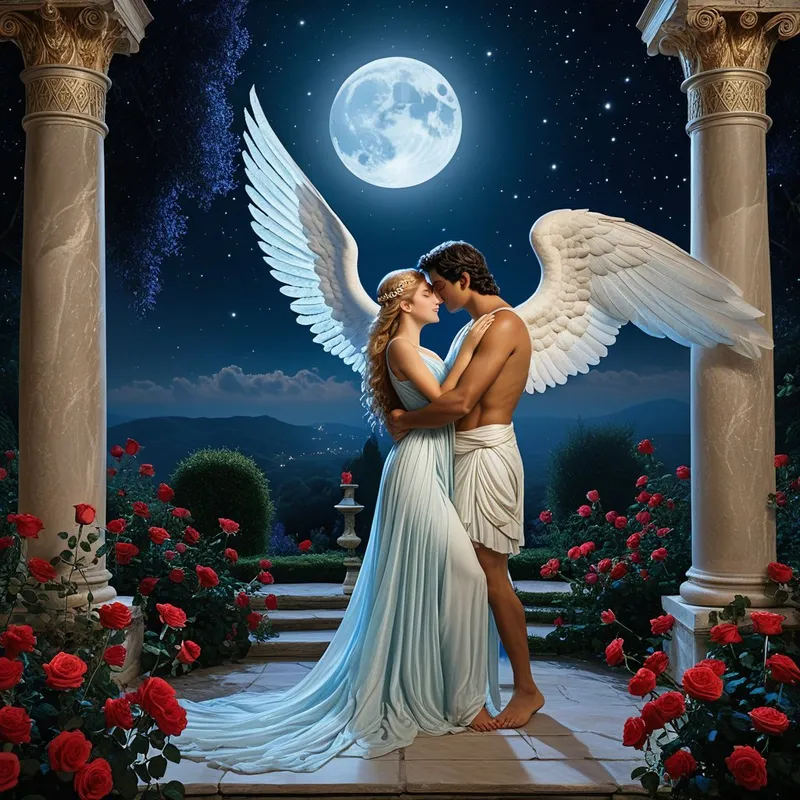
Eros and Psyche Myth Meaning & Symbolism
A mortal princess, Psyche, must complete impossible tasks to reunite with her divine lover, Eros, in a story of love, betrayal, and the soul's transformation.
The Tale of Eros and Psyche
Listen, and I will tell you of a beauty that became a curse, of a love that dared not speak its name, and of a soul that was forged in the fires of impossible tasks.
In a kingdom by [the sea](/myths/the-sea “Myth from Greek culture.”/), there lived a princess named [Psyche](/myths/psyche “Myth from Greek culture.”/), whose mortal beauty was so radiant it stole the breath from men’s lungs. They began to whisper that she surpassed even Aphrodite herself. Incensed, the goddess summoned her son, Eros, and commanded him to pierce [Psyche](/myths/psyche “Myth from Greek culture.”/) with a golden arrow, making her fall in love with the most vile creature he could find. But when Eros beheld Psyche, he pricked himself with his own arrow, and a love deeper than any command was born in his divine heart.
An oracle declared Psyche was destined to wed a monster on a mountain peak. In despair, her family led her there and abandoned her. But the West Wind, [Zephyrus](/myths/zephyrus “Myth from Greek culture.”/), gently carried her down to a hidden valley, where she found a palace of unimaginable splendor, wrought of gold and light. Invisible servants attended her, and a voice, rich and warm as honeyed wine, spoke to her in the darkness of night. It was her husband. He would give her everything, he said, but she must never seek to see his face. She must trust him in the dark.
For a time, Psyche lived in bliss, her heart full, her senses sated by the voice and touch of her mysterious beloved. But loneliness crept in. When her sisters visited, seeded with envy by Aphrodite, they poisoned her mind. “Your husband is a serpent,” they hissed. “He will devour you once your child is born. You must take a lamp and a knife, see his true form, and strike!”
Terror took root. That night, her heart pounding like a trapped bird, Psyche took a lamp and a blade and crept to the bed. The golden light fell upon not a monster, but the most beautiful being she had ever seen: Eros himself, his wings shimmering, his face the very image of perfect love. In her awe, her hand trembled. A drop of scalding oil fell upon his shoulder.
He awoke. His eyes, full of betrayed love and profound sorrow, met hers. “You have destroyed us with your doubt,” he said, his voice breaking. “Love cannot live where there is no trust.” And he was gone, the palace with him, leaving Psyche alone on the cold earth, clutching nothing but the memory of his face and the weight of her error.
Thus began her pilgrimage of atonement. To win back her love, she had to face the wrath of Aphrodite, who set before her four impossible tasks. She had to sort a mountain of mixed seeds, aided by an army of ants. She had to gather golden wool from fierce, sun-crazed sheep, guided by a whispering reed. She had to fetch black [water](/myths/water “Myth from Chinese culture.”/) from the source of the rivers Styx and [Cocytus](/myths/cocytus “Myth from Greek culture.”/), saved by the eagle of Zeus. Finally, she had to descend into [the underworld](/myths/the-underworld “Myth from Greek culture.”/) itself and retrieve a box of beauty from [Persephone](/myths/persephone “Myth from Greek culture.”/).
Psyche, aided by the very world that pitied her, succeeded in each task through humility, courage, and help from unexpected allies. But on her final return, human curiosity overcame her once more. She opened the box, hoping for a drop of divine beauty to present herself to Eros, and was instead plunged into a deathlike sleep.
It was Eros, his wound healed by his longing, who found her. He flew to Olympus and pleaded their case before Zeus. The king of gods granted Psyche immortality, serving ambrosia to her lips. Aphrodite was appeased. And in the great hall of the gods, Eros and Psyche were wed in a true, celestial marriage. From their union was born a daughter named Voluptas—Joy.

Cultural Origins & Context
This myth comes to us from the Latin novel [Metamorphoses](/myths/metamorphoses “Myth from Greek culture.”/) (also known as The Golden Ass) by Apuleius, written in the 2nd century CE. While recorded in Latin, its characters, themes, and divine machinery are profoundly Greek, reflecting the syncretic culture of the Roman Empire that deeply absorbed Hellenistic mythology. It is a rare, complete fairy-tale embedded within a larger narrative, functioning as an allegory that would have resonated with mystery cults of the era, particularly those focused on the soul’s journey and salvation.
Unlike the grand, cosmic tales of the Iliad or Theogony, the story of Eros and Psyche feels intimate, almost novelistic. It was likely a sophisticated entertainment for a literate audience, but its core—the trials of the soul (Psyche) seeking union with divine love (Eros)—tapped into deep philosophical and religious currents. It gave narrative form to Platonic ideas of the soul’s ascent and the human yearning for the divine, making abstract philosophy feel visceral and personal.
Symbolic Architecture
At its [heart](/symbols/heart “Symbol: The heart symbolizes love, emotion, and the core of one’s existence, representing deep connections with others and self.”/), this is the myth of the [human](/symbols/human “Symbol: The symbol of a human represents individuality, complexity of emotions, and social relationships.”/) [soul](/symbols/soul “Symbol: The soul represents the essence of a person, encompassing their spirit, identity, and connection to the universe.”/)’s [journey](/symbols/journey “Symbol: A journey in dreams typically signifies adventure, growth, or a significant life transition.”/) to [consciousness](/symbols/consciousness “Symbol: Consciousness represents the state of awareness and perception, encompassing thoughts, feelings, and experiences.”/) through the [crucible](/symbols/crucible “Symbol: A vessel for intense transformation through heat and pressure, symbolizing spiritual purification, testing, and alchemical change.”/) of [relationship](/symbols/relationship “Symbol: A representation of connections we have with others in our lives, often reflecting our emotional state.”/). Psyche (Ψυχή) means “[soul](/symbols/soul “Symbol: The soul represents the essence of a person, encompassing their spirit, identity, and connection to the universe.”/)” or “[butterfly](/symbols/butterfly “Symbol: Symbolizes transformation, beauty, and the ephemeral nature of life.”/)” in Greek. Eros (Ἔρως) is not mere Cupidian flirtation, but the fundamental force of attraction, the desire for [connection](/symbols/connection “Symbol: Connection symbolizes relationships, communication, and bonds among individuals.”/) and creation that binds the [cosmos](/symbols/cosmos “Symbol: The entire universe as an ordered, harmonious system, often representing the totality of existence, spiritual connection, and the unknown.”/).
The soul, in its mortal innocence, is beautiful but incomplete. It yearns for love, yet its first encounter with the divine is in darkness, requiring a trust that precedes understanding.
The central prohibition—“never look upon me”—is the myth’s great psychological pivot. It represents the necessary [space](/symbols/space “Symbol: Dreaming of ‘Space’ often symbolizes the vastness of potential, personal freedom, or feelings of isolation and exploration in one’s life.”/) in intimacy, the [mystery](/symbols/mystery “Symbol: An enigmatic, unresolved element that invites curiosity and exploration, often representing the unknown or hidden aspects of existence.”/) of the Other that must be respected. To violate this is to attempt to possess, to control, to reduce the divine/other to a known object. Psyche’s “failure” is not a moral failing, but an inevitable stage in the soul’s development: the [movement](/symbols/movement “Symbol: Movement symbolizes change, progress, and the dynamics of personal growth, reflecting an individual’s desire or need to transform their circumstances.”/) from passive, blissful unconscious union to active, conscious seeking, even if that seeking begins in destructive doubt.
Her four labors are the archetypal tasks of individuation. They move from ordering [chaos](/symbols/chaos “Symbol: In Arts & Music, chaos represents raw creative potential, uncontrolled expression, and the breakdown of order to forge new artistic forms.”/) (sorting seeds), to navigating dangerous, instinctual [energy](/symbols/energy “Symbol: Energy symbolizes vitality, motivation, and the drive that fuels actions and ambitions.”/) (the golden [wool](/symbols/wool “Symbol: A natural fiber representing warmth, protection, and connection to tradition. Often symbolizes comfort, labor, or spiritual purity.”/)), to confronting the waters of [death](/symbols/death “Symbol: Symbolizes transformation, endings, and new beginnings; often associated with fear of the unknown.”/) and the unconscious (the Stygian [water](/symbols/water “Symbol: Water symbolizes the subconscious mind, emotions, and the flow of life, representing both cleansing and creation.”/)), and finally, to a true nekyia, a descent into the [underworld](/symbols/underworld “Symbol: A symbolic journey into the unconscious, representing exploration of hidden aspects of self, transformation, or confronting repressed material.”/) of the psyche to retrieve a vital essence. Each [task](/symbols/task “Symbol: A task represents responsibilities, duties, or challenges one faces.”/) requires her to surrender her egoic will—she does not conquer through brute force, but through receptivity to help (from ants, [reed](/symbols/reed “Symbol: A flexible plant symbolizing resilience, adaptability, and vulnerability. It bends without breaking, representing survival through yielding.”/), [eagle](/symbols/eagle “Symbol: The eagle is a symbol of power, freedom, and transcendence, often representing a person’s aspirations and higher self.”/)). She learns interdependence.

The Dreamer’s Resonance
When this myth stirs in the modern dreamer, it often signals a profound crisis or initiation within a deep relationship or the relationship to one’s own soul. To dream of a radiant but faceless lover speaks to an encounter with an anima/animus figure that feels divinely transformative, yet whose full nature remains unconscious. The dreamer is in the “palace of night,” experiencing a blissful but fragile connection based on [projection](/myths/projection “Myth from Alchemical culture.”/).
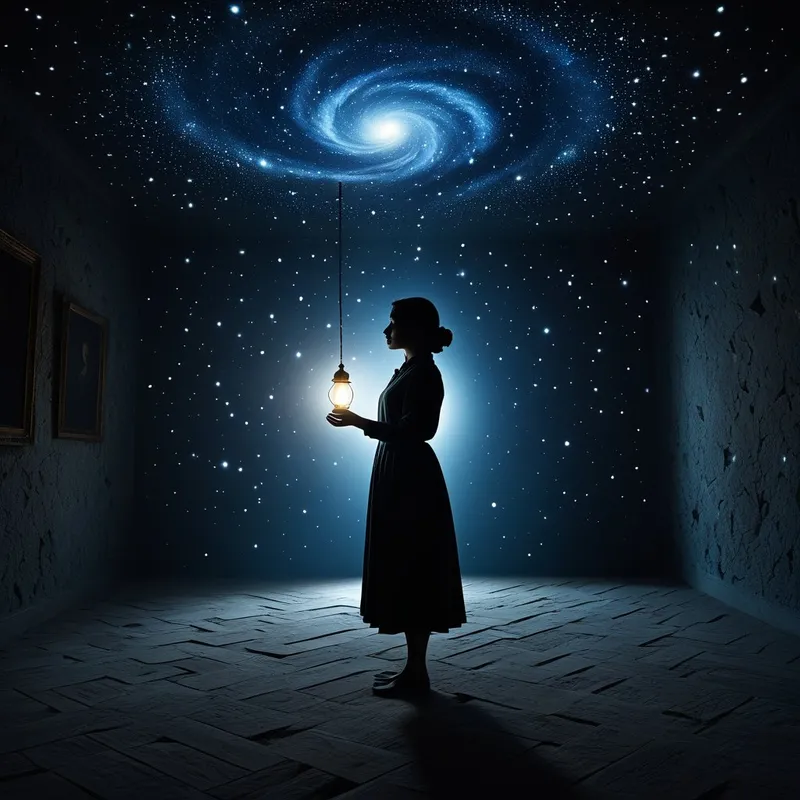
Dreams of spying with a lamp, of seeing something breathtaking only to have it vanish, mirror Psyche’s pivotal moment. This is the somatic shock of disillusionment—the moment a projection shatters, when we see the complex, flawed humanity of a partner (or a part of ourselves) and the idealized image dies. The feeling is one of catastrophic loss and burning regret. Conversely, dreams of being given impossible, meticulous tasks (sorting, fetching, descending) reflect a psychological state of atonement and re-building. The dream-ego is in the labor phase, slowly, painstakingly reconstructing a sense of self and worth after a rupture, often feeling small, assisted by “instinctual” helpers (animals, guides) in the psyche.
Alchemical Translation
The myth of Eros and Psyche is a perfect map of the alchemical conjunctio, [the sacred marriage](/myths/the-sacred-marriage “Myth from Various culture.”/) that produces the gold of the integrated self. It models psychic transmutation not as a solitary hero’s quest, but as a relational ordeal.
The initial state is [prima materia](/myths/prima-materia “Myth from Alchemical culture.”/): the beautiful but naive soul, worshipped for its exterior, suffering from the envy of the gods (the critical, perfectionistic super-ego). The marriage in darkness is the [nigredo](/myths/nigredo “Myth from Alchemical culture.”/), a union in the blackness of the unconscious, fertile but unstable. The betrayal with [the lamp](/myths/the-lamp “Myth from Alchemical culture.”/) is the necessary [separatio](/myths/separatio “Myth from Alchemical culture.”/). The conscious mind, driven by fear and curiosity, forces a separation from the unconscious content, causing immense pain but also allowing Eros (instinctual love) to become a distinct, visible entity for the first time.
The soul does not find itself by remaining in blissful darkness, but by losing its paradise and undertaking the conscious, laborious work of re-finding it on a higher level.
The four tasks are the albedo and citrinitas, the purification and illumination of the soul through humble service to the impossible. The final descent and sleep is a second, deeper nigredo, a symbolic [death](/myths/death “Myth from Tarot culture.”/). Only when [the ego](/myths/the-ego “Myth from Jungian culture.”/) has fully surrendered, “dead” to its old ways, can the transcendent function—here, Eros himself—return to rescue it.
The granting of ambrosia by Zeus represents the intervention of the unifying symbol of [the Self](/myths/the-self “Myth from Jungian culture.”/), the central archetype of order. The celestial wedding is the [rubedo](/myths/rubedo “Myth from Alchemical culture.”/), the reddening, the achievement of lasting wholeness. The born child, Voluptas (Joy), is the lapis, the Philosopher’s Stone—the enduring capacity for deep, embodied pleasure that is the fruit of the union between conscious soul and transformative, loving instinct. The mortal becomes immortal. The soul, having faced its darkness and earned its light, is finally ready to love and be loved, consciously and forever.
Associated Symbols
Explore related symbols from the CaleaDream lexicon: