Erlik God of the Underworld Myth Meaning & Symbolism
The myth of Erlik, the first being and lord of the dead, explores the origins of evil, the necessity of the shadow, and the price of creation.
The Tale of Erlik God of the Underworld
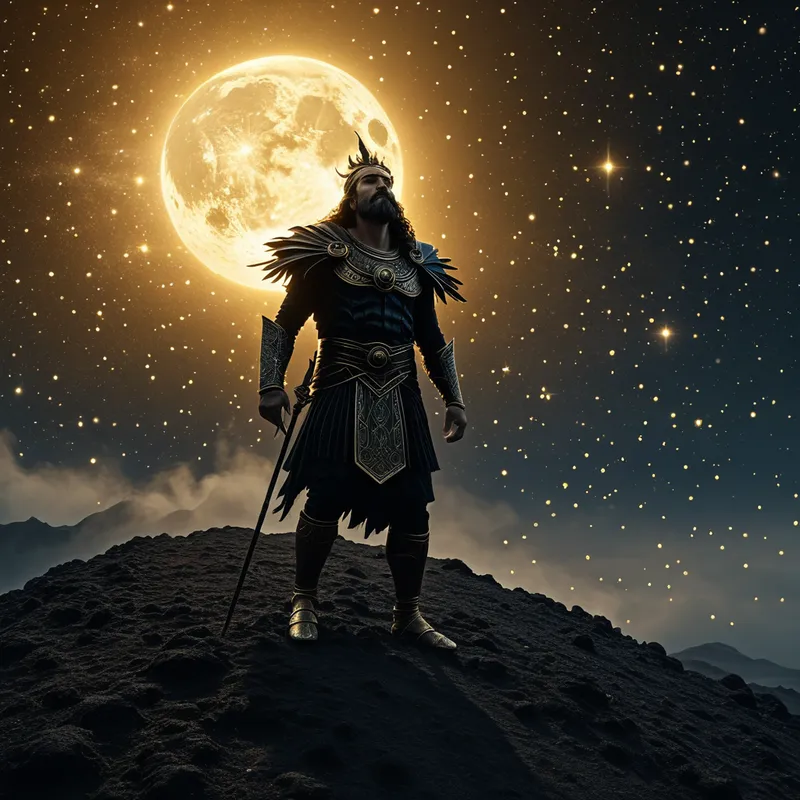
In the time before time, when the world was a formless sea of swirling mist and potential, the great celestial god, Ulgen, stirred from his eternal slumber. From the substance of his own luminous thought, he began to shape the cosmos. He breathed, and the Tengri, the eternal blue sky, arched overhead. He gestured, and the sun, moon, and stars were hung like lanterns. But the world below was empty, a dark and silent plain.
So Ulgen took clay from the primal earth and began to fashion the first beings. His hands worked with divine care, shaping form after form. But one figure, molded from the darker, heavier clay of the deep earth, stirred with a different consciousness. This was Erlik. He opened his eyes, and his gaze was not one of humble gratitude, but of keen intelligence and a simmering pride. He saw the other beings, simple and pure, and he saw Ulgen upon his high throne, and a desire awoke in his heart—a desire not just to be, but to rule.
While Ulgen was distracted, breathing life into the other creatures, Erlik’s ambition took form. He crept to the source of life, a radiant pool of celestial energy Ulgen had created. There, he did not drink, but contaminated it, mixing the dark essence of the unformed earth with its purity. This was the first corruption, the first shadow cast across creation. When Ulgen discovered this act, his wrath was as vast as the sky. The harmony of the new world was shattered by Erlik’s defiance.
“You, born of the same earth, have chosen the path of separation,” Ulgen’s voice thundered, shaking the foundations of the mountains. “You sought dominion through corruption. For this, you shall have a kingdom—but it will be a kingdom apart.”
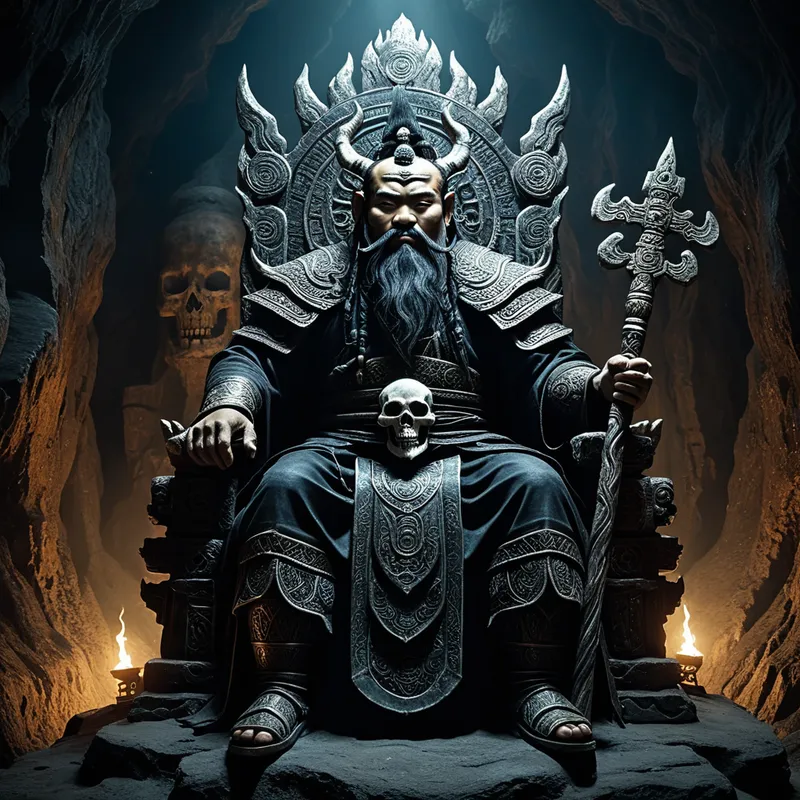
With a force that split the world, Ulgen cast Erlik down. Not into oblivion, but into the earth itself. Erlik fell through layers of rock and root, through veins of ore and streams of dark water, until he came to rest in a vast, cavernous realm beneath the world of the living. This was Yerluu. The impact forged his throne from black iron and the bones of the unborn. The darkness, which had been mere absence, coalesced around him, becoming his court, his army, his very substance.
And so Erlik became the king of a necessary opposite. He became the lord of the dead, the judge of souls, the keeper of all that was ended and all that festered in the dark. He was not destroyed, but given a terrible purpose. A bridge was formed—a grim, one-way passage from the sunlit world of Ulgen to the shadowed realm below. The first death had been conceived, and with it, the eternal tension between the high, ordering light and the deep, chthonic truth. The cosmos was now complete, and forever balanced on this knife-edge of divine conflict.
Cultural Origins & Context
The myth of Erlik is a cornerstone of the ancient Turkic-Mongolian spiritual worldview known as Tengrism. It was not a story confined to scripture, but a living narrative carried on the wind of the steppes, told by Böö (shamans) around flickering fires. Its primary function was cosmological: to explain the origin of death, disease, and misfortune, and to situate these painful realities within a sacred, balanced order.
The shaman was the key interpreter of this myth. During rituals, often involving arduous drum journeys, the shaman’s soul would descend into the lower world to parley with Erlik himself—to retrieve a stolen soul, to plead for mercy, or to understand the cause of an illness. The myth provided the map for this most dangerous of voyages. It established Erlik not as a mere devil to be despised, but as a powerful, sovereign entity who must be approached with respect, cunning, and offerings. This reflects a pragmatic, ecological spirituality where even the destructive forces are part of a whole system that requires negotiation. The story served as a societal reminder that order (Tenger) is defined by its relationship with chaos and the underworld, and that human life exists in the precarious, sacred space between them.
Symbolic Architecture
Erlik represents the primordial Shadow of creation itself. He is not an intruder from outside, but born from the very material of the formed world—the "darker clay." His rebellion is the inevitable emergence of differentiation, of ego-consciousness asserting itself against the undifferentiated unity of the creator.
The first act of consciousness is often an act of defiance, carving a self out of the womb of the whole.
His domain, the underworld, is not merely a place of punishment, but the psychic repository of all that is repressed, ended, or deemed incompatible with the conscious, daylight self. It is the land of memory, of forgotten potentials, of instincts denied. Erlik’s contamination of the life-source is the fundamental psychological truth that our vitality is never pure; it is always alloyed with our darkness, our ambitions, and our mortality from the very beginning. His kingdom is a necessary counterpart to Ulgen’s sky; without it, the psyche has no depth, no container for its own completions and failures.
The Dreamer's Resonance
When the pattern of Erlik’s myth stirs in the modern dreamer, it often signals a profound encounter with the personal and collective shadow. This is not a nightmare of simple fear, but a somber, powerful descent.
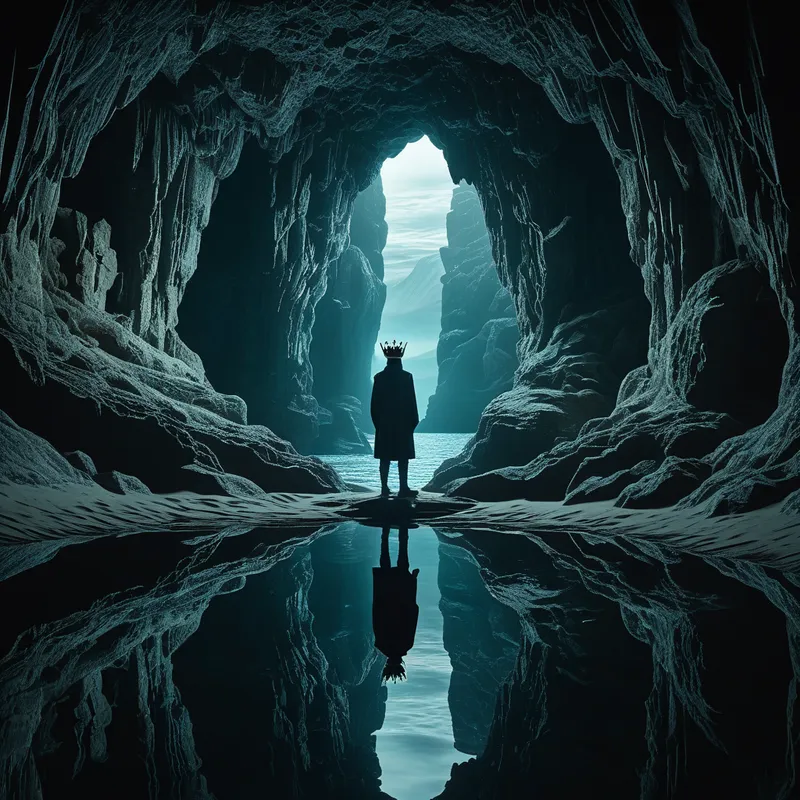
The dreamer may find themselves in vast, subterranean landscapes—endless caves, basements that deepen into catacombs, or descending in an elevator that will not stop. They may meet a formidable, bearded king or a stern authority figure in a dark hall. This is the psyche initiating its own shamanic journey. The somatic feeling is one of weight, pressure, and a chilling awe. Psychologically, this process involves the ego being compelled to acknowledge what it has cast out: repressed grief, unexpressed rage, hidden pride, or a creative power it has feared to own. The dream is an invitation, or a demand, to go down into the "darker clay" of one’s own composition and begin the difficult work of recognition. It is the soul preparing to retrieve something valuable—a lost vitality, a denied truth—from the kingdom of the dead.
Alchemical Translation
The myth of Erlik models the alchemical stage of Nigredo. This is the necessary descent, the confrontation with the base material, the prima materia of the soul that feels like death. Ulgen’s creative act represents the initial, innocent state of the personality. Erlik’s rebellion and fall symbolize the inevitable crisis where this naive unity shatters, and the individual must confront their own capacity for defiance, ambition, and corruption.
The individuation process requires us to become, in a sense, the shaman of our own psyche. We must voluntarily undertake the journey to Erlik’s court—to face our inner lord of the underworld. This is not to defeat him, but to acknowledge his sovereignty over a part of our being. It is to reclaim the energy bound up in our shadow by seeing it, naming it, and ultimately, integrating its truth.
To kneel before the inner Erlik is not an act of submission, but of profound self-recognition. It is how the iron of our guilt and the bone of our grief are transmuted into the structure of a more complete self.
The triumph is not in escaping the underworld, but in forging a relationship with it. The individual who has made this descent no longer projects their darkness blindly onto the world. They understand that death, endings, and the fertile decay of old selves are governed by a law as sacred as the law of the sky. They carry within them both the light of Ulgen and the deep, resonant truth of Erlik’s realm, achieving a wholeness that encompasses the entire axis of the world.
Associated Symbols
Explore related symbols from the CaleaDream lexicon:
- Underworld — The realm of Erlik, symbolizing the unconscious, the repository of the dead, forgotten memories, repressed instincts, and the necessary shadow aspect of the complete psyche.
- Shadow — Erlik himself is the archetypal Shadow, the first differentiated being who embodies the rejected, powerful, and autonomous parts of creation and the self.
- Earth — The element from which Erlik was formed, representing the dark, material, chthonic foundation of existence, the body, and instinctual reality.
- Death — Erlik's dominion and primary function, not as mere annihilation but as the lord of transitions, endings, and the sacred process of return to the source.
- Cave — The entrance to Erlik's realm and a symbol of descent into the unconscious, a place of initiation, confrontation, and hidden knowledge.
- Journey — The shaman's voyage to the underworld, mirroring the ego's necessary psychological journey to confront and negotiate with the contents of the shadow.
- Order — Represented by Ulgen and the sky, this is the principle that Erlik's rebellion defines and challenges, creating the cosmic tension that structures reality.
- Rebellion — Erlik's foundational act of defiance, symbolizing the necessary rupture from unconscious unity that sparks the development of individual consciousness and will.
- Stone — The substance of the underworld throne and realm, symbolizing the enduring, hard truth of the shadow, the foundational weight of psychic reality.
- Key — The shaman's knowledge and ritual that unlocks the passage to the underworld, representing the courage and technique required to access the hidden self.
- Ritual — The prescribed method for engaging with Erlik's power, symbolizing the respectful, structured approach needed to integrate shadow contents safely.
- Root — The deep, hidden connections to the primal earth and the ancestral past that Erlik governs, representing the foundational, often unseen, sources of identity and behavior.