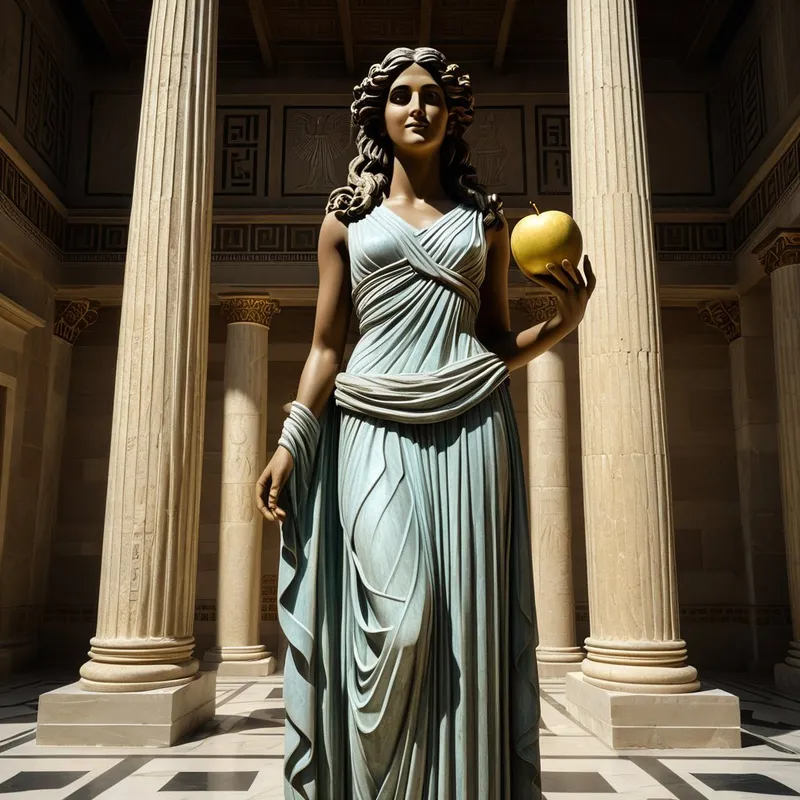
Eris' Apple Myth Meaning & Symbolism
The goddess of discord, uninvited to a wedding, throws a golden apple inscribed 'for the fairest,' igniting a divine rivalry that leads to the Trojan War.
The Tale of Eris' Apple
Listen, and hear of the seed of fire that grew into a ten-year war. It began not on a battlefield, but in a hall of celebration, where the air was thick with nectar and the laughter of gods. The mighty Peleus was to wed the sea-nymph Thetis, and all of Olympus was invited to bless the union. All, save one.
She was Eris, sister to Ares, a daughter of the primal night. Her presence was the uninvited thought, the crack in the perfect vase, the cold draft in a sealed room. Where she walked, harmony frayed. And so, she was pointedly, deliberately, left off the gleaming guest list.
From the shadows of the mortal world, Eris watched the procession of light and divinity entering the feast. She felt not sorrow, but a cold, sharpening focus. A smile, thin and knowing, touched her lips. If she was not welcome for her presence, she would make herself unforgettable through her gift.
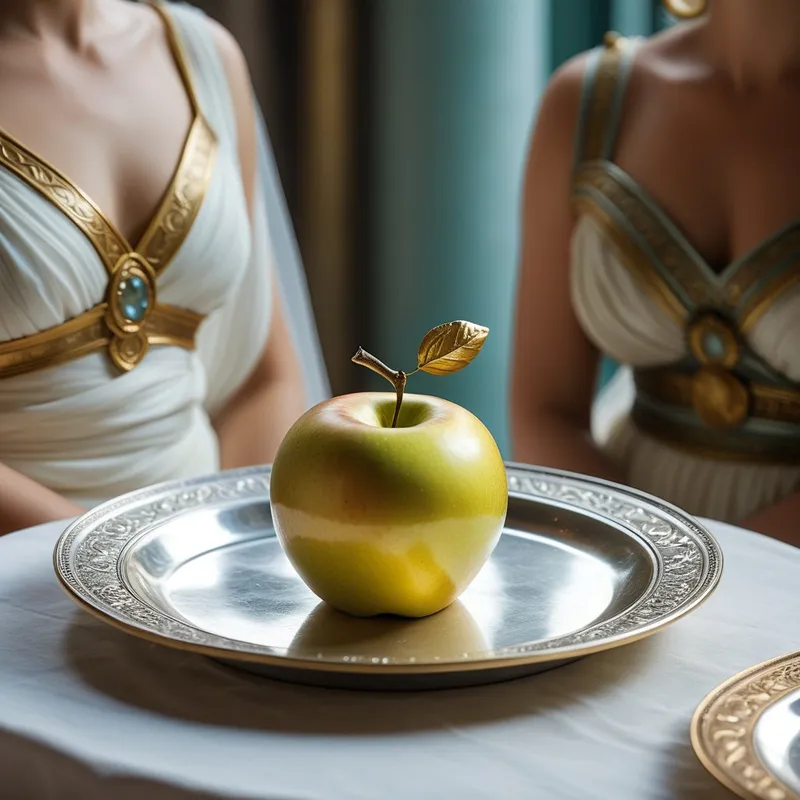
When the feast was at its height, when the gods were flush with ambrosia and self-congratulation, a single, solid thud echoed through the hall. Conversation died. All eyes fell to the center of the floor. There, rolling to a perfect stop, was an apple. But no ordinary fruit—this was of the purest, most luminous gold, as if a piece of the sun had been plucked and polished. And upon its flawless skin, a phrase was etched, burning with its own inner light: Kallisti. “For the Fairest.”
A silence, deeper than before, descended. Then, a rustle of divine cloth. The Queen of Olympus, Hera, stood, her regal bearing absolute. The grey-eyed Athena straightened, her gaze intelligent and sharp. And Aphrodite rose, a smile already playing on her lips, the very air around her sweetening. Three hands reached for the apple. Three voices, each layered with the power of a domain, claimed it.
“By right of my throne, it is mine,” declared Hera, her voice the sound of law. “By virtue of wisdom and noble spirit, it is mine,” asserted Athena, her voice the ring of strategy. “The word speaks of beauty,” murmured Aphrodite, her voice a honeyed promise. “And who here embodies that more than I?”
The argument spiraled, a tempest of divine ego contained within the wedding hall. No god dared judge, for to choose one was to earn the eternal wrath of two. The perfect celebration was now fractured, the discord sown deep into the heart of divinity itself. The solution, born of divine cowardice, was to pass the poisoned chalice downward. They would find a mortal judge, one outside the politics of Olympus: Paris, a shepherd-prince on the slopes of Mount Ida.
And so the three radiant goddesses descended to the mortal plane, standing before the bewildered prince. But they did not merely present themselves. They offered bribes, each a distillation of their essence. Hera offered all the kingdoms of the earth. Athena offered victory and wisdom in every battle. Aphrodite, stepping closer, offered the love of the most beautiful woman in the world: Helen.
Paris, a man of passion, not politics, handed the apple to Aphrodite. In that moment, he chose not fairness, but desire. He chose the personal over the political, the heart over the head or the hand of power. Hera and Athena departed, their divine smiles ice, their hearts seeding a future vengeance. Aphrodite claimed her prize, and set in motion the fulfillment of her promise: the abduction of Helen from her husband, Menelaus. And from that single act of mortal desire, ratified by a divine quarrel, the sails of a thousand ships were readied, and the plains of Troy were destined to drink the blood of heroes for a decade. All from one uninvited guest, and one golden, gleaming apple.
Cultural Origins & Context
This myth, often called the “Judgment of Paris,” is our primary window into the genesis of the Trojan War cycle. It is not a standalone folktale, but the essential prologue to the greatest epic tradition of the ancient Greek world, immortalized in Homer’s Iliad and echoed throughout later works like the Cypria (now lost) and the writings of later mythographers. Its function was profound: to provide a divine and causal origin for a cataclysmic historical (or pseudo-historical) event. The war was not merely a clash of men over a woman, but the inevitable playing-out of a conflict seeded in the realm of the gods themselves.
The tale served as a foundational “why.” It explained the epic scale of the suffering at Troy as the result of cosmic forces—the wounded pride of Hera and Athena, the manipulative power of Aphrodite, and the chaotic agency of Eris. It was a story told by bards and poets to frame human history within a divine drama, teaching that mortal affairs are often the chessboard for immortal disputes, and that a single moment of choice (Paris’s judgment) can unleash tides of fate that drown generations. It reinforced a cultural worldview where the divine was intimately, and often catastrophically, intertwined with the human.
Symbolic Architecture
The myth is a masterclass in symbolic cause and effect. At its core, it is not about beauty, but about recognition. The apple, inscribed Kallisti, is a mirror. It does not create vanity; it reveals it. It is the ultimate projection screen for the psyche’s deepest need for validation.
The Apple of Discord is not an object, but an event. It is the moment an unacknowledged part of the self is thrown into the center of a carefully constructed reality, demanding to be seen.
Eris represents the archetypal Shadow of the social self—the excluded, the disruptive, the agent of necessary chaos. She is the part of the psyche, and of society, that is dis-invited from the “wedding feast” of conscious agreement and polite convention. Her “gift” is the forced confrontation with what has been repressed: in this case, the simmering, competitive vanity of the goddesses (and by extension, those human qualities they govern).
The three goddesses represent a tripartite division of core human drives: Hera (Sovereignty, Power, Structure), Athena (Wisdom, Strategy, Achievement), and Aphrodite (Love, Desire, Sensual Pleasure). Paris’s choice of Aphrodite is a profound psychological statement. It signifies the primal, often overriding, power of the desire principle (Eros) over the principles of power (Nomos) and wisdom (Logos). His judgment suggests that when the raw, seeking energy of the soul is activated, it can eclipse all other considerations, with devastating consequences.

The Dreamer's Resonance
When this mythic pattern stirs in the modern dreamscape, it often manifests as a scenario of impossible choice or sudden, disruptive conflict in a setting that “should” be harmonious—a family gathering, a workplace meeting, a celebration. The dreamer might be forced to judge between three people, three paths, or three offers, each representing a different core value or part of their identity (e.g., career vs. family vs. personal passion).
The somatic feeling is one of tense, escalating pressure, of being put on the spot. The golden apple itself may appear as a coveted object, a award, a job title, or simply a glowing, attractive focus of attention that splits a group. This dream signals that an unintegrated aspect of the dreamer’s own “divine” potential—their inner Hera (authority), Athena (competence), or Aphrodite (desire)—is clamoring for recognition, and its exclusion is causing internal (and likely external) discord. The dream is the psyche’s own Eris, throwing the apple into the conscious mind, demanding a reckoning with one’s own unacknowledged worth, envy, or longing.

Alchemical Translation
The alchemical journey modeled here is the transmutation of naive desire into conscious responsibility. The initial state is a false unity—the “wedding feast” where discord is politely excluded. Eris’s act is the essential nigredo, the blackening, the introduction of the corrupting element that begins the entire work. The apple is the prima materia, the base matter containing both poison and potential.
The path to individuation often begins with a deeply unwelcome gift: the confrontation with one’s own capacity for envy, vanity, and divisive desire.
The “Judgment of Paris” represents a failed alchemical operation. It is a choice made from an unconscious, one-sided position. He chooses only Aphrodite, rejecting the gifts of Hera and Athena, and thus fails to integrate the full triad of powers. The consequence is not individuation, but projection and catastrophe—he must seek his “Aphrodite” in the outer world (Helen), leading to war.
The successful alchemical translation for the modern individual involves hosting the entire wedding. It requires inviting Eris to the table, acknowledging the discord within. It means holding the golden apple of one’s own need for recognition, and instead of projecting the “fairest” onto an external object or person, internalizing the judgment. One must ask: What part of me seeks Hera’s power? What part seeks Athena’s mastery? What part is ruled by Aphrodite’s longing? The goal is not to choose one, but to recognize that all three are rightful claimants within the self. The ultimate “fairest” is the integrated psyche that can honor each goddess—structure, wisdom, and desire—without letting any one plunge the inner world, or the outer world, into ruinous war. The apple, then, is not a prize to be won, but a mirror in which to see the whole, conflicted, and divine council of the self.
Associated Symbols
Explore related symbols from the CaleaDream lexicon: