Eris Myth Meaning & Symbolism
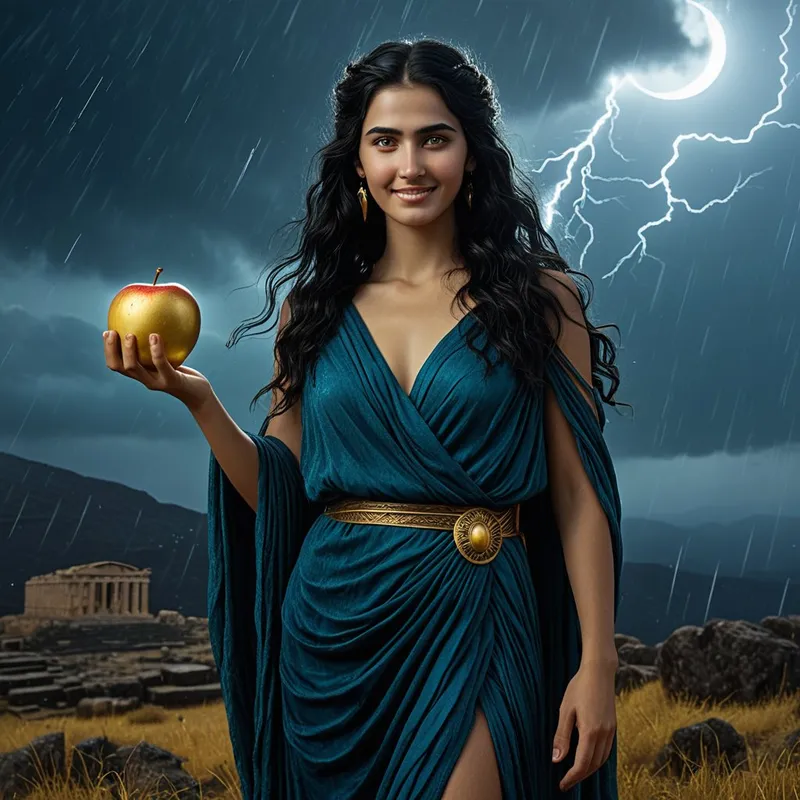
The goddess of discord, uninvited to a wedding, tosses a golden apple inscribed 'for the fairest,' igniting a divine feud that leads to the Trojan War.
The Tale of Eris
The air on Olympus was thick with the scent of nectar and the sound of immortal laughter. A wedding feast was in full, glorious swing. The halls gleamed, the music soared, and every god and goddess of note had come to celebrate the union of Thetis and Peleus. All were there—all but one.
She stood beyond the shimmering threshold, a figure of storm and silence. Eris. Her name was a whisper on the wind that dared not enter the hall. She, the sister of Ares, the daughter of Night, was purposefully, pointedly, not invited. The hosts feared her gift, the one she brought to every gathering: the seed of chaos, the ferment of quarrel. To exclude her was to believe one could exclude the very principle of disruption itself.
A cold fire ignited in her eyes. If they would not welcome her presence, they would know her power by its absence, made manifest. From the folds of her dark robe, she drew forth not a weapon of iron, but one of gold. An apple, perfect and irresistible, plucked from the gardens of the Hesperides. With a finger that could trace the lines of fate, she inscribed upon its skin a single, devastating phrase: ΤΗΙ ΚΑΛΛΙΣΤΗΙ—For the Fairest.
With the grace of a falling star and the malice of a poised serpent, she let the apple roll. It crossed the threshold, a sphere of molten sunlight, tumbling across the polished floor until it came to rest at the feet of the most powerful beings in creation.
The music died. The laughter froze. All eyes fell upon the golden prize and its terrible dedication. Three goddesses, their vanity a divine force, stepped forward as one: Hera, radiant in majesty; Athena, gleaming with fierce intelligence; and Aphrodite, whose very presence was a physical enchantment. Each claimed the apple. Each demanded the title.
A quarrel that began as a whisper rose to a thunder that shook the halls of heaven. No god, not even Zeus himself, dared to judge between his wife, his daughter, and the power of love itself. So the poison was passed. The solution, he decreed, lay in the mortal world. The apple, and the goddesses, would be taken to Paris, a shepherd-prince on the slopes of Mount Ida, to make the fateful choice.
There, in a sun-drenched grove, the three immortals stood before the mortal youth, each offering a bribe for his favor. Hera promised imperial power over all nations. Athena offered wisdom and victory in every battle. Aphrodite, with a smile that promised everything and nothing, pledged the love of the most beautiful woman in the world: Helen.
Paris, swayed not by empire or wisdom but by desire, handed the apple to Aphrodite. In that moment, the seed Eris had planted broke open. The goddesses who were spurned nursed a wrath that would fuel a thousand ships. The promise of love became a theft that would burn a city to the ground. The golden apple was no longer a fruit, but a spark. And from that spark, the fires of Troy would rise, consuming heroes and nations alike. All because one goddess, the uninvited, had been left at the door.

Cultural Origins & Context
The myth of Eris and the Apple of Discord is primarily preserved for us in the epic cycle poems that surrounded the story of the Trojan War, most notably in the Cypria, a now-lost work that served as a prelude to Homer’s Iliad. It functioned as the essential etiological myth—the “how it began”—for the greatest conflict in Greek legendary history. This was not a bedtime story for gentle comfort; it was a foundational narrative about the origins of catastrophic war, recited by bards to explain the inexplicable: how vast, civilization-altering conflict can spring from a seemingly petty slight.
In the highly social and honor-based world of ancient Greece, the act of exclusion from a feast was a profound insult, a rupture in the social fabric. Eris’s myth gave a divine face to the terrifying reality that a single social rupture, a single moment of disrespect or overlooked obligation, could unravel the world. It served as a cautionary tale about the necessity of ritual inclusion and the dangerous folly of believing any aspect of reality—especially the disruptive—could be safely ignored. The poets who told this story were not just entertainers; they were cultural psychologists, mapping the volatile forces that governed human (and divine) relations.
Symbolic Architecture
Eris is the embodiment of the Shadow principle invited to consciousness. She is not “evil” in a simplistic sense, but the necessary force of discord, strife, and differentiation. Without her, there is only stagnant harmony, a false unity that suppresses necessary tensions.
The uninvited guest is the truth the party cannot bear to hear. The golden apple is the question the system is built to avoid.
The apple itself is a perfect symbol of temptation and latent consequence. Golden, it represents a highest value (“the fairest”), but its inscription immediately fractures that unity into competing claims. It is the catalyst that forces hidden rivalries, unacknowledged vanities, and repressed conflicts into the open. The three goddesses represent fundamental human drives: Power (Hera), Wisdom (Athena), and Desire (Aphrodite). Paris’s choice is not between good and evil, but between competing value systems, revealing that our deepest choices are often not logical, but libidinal, rooted in our core desires.
The myth’s terrible beauty lies in its demonstration that from the seed of chaos (Eris’s wrath) comes differentiation (the goddesses’ quarrel), choice (Paris’s judgment), and ultimately, a world-altering narrative (the Trojan War). Discord is the mother of narrative, of history, of consequence.
The Dreamer's Resonance
When the pattern of Eris manifests in modern dreams, it rarely appears as a goddess in classical garb. Instead, the dreamer may experience being cruelly excluded from a crucial meeting or family event. They may discover a mysterious, compelling object—a phone, a letter, a key—that disrupts a serene dreamscape. They may find themselves in the role of Paris, forced to make an impossible choice between three bad options, each offered by a powerful, archetypal figure.
Somatically, this dream process often accompanies a feeling of intense social anxiety, a simmering resentment, or the nervous energy of a conflict one is trying to avoid. Psychologically, it signals that a repressed element of the dreamer’s psyche—their own capacity for healthful strife, their justified anger, or a talent they’ve been sidelining—is demanding recognition. The dream is the uninvited guest itself, tossing the golden apple of awareness into the conscious mind’s banquet, forcing a confrontation with whatever “fairest” ideal or hidden competition is governing—and poisoning—their life.

Alchemical Translation
The alchemical journey modeled by Eris’s myth is not one of conquering a monster, but of consciously integrating the principle of chaos. The first stage is nigredo, the blackening: the recognition of the excluded, shadowy element (Eris at the door). The conscious ego’s attempt to maintain perfect, conflict-free order (the wedding) is the illusion that must be dissolved.
Individuation begins not with a call to adventure, but with an insult that wakes you from a collective slumber.
The throwing of the apple is the separatio, the necessary act of differentiation that breaks apart a complacent unity. The quarrel of the goddesses represents the albedo, the whitening, where the once-hidden components of the self (drives for power, wisdom, love) are clarified and seen in their full, conflicting glory. Paris’s choice is the crucial, often painful, act of commitment (rubedo, the reddening) where one value-system is consciously chosen over others, accepting the consequences.
For the modern individual, the “alchemical gold” forged in this process is not a life without conflict, but a life where conflict is recognized as a creative, differentiating force. It is the ability to invite one’s own “Eris” to the table—to acknowledge one’s disruptive thoughts, competitive instincts, and righteous anger—not to let them destroy from the shadows, but to allow them to catalyze the difficult choices that lead to authentic, rather than appeasing, existence. One learns that the apple of discord, when consciously held and examined, can become the apple of knowledge.
Associated Symbols
Explore related symbols from the CaleaDream lexicon: