
Epiphany Myth Meaning & Symbolism
The moment a god reveals their true form to a mortal, a shattering and sacred encounter that forever alters the boundary between the human and the divine.
The Tale of Epiphany
The air in the high mountain meadow was still, thick with the scent of thyme and the distant salt of the sea. A shepherd, his name lost to the wind, leaned on his staff, watching his flock drift like clouds across the green slope. The sun was a tyrant, and the world hummed with a drowsy, earthly peace. He was a man of calloused hands and simple thoughts, his world bounded by the stone fold and the weather.
A traveler appeared on the path, a man of unremarkable feature, cloaked in the dust of the road. He asked for water, and the shepherd, with the unthinking hospitality of the wild places, shared his skin. They spoke of the lean wolves in the valleys and the price of wool in the city below. The traveler’s eyes, however, held a peculiar depth, a stillness that seemed to drink in the light rather than reflect it. He spoke of music that could heal wounds and poetry that could chart the paths of stars—whimsies to the shepherd’s ear.
As the sun began its descent, painting the sky in hues of fire and wine, the traveler asked, “Do you know to whom you speak?” The shepherd laughed, a short, rough sound. “A weary poet, perhaps. Or a city man gone wandering.”
“Look,” said the traveler, and his voice was no longer a single voice. It was the sound of the lyre’s first string being plucked, the whisper of the laurel leaves, the clear note of a spring breaking from rock. The shepherd’s laughter died in his throat.
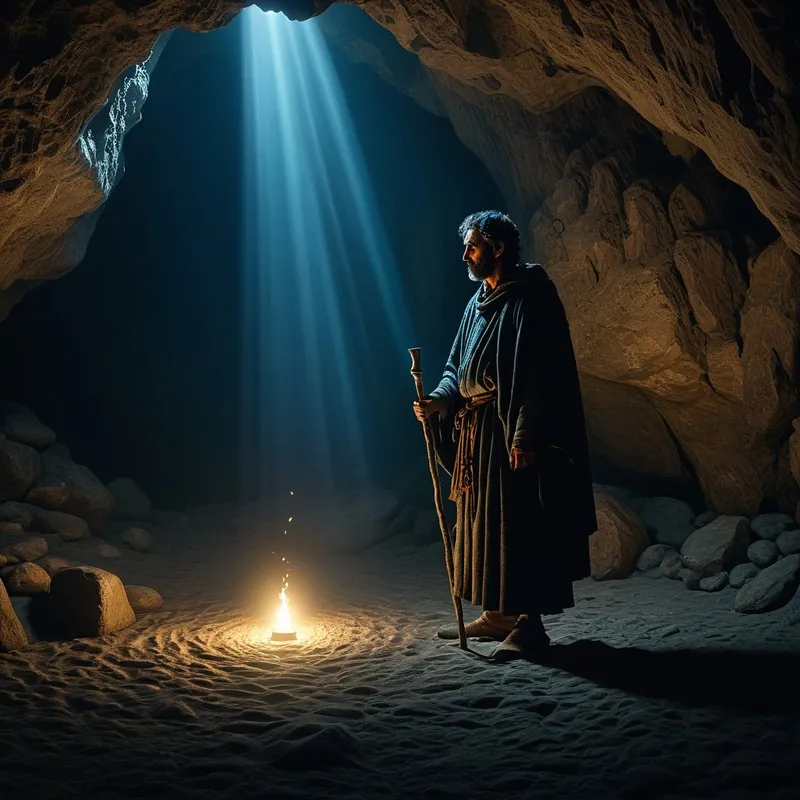
The air around the traveler began to shimmer. Not with heat, but with a light that came from within. The dusty cloak dissolved into motes of gold. The man’s form expanded, not in size, but in presence. Where a mortal stood, there was now a column of terrifying, beautiful radiance. The shepherd’s eyes burned, yet he could not look away. He saw the unblinking sun, the truth of prophecy, the unbearable clarity of reason made flesh. It was Apollo in his epiphany, the god who had walked beside him in disguise, now pulling aside the veil of mere appearance.
The shepherd fell to his knees, not in worship, but in a primal reflex of the soul confronted with the Absolute. The grass beneath him crisped and smoked. The very air vibrated with a silent, piercing music that seared his mind. He hid his face in his hands, but the light was inside him now, scouring his simple thoughts, filling him with a knowledge he could not contain—a vision of the intricate, divine machinery of the world, beautiful and merciless. The god spoke, and the words were not sounds but truths etched directly upon his spirit. Then, as suddenly as it had come, the presence was gone.
The meadow was just a meadow again, twilight gathering in the hollows. But the shepherd was no longer a shepherd. He was a man who had seen. His eyes, forever after, held a distant, wounded light. He would build an altar on that spot, a pile of uncut stones, and the story he would tell—when he could speak of it at all—was not of a conversation with a stranger, but of the day the sky tore open and divinity touched the earth.
Cultural Origins & Context
The concept of Epiphany (from the Greek epiphaneia, meaning “manifestation” or “striking appearance”) was not a single, codified myth but a pervasive religious experience woven into the fabric of ancient Greek spirituality. Unlike the grand, public narratives of the Titans or the Olympians, epiphany was intimate and terrifyingly personal. These stories were told not by epic poets alone, but by priests at local shrines, by travelers sharing wonders, and inscribed as grateful dedications on votive offerings: “To the god who appeared.”
Its societal function was dual. Firstly, it validated cult worship. The altar on the lonely hill, the strange rite in the grove—these were often explained by a foundational epiphany, a moment when a god chose that specific place and person for revelation. It grounded religion in experiential truth. Secondly, it rigorously defined the boundary between mortal and immortal. The epiphany was not a gentle merging but a shocking confrontation. The mortal was almost always overwhelmed—blinded, driven mad, or physically marked (like the shepherd’s scorched earth). This reinforced the fundamental Greek concept of hubris: to mistake oneself for, or demand equality with, the divine was the ultimate transgression. The epiphany was the god’s ultimate proof of that unbridgeable gap, even in a moment of connection.
Symbolic Architecture
At its core, the myth of Epiphany symbolizes the violent, irreversible intrusion of absolute reality into the comfortable world of appearances. The mortal life, with its mundane concerns and accepted truths, is the “disguise.” The god is the hidden, foundational pattern—the Logos—that undergirds all things.
The epiphany is not an answer to a prayer, but an answer to a question the mortal was too afraid to ask.
The shepherd represents the conscious ego, tending to its flock of daily thoughts and perceptions. The disguised god is the Self—the total, archetypal psyche—incognito, waiting for a moment of receptivity. The revelation itself is the shattering of the ego’s frame of reference. The “blinding light” is not punishment, but the sheer overload of meaning. One cannot “understand” an archetype with the everyday mind; one is reconfigured by it. The resultant “wound”—the shepherd’s altered perception—is the symbolic birth of consciousness itself. He can no longer see the world as a simple pasture; he now sees it as a field of divine forces. He has gained profound meaning but lost simple peace.

The Dreamer's Resonance
When this mythic pattern stirs in the modern unconscious, it often manifests in dreams not of kindly guides, but of overwhelming, awe-full encounters. A dreamer may dream of a familiar room suddenly filled with an incomprehensible, geometric light. A loved one’s face may shift and become an oracle speaking unbearable truths. There is a somatic signature here: the dreamer often reports waking with a racing heart, a sense of visceral terror mixed with sublime wonder, or the lingering feeling of having been “scoured clean.”
Psychologically, this signals a direct encounter with an autonomous complex or archetypal content too potent for the dream-ego to assimilate in a narrative form. The psyche is not presenting a problem to be solved, but a fact to be acknowledged. The dreamer is undergoing what James Hillman called “soul-making” at its most abrupt. The ego’s comfortable identity is being forcibly expanded or dismantled to make room for a larger psychic truth. It is the process of being claimed by a piece of one’s own depth, a call to vocation or self-knowledge so fundamental it feels alien and divine.

Alchemical Translation
In the alchemy of individuation, the epiphany models the critical phase of illumination—not as a gentle dawning, but as the fulguratio, the lightning strike. The “lead” of the mundane personality is not patiently heated; it is shattered by a bolt of transcendent energy to reveal the latent “gold” within.
The modern individual’s journey often involves constructing a stable, adapted persona—the shepherd tending his flock. The alchemical work begins when this adaptation becomes a prison, when life feels meaninglessly routine. The disguised god is the neglected Self, which often first appears in projections—on a therapist, a spiritual teacher, or an obsession. The “epiphany” occurs when that projection violently collapses, and the energy is recognized as one’s own. This is the terrifying moment of solutio: the dissolution of the old ego-structure.
The goal is not to become the sun, but to learn to bear its reflection within the vessel of a human life.
The transformation is not about acquiring the god’s power, but about integrating the knowledge of the god’s perspective. The shepherd does not become Apollo. He becomes a man who has seen Apollo, and must now live in a world where the sun is both a life-giver and a force that can blind. His task is to build his “altar”—a new, conscious structure of life (a creative practice, a philosophical stance, a deepened relationship) that can honor and contain the revelation without being destroyed by it. He transmutes the shock of the absolute into a lasting, human wisdom. The epiphany ends; the individuation, forged in its light, begins.
Associated Symbols
Explore related symbols from the CaleaDream lexicon: