
Epimetheus Myth Meaning & Symbolism
The Titan who accepted the first woman, Pandora, and her jar, unleashing suffering but also hope into the world through unconsidered action.
The Tale of Epimetheus
Listen. Before the reign of the Olympians, in the age of the primal Titans, there were two brothers, sons of the cunning Iapetus. One was Prometheus, whose mind raced ahead like a spark before the flame. The other was Epimetheus, whose understanding came only in the wake of the deed, like an echo returning from a distant cliff.
When the new gods of Olympus commanded the shaping of mortal creatures, the task fell to these brothers. Prometheus, the foreseer, fashioned humanity from clay and water, breathing into them a divine spark stolen from the sun-chariot of Helios. But to Epimetheus was given the distribution of gifts to all the beasts of the earth. With a generous and unthinking heart, he strode across the newborn world. To the lion, he gave claws and courage; to the deer, swiftness and grace; to the eagle, wings and piercing sight. He poured out the treasures of strength and hide, tooth and talon, until the bag of gifts was empty, and he stood before the naked, shivering form of humankind, who had received nothing.
This was the first forgetting. The first consequence.
Later, when Prometheus defied Zeus to bring fire to humanity, the Lord of Thunder’s wrath was terrible. But his vengeance was cunning. He commanded Hephaestus to mix earth and water and fashion a being of breathtaking beauty—the first woman. Aphrodite gave her grace and desire. Athena clothed her in a shimmering gown. Hermes placed in her heart a lying, thieving nature and a persuasive voice. They named her Pandora, "All-Gift." And into her hands they placed a great jar—a pithos—sealed tightly, containing all the spirits of toil, sickness, sorrow, and evil that would plague mankind.
Zeus sent this "gift" to Epimetheus. Prometheus, ever the forethinker, had warned his brother: "Accept no gift from Olympus." But Epimetheus, the afterthinker, beheld Pandora. He saw not the trap, but the dazzling offering. He felt not suspicion, but wonder. His heart, still aching from his earlier failure to provide for humanity, now swelled at this chance to receive a boon. He welcomed her. He took the sealed jar into his home.
And then, driven by the divine trickery within her, Pandora lifted the heavy lid. In a shrieking, whispering torrent, the contents escaped—Grief, Malice, Plague, Despair—flying out into the wide world to take up residence in the hearts of mortals forever. In terror, she slammed the lid back down, trapping the final spirit inside: Elpis, Hope.
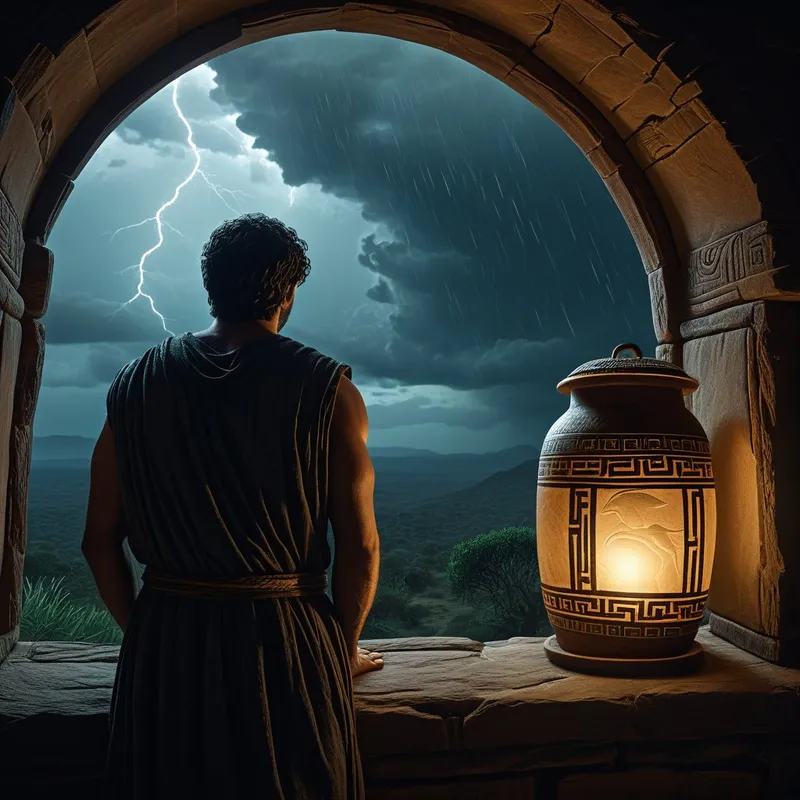
Epimetheus stood in the silent aftermath, the empty jar a monument in his home. The deed was done. The world was changed. Only then, in the long, cold shadow of the consequence, did understanding flood his being. He was the receiver, the one who opened the door. His name became his fate.
Cultural Origins & Context
The myth of Epimetheus is woven into the foundational tapestry of Greek cosmology, primarily preserved in the didactic poetry of Hesiod’s Works and Days and Theogony. Hesiod, a Boeotian farmer writing in the 8th or 7th century BCE, used these myths not as mere entertainment but as theological and ethical instruction. The tale was part of an oral tradition explaining the origin of human suffering (ponos) and the precarious nature of existence.
In the Greek worldview, this myth served a critical societal function: it explained the human condition as one of inherent lack and subsequent burden. We are the creatures for whom Epimetheus forgot to save a gift, making us dependent on wit (Prometheus’s fire) and vulnerable to divine whim. The story codified a profound cultural pessimism mixed with resilience. Evil is not a moral fall but a structural reality of the world, released by a chain of events involving divine punishment, brotherly failure, and fatal curiosity. It was told to remind listeners of the Olympian order’s power, the importance of heeding wise counsel (Prometheus’s warning), and the inescapable reality that actions have irreversible, world-altering consequences.
Symbolic Architecture
Epimetheus is the archetype of the unreflective impulse, the embodiment of Hindsight. He is not evil, but profoundly limited. His function in the psychic drama is to complete the action that forethought alone cannot. Prometheus can plan and steal fire, but it is Epimetheus who must ground the divine drama in the mortal realm by accepting Pandora. He represents the necessary, often painful, moment of enactment where thought becomes deed and consequence is born.
He is the part of the psyche that must live out the error to gain the wisdom. Without Epimetheus, Prometheus’s foresight remains abstract, unrealized. The shadow must be made flesh.
His "forgetting" to save a gift for humanity symbolizes our innate, biological disadvantage—our lack of instinctual certainty. We are born "unfinished," forcing us to rely on culture, technology (fire), and troubled consciousness. Pandora is not merely a "temptress" but the irresistible complex—a beautiful, divinely crafted package that contains both fascination and catastrophe. She is the projected ideal that carries the shadow within it. The jar (pithos) is the vessel of the unconscious itself, holding all latent potentials, both destructive and salvific. The trapping of Elpis inside is the most ambiguous and profound symbol: is Hope a merciful comfort, or the final, cruel evil—the capacity for delusion that keeps us striving in a painful world?

The Dreamer's Resonance
When the Epimethean pattern stirs in the modern unconscious, it often manifests in dreams of profound regret or shocking realization after the fact. The dreamer may replay a scene where they sign a contract, open a door, or accept a gift, only to watch in horror as the environment decays, or a hidden poison spreads. The somatic feeling is one of visceral sinking, a cold weight in the gut—the body recognizing a consequence before the mind can articulate it.
This is not the dream of the active hero, but of the receptive witness to their own life. The dream-ego is passive, swept along by events, often charmed or distracted by something beautiful (a person, an opportunity, an idea) that obscures a foundational warning. The psychological process is one of assimilating the shadow of naivete. The dream forces a confrontation with the part of oneself that acts on impulse, trust, or desire without adequate reflection, and now must bear the emotional and psychological fallout. It marks the painful, but necessary, transition from innocence to experience, where one finally understands the cost of a choice that seemed harmless at the time.

Alchemical Translation
In the alchemy of individuation, the Epimetheus myth models the crucial stage of mortificatio—the blackening, the death of naivete. The psychic journey is not solely one of heroic striving (Prometheus) but must include the humble, devastating reception of one's own limitations and errors (Epimetheus). The "gift" we unthinkingly accept is often our own complex—a relationship pattern, a professional identity, a cherished belief—that arrives beautifully packaged but contains within it all our latent sufferings.
The alchemical vessel is shattered, and the escaping spirits are the contents of our own repressed shadow, now free to roam our inner world. This is not a failure, but the beginning of true work.
The process of transmutation requires this "Pandora's Jar" moment. We must open ourselves to the full spectrum of our human experience—the grief, malice, and sorrow—that we have sealed away. Only by allowing these spirits into consciousness can we work with them. And crucially, at the bottom, trapped under the lid, remains Elpis. In psychological terms, this is not blind optimism, but the transcendent function—the nascent, fragile potential for a new attitude that emerges only after the catastrophic confrontation with the shadow. It is the capacity to endure meaningfully, to find a new direction from the ruins of the old understanding. To integrate Epimetheus is to make peace with our hindsight, to forgive ourselves for what we did not see, and to recognize that our deepest wounds are also the vessels for our most authentic hope. We become, like him, the guardians of the empty jar that once held everything, now containing only the quiet, stubborn potential for what comes next.
Associated Symbols
Explore related symbols from the CaleaDream lexicon: