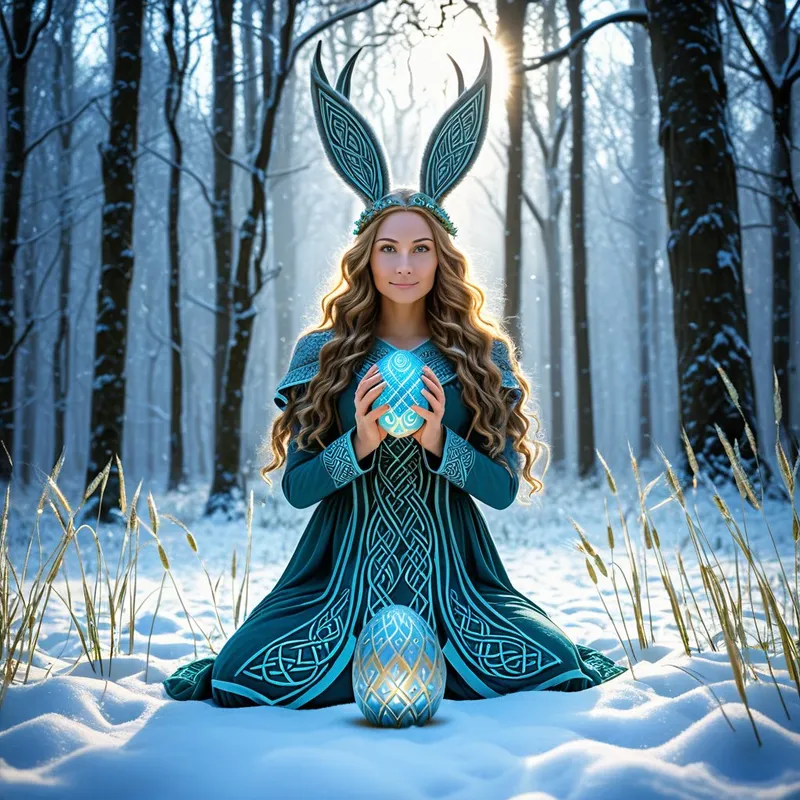
Eostre's Hare Myth Meaning & Symbolism
A goddess, wounded by winter's spear, is healed by a hare's ultimate sacrifice, birthing the egg of spring and the cycle of death and rebirth.
The Tale of Eostre's Hare
Listen. The world was held in the iron grip of the Cailleach. Her breath was the north wind, her tears the sleet, her spear the frozen branch that pierced the heart of the land. All green things slept a death-like sleep beneath a blanket of endless white. But in a hidden grove, where the oldest oaks whispered secrets to the stones, there remained a single ember of warmth.
Her name was Eostre. She was the memory of dawn, the promise of the sun’s return. Yet, she lay wounded. The Cailleach’s icy spear had found her, and her life-force, the sap that should have quickened the trees, seeped into the frozen ground. Her light grew dim, a guttering candle in the vast, cold hall of winter.
The creatures of the grove mourned. The badger in its sett, the fox in its den, the birds who had forgotten their songs—all felt the fading pulse. But one creature watched with eyes that held no fear, only a deep, abiding knowing. It was the Hare. Not a simple animal of the field, but an ancient one, whose long ears heard the turning of the stars and whose swift feet traced the ley lines of the world.
The Hare approached the slumbering goddess. It saw the pallor on her skin, like frost on a rose, and the terrible stillness where there should have been a vibrant hum. It nuzzled her cold hand, and in that touch, it understood the choice. The land could not wake without her. The great wheel of the year was stuck.
Without a sound, the Hare turned and bounded to the center of the grove. It raised its face to the sliver of a cold moon and began a dance. It was a dance of impossible speed and grace, a spiral etched upon the snow, a prayer written with paws. Faster and faster it spun, a blur of brown and white, until its very form began to dissolve, its earthly life burning away in a final, concentrated act of will.
From the center of that sacred spiral, where the Hare’s essence pooled like molten silver, a new form coalesced. Not the Hare, but what the Hare had always carried in its secret heart: a single, perfect Egg. It was no ordinary egg. Its shell was the color of the first twilight, patterned with symbols of budding life and spiraling galaxies. Within it pulsed a golden, radiant light—the concentrated life-force of the Hare, given freely.
The Egg rolled to rest at Eostre’s side. Its warmth touched her wound. The light seeped through the shell, through her skin, and into her heart. A gasp, a shudder, and Eostre’s eyes opened—eyes that were now the clear blue of a spring sky. Color returned to her cheeks. She sat up, and as she did, she beheld the Egg. She understood the sacrifice. With infinite tenderness, she cradled it.
And then, she let it fall. It struck the hard, frozen earth. A crack rang out like the first thunder. From the shattered shell erupted not a chick, but a torrent of living light. It washed over the grove. Snow melted into rivulets. Frost retreated from leaf and branch. Buds swelled on the oak, and the first, brave snowdrop pushed through the black soil. The wheel turned. Spring was born from a Hare’s gift, carried in the shell of its own end.
Cultural Origins & Context
The figure of Eostre is a complex tapestry woven from threads of Germanic and potentially older, pan-European tradition, later embraced and adapted within the cultural milieu of the Insular Celts, particularly in Britain. Our primary source is the Venerable Bede, an 8th-century monk, who noted that the Anglo-Saxon month of Ēosturmōnaþ (April) was named for a goddess Eostre, whose festivities celebrated the renewal of spring. While Bede was not documenting Celtic practice per se, the myth’s themes are profoundly resonant with Celtic cosmological principles, leading to its deep adoption and retelling in Celtic folk tradition.
The story was not preserved in grand epics but in the oral lore of the countryside, told by firesides as the last of winter’s peat burned low. It was a seanchai’s tale, a teaching story for the community. Its societal function was twofold: first, to explain and sanctify the observable, terrifying death and glorious rebirth of the natural world each year; second, to encode a fundamental ethical and spiritual principle—that true renewal is never free, but is purchased through a sacred exchange. The hare, an animal revered and often considered taboo to hunt due to its perceived otherworldliness, was the perfect vessel for this lesson of self-offering.
Symbolic Architecture
At its core, the myth is an alchemical drama of the psyche and the cosmos. Eostre represents the anima mundi, the world soul, or the conscious principle of life and growth. Her wounding is the inevitable descent, the winter of the spirit, the depression or stagnation that follows periods of creativity and expansion.
The Hare is the instinctual, sacrificial self—the part of the psyche that acts not from ego, but from a deep, archetypal imperative to serve the whole.
The Hare is a classic psychopomp, a guide between states of being. Its famous fertility is secondary to its deeper role as the sacrificial vessel. It does not fight the winter king; it performs a ritual of transformation upon itself. The dance is the act of concentrating one’s entire being into a single, purposeful intent. The Egg is the prima materia, the philosopher’s stone of this brief, intense process. It contains the potential for the new world, but that potential is locked within the form of an ending.
The cracking of the Egg is the critical moment of enantiodromia—the emergence of the opposite from within a condition. Life from death, light from darkness, spring from winter. It is not a battle won, but a transformation completed through a willing surrender.
The Dreamer's Resonance
When this myth stirs in the modern dreamer, it often surfaces during periods of profound transition, burnout, or healing. To dream of a wounded or sleeping luminous figure signifies a feeling that one’s vital energy, one’s core identity or creativity (the inner Eostre), is incapacitated.
The appearance of the Hare, especially if it is watching you intently or begins a strange, compelling movement, is the psyche’s signal that an instinctual solution is presenting itself. This is not a solution of the rational mind. The somatic experience might be one of restless energy, a feeling of being “called” to make a change that feels illogical yet deeply right. The Hare’s sacrifice in the dream may manifest as the dreamer willingly giving up a long-held identity, a secure but soul-deadening job, or a defensive behavior. There is often a feeling of anxiety mixed with profound relief—the terror and necessity of the dance.
Dreaming of the Egg, particularly of holding it or seeing it crack, indicates the dreamer is in the nascent, vulnerable stage of this rebirth. The new life is present but not yet fully formed; it requires protection and a willingness to let the old “shell” break apart.
Alchemical Translation
For the individual navigating the path of individuation, the myth of Eostre’s Hare is a master map for the process of psychic transmutation. Our personal winters—depression, loss, stagnation—are not failures, but the necessary freezing point where the Cailleach’s spear finds us. The ego, identified with the vibrant goddess of summer, is wounded. The conscious attitude can go no further.
The alchemical work begins when we stop trying to heal the wound with the same energy that was wounded, and instead turn to the instinctual, “animal” soul—the Hare.
This is the move from thinking to doing, but a doing that is ritualistic and symbolic. It is the sacrifice of the ego’ attachment to its former, un-wounded state. The “dance” is any sustained, devoted practice that consumes our old form: journaling until a truth is revealed, the disciplined practice of art or meditation, the act of therapy where we circle around the core wound again and again. We dance until our old identity is spent.
What is born is the Egg—the new, nascent Self, fragile and full of potential. This is the caelum, the sacred vessel of the reborn personality. The goddess, our awakening consciousness, must then perform the final act: she must let it fall. She must incarnate it. This is the application of the insight, the living out of the transformation in the hard, earthly reality of daily life. The crack is the sound of the new consciousness breaking into the world. The light that floods out is not just renewed energy, but energy that has been transmuted through the mystery of sacrifice. One does not simply recover from the winter; one becomes the spring itself, carrying within the memory and meaning of the Hare’s gift.
Associated Symbols
Explore related symbols from the CaleaDream lexicon: