
Eos Myth Meaning & Symbolism
The goddess of dawn, eternally rising, eternally grieving for her mortal lovers, embodying the bittersweet cycle of renewal and loss.
The Tale of Eos
Before the sun’s chariot scorches the earth, in that sacred, silent hinge of the world, she arrives. The sky holds its breath, a deep and endless indigo. Then, a whisper of rose at the farthest edge of the sea. It is not a sound, but a feeling—a parting of the velvet dark. Her fingers, tinged with the light of unborn day, stroke the horizon. They are the rosy fingers of Eos.
Daughter of the Titans Hyperion and Theia, sister to Helios and Selene, she is the herald, the opener of the gates of heaven. Each morning, she rises from her couch beside Oceanus, dons her shimmering saffron robes, and harnesses her swift horses, Lampus and Phaethon. Her chariot is a vessel of light, and as she drives it across the dome of the sky, the stars flee before her like scattered pearls, and the dark cloak of Nyx is gently folded away.
But Eos’s heart, for all its luminous power, is a mortal heart. It is prone to a passion that the eternal gods find baffling. She is drawn to the beautiful, fleeting sons of men, to the very mortality that defines them. She loved the hunter Orion, until the jealousy of the gods intervened. She carried off the noble Cephalus, though his heart remained with his mortal wife. But her great, tragic love was for Tithonus.
She found him, a prince of Troy, radiant with youth. Smitten, she stole him away to the ends of the earth, to Ethiopia. She could not bear the thought of his beauty turning to dust, of his light being extinguished. So, she went to Zeus and begged a boon: grant Tithonus eternal life. The Father of Gods granted it. But Eos, in her desperate love, had forgotten to ask for the one thing that makes life a gift: eternal youth.
For a time, they lived in bliss. But the years, which could not kill him, began to work their slow, cruel magic. Tithonus grew gray, then frail. His strength withered, his voice became a thin rasp. He shrank in upon himself, a prisoner of an unending decay. The goddess who loved him could only watch, her dawn-light falling on a living monument to her own mistake. In the end, he could only babble endlessly, a wizened, immobile thing. Some say she locked him in a chamber, out of pity and sorrow. Others say she transformed him into a cicada, a creature whose endless, dry chirping echoes his lost voice, shedding its brittle skin in a mockery of renewal.
And so, Eos rises. Every morning, she opens the gates of day, her cheeks often wet with tears—amber tears that fall to earth as the morning dew. She brings light, but she carries grief. She is the promise of a new beginning, forever stained by the memory of an ending that would not end.

Cultural Origins & Context
The myth of Eos is ancient, predating the Olympian order and reaching back into the Proto-Indo-European poetic tradition. She is a direct cognate of the Roman Aurora, the Vedic Ushas, and the Lithuanian Aušrinė. This makes her not merely a Greek deity, but a fundamental archetype of human observation: the daily victory of light over darkness.
In Greek culture, she was a fixture of epic poetry. Homer’s famous epithet “rosy-fingered Dawn” ritualizes her appearance, marking the passage of narrative time. Her stories were not the center of state cults but lived in the lyrical space of poetry and vase painting. Bards used her to frame the day’s actions, and her tragic love affairs served as a poignant counterpoint to the deeds of heroes. She was a reminder that even the divine forces that order the cosmos are subject to the profound, destabilizing power of eros—desire—and its attendant suffering. Her function was atmospheric and philosophical: to embody the bittersweet, cyclical nature of time itself, where every beginning implies an ending, and every hope carries the seed of potential loss.
Symbolic Architecture
Eos is not just the dawn; she is the moment of dawn. She is the threshold, the liminal space between the unconscious (night) and consciousness (day). Her symbolism is a profound study in paradox.
She is the goddess of renewal who cannot renew what she loves most. Her light reveals the world, yet her greatest action is born of a desire to hide from time’s revelation.
Her love for mortals symbolizes the soul’s attraction to the temporal, the beautiful, the real in its most fleeting form. The gods are eternal but static; mortals burn brightly and die. Eos is caught between these two states, embodying the eternal recurrence of a moment (dawn) that is itself defined by change. Her tragedy with Tithonus is the ultimate psychological parable of incomplete transformation. She secured life (existence) but forgot vitality (essence). It is the danger of wanting to possess a beautiful moment forever, which only succeeds in grotesquely prolonging its dying.
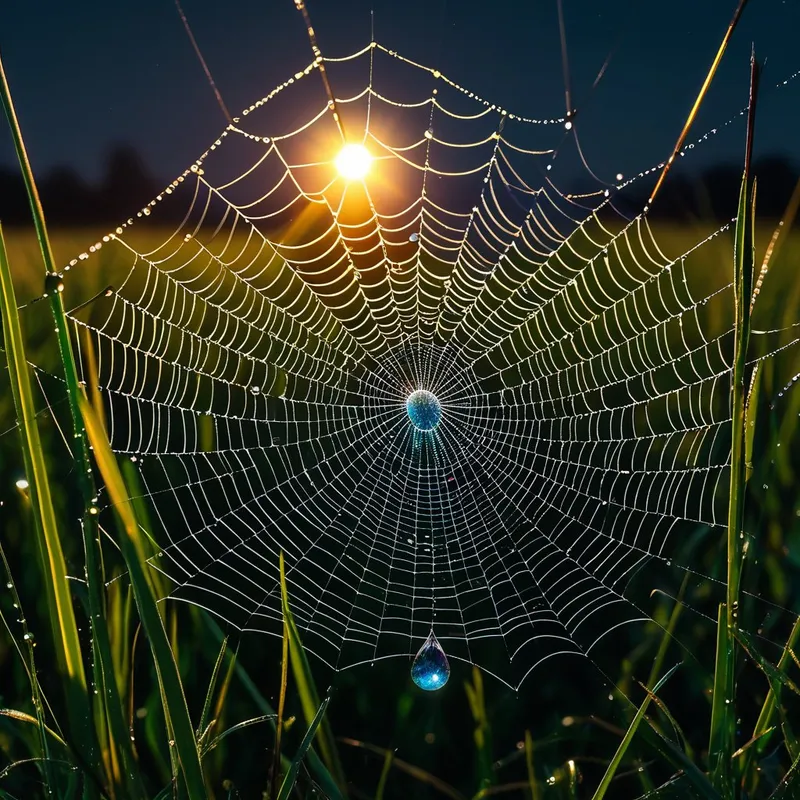
The dew, her tears, is a key symbol. It is ephemeral, evaporating with the very sun she heralds. It nourishes life briefly but cannot sustain it. It reflects the world perfectly for a moment, then is gone. This is the essence of her gift and her grief: transient beauty, momentary refreshment, a daily baptism of the world that cannot wash away the fundamental conditions of existence.
The Dreamer's Resonance
To dream of Eos is to dream of thresholds. It may manifest as standing before a door washed in pale pink light, or watching the sky lighten with a mixture of intense hope and deep sorrow. The somatic feeling is one of suspension—a held breath, a heart both lifting and aching.
Psychologically, this dream pattern emerges when one is in a prolonged state of becoming without arriving. It is the feeling of perpetual potential that never quite incarnates. You may be on the verge of a new chapter—a relationship, a career, a creative project—but are paralyzed by the fear that, like Tithonus, it will become a prison instead of a liberation. The dreamer is wrestling with the cost of desire. The tears in the dream are not just sadness; they are the necessary moisture of feeling, the acknowledgment of loss that must accompany any genuine new beginning. To dream of her chariot stalled, or her light unable to disperse the mist, points to a blockage in this transitional energy, a refusal to accept the bittersweet terms of change.
Alchemical Translation
The alchemical journey modeled by Eos is the solutio—the dissolution in the waters of feeling, followed by the coagulatio—the forming of a new, conscious stance from that dissolution. Her myth maps the individuation process of integrating the longing, romantic, life-affirming but tragically inclined anima (or the related animus drive for connection).
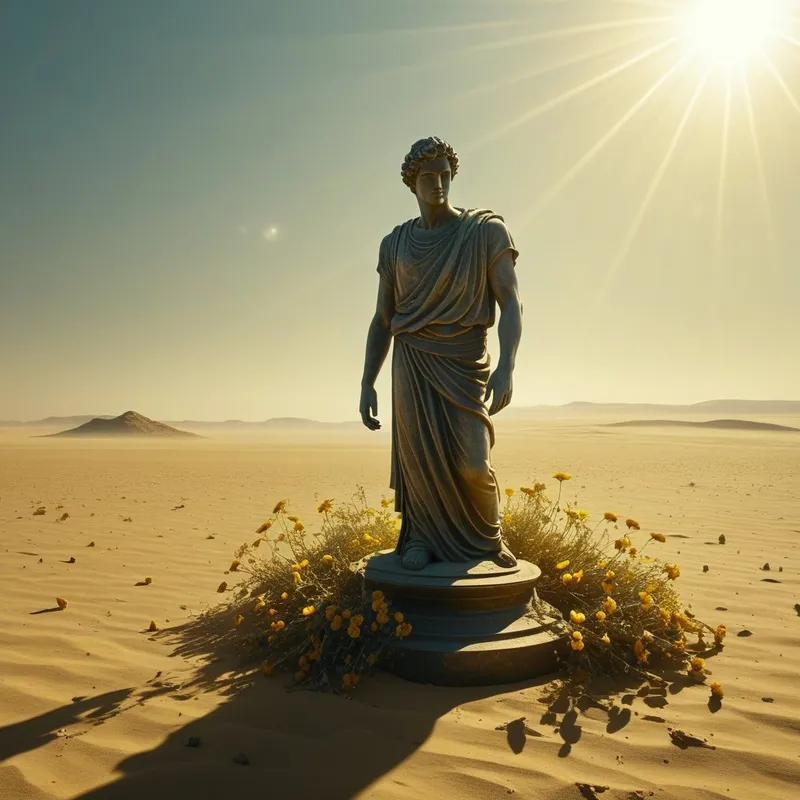
The first, flawed operation is to beg for eternal life for the beloved object (the complex, the relationship, the youthful state of the Self). The true, alchemical operation is to love the dawn itself—the process of awakening—and to consent to the dying of each day.
Eos’s ultimate triumph is not in defying time, but in her unwavering return. Her grief is not a failure; it is the proof of her full engagement with life. The modern individual undergoing this transmutation must move from the possession of love, youth, or a perfect state, to becoming a vessel for the process of loving, awakening, and renewing. The Tithonus complex—the thing we kept alive past its natural span—must be allowed to shrivel and transform. Its essence, like the cicada’s song, may remain as memory or insight, but its form must be released.
The gold to be found here is not in a happy ending, but in the daily courage to open the gates again. It is the psychological capacity to feel the profound sorrow of impermanence deeply, to let it water the soul like dew, and then, from that moistened ground, to will the light to rise once more. We become whole not by avoiding Eos’s tears, but by understanding that they are the very source of her, and our, renewing light.
Associated Symbols
Explore related symbols from the CaleaDream lexicon: