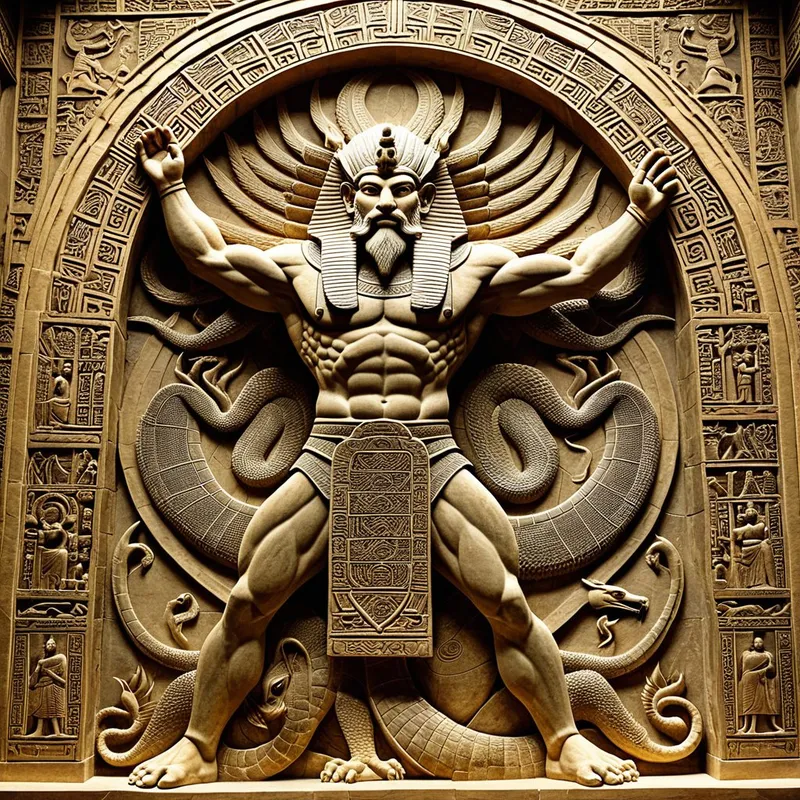
Enuma Elish Myth Meaning & Symbolism
The Babylonian creation epic where the god Marduk battles the primordial sea dragon Tiamat, creating the ordered world from her divided body.
The Tale of Enuma Elish
Listen, and hear the tale of the First Time, when above, the heavens had not been named, and below, the earth bore no name. There was only the mingled, formless waters of the beginning. From these waters, two beings emerged: the sweet, fresh waters of the male Apsu, and the salt, tumultuous waters of the female Tiamat. They lay together in the silent, timeless deep, and from their union, the first generations of gods were born.
These young gods were vibrant and noisy, their divine energy a crackling storm in the quiet womb of the abyss. Their laughter and motion churned the waters, and this disturbance became an agony to the primordial stillness of Apsu. He could find no rest. "Their ways are loathsome to me," he groaned to Tiamat. "By day I cannot rest, by night I cannot sleep. I will destroy them, that we may have quiet again!"
But Tiamat, the mother of all, roared in anger at this plot against her children. "Shall we destroy what we have made? Their ways are troublesome, but let us be patient." Yet Apsu would not be swayed. He and his vizier, Mummu, laid their plans. But the clever god Ea, the all-knowing, heard their whispered conspiracy. With a potent spell of sleep, he ensnared Apsu. He took Apsu’s divine aura, his splendor, and made it his own. From Apsu’s silent, sleeping form, Ea built his own sacred dwelling, the Apsû. And in this hall, in the heart of the conquered deep, Ea and his consort Damkina conceived a son. This son was a storm unto himself, born with four all-seeing eyes and four all-hearing ears. Fire blazed from his lips. They named him Marduk.
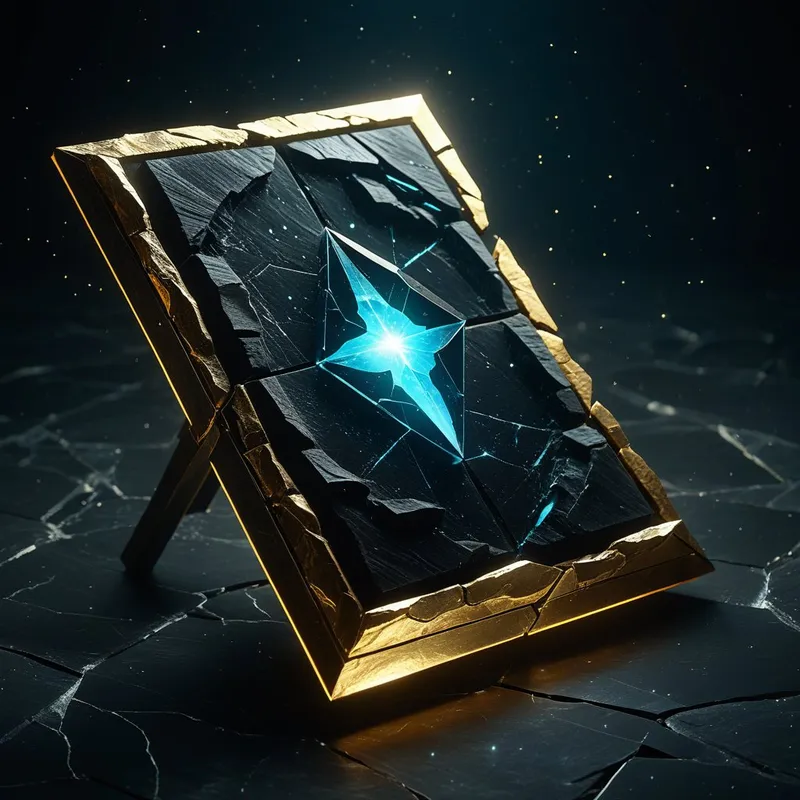
Meanwhile, a greater fury was stirring. Tiamat, grieving and enraged by the fate of Apsu and the unchecked clamor of the younger gods, resolved on a war of annihilation. She birthed a host of monstrous allies: venomous serpents with fangs dripping poison, fierce dragons clad in terrifying radiance, the Kusarikku, the Umu-dabrutu, and great raging lions. At the head of this terrible army, she placed her new consort, the god Kingu, and to him she gave the ultimate authority: the Tablets of Destiny, which command the fixed laws of all things.
Terror seized the assembly of gods. One by one, they went forth to face Tiamat’s wrath, and one by one, they turned back, paralyzed with fear. No one could withstand her roaring advance. In their despair, they turned to the young Marduk. "If we appoint you as our champion," they pleaded, "and you go and slay Tiamat, then you shall hold the supreme command. Your word shall be unchallengeable, your decree unalterable."
Marduk agreed, but on one condition: his sovereignty must be absolute and eternal. The gods gathered in a great feast. They set up a constellation in the sky, a test of his power. "Speak a word," they said, "and let the constellation vanish. Speak again, and let it reappear." Marduk spoke. The constellation was destroyed. He spoke again. The constellation was restored. A cry of joy went up. They clothed Marduk in a terrifying armor of divine radiance, placed a mighty bow and a net of storms in his hands, filled his body with a blazing flame, and set him upon his devastating chariot, drawn by four ferocious winds.
He advanced to meet the Mother of All. When Tiamat saw him, she lost her reason, screaming curses. They closed for battle. Marduk spread his net to ensnare her. When she opened her mouth to consume him, he drove the Evil Wind into her belly, distending her, holding her jaws agape. Then, he shot an arrow that pierced her heart and split her inward parts. He stood upon her carcass. With his merciless mace, he smashed her skull. He severed her arteries, and the north wind carried her blood to hidden places. Then, the creator-work began. He split her carcass like a shellfish. One half of her body he set up as the sky, a ceiling to hold back her waters. The other half he made the earth. From her eyes, he caused the Tigris and Euphrates to flow. He organized the cosmos: he established the stations for the great gods, defined the year, marked the months. From the defeated host, he took the ringleader, Kingu, and from his blood, mixed with clay, Ea fashioned humankind—to bear the burdens of the gods, so that the gods might be at leisure.
Finally, the gods built for Marduk, their king, a great city between the split halves of Tiamat: Babylon, "The Gate of the Gods." And there, in his temple Esagila, they sang his fifty names, each a power, each a decree, cementing the new, eternal order born from the body of the slain chaos.
Cultural Origins & Context
The Enuma Elish, meaning "When on High" from its opening words, is not merely a story but a liturgical and political cornerstone of ancient Babylon. Its earliest known copies date to the late second millennium BCE, though its roots likely stretch back into older Sumerian traditions. It was recited, and possibly enacted, during the grand Akitu festival, particularly on the fourth day. This was no simple entertainment; it was a ritual of cosmic and social renewal.
The myth served a profound dual function. Cosmologically, it explained the origin of the world from a state of watery chaos, establishing the divine hierarchy and the very structures of reality—time, seasons, celestial movements, and humanity’s place as servants to the divine order. Politically, it was a potent piece of theological propaganda. By elevating the city-god Marduk, previously a minor deity, to the position of king of all gods, the myth legitimized Babylon’s own rise to imperial supremacy in Mesopotamia. Marduk’s victory and subsequent creation of Babylon as the cosmic center (axis mundi) mirrored and sanctified the earthly power of the Babylonian king, who ruled as Marduk’s regent. The story was thus a living force, recited to reaffirm the stability of the cosmos and the state, binding the fate of the city to the primordial act of creation.
Symbolic Architecture
At its core, the Enuma Elish is a grand metaphor for the psychic process of bringing consciousness out of the unconscious. Tiamat is not "evil" in a moral sense; she is the primal, undifferentiated state—the womb of all potential, the chaotic matrix of being before the light of awareness strikes. She is the unconscious in its totality: creative, nourishing, but also terrifying and annihilating when approached without structure.
The birth of consciousness is an act of violence against the blissful unity of the unconscious. It requires a separation, a naming, a slaying of the formless Mother to build a world where "I" can stand.
Apsu represents the initial, fragile order that finds the emergent activity of psychic life (the young gods) to be an intolerable disturbance. His desire for silence is the ego’s first, naive wish to suppress the dynamic, often troubling contents of the deeper psyche. Ea, the god of wisdom and magic, represents a more sophisticated form of consciousness that can contain and structure these primal energies (building his dwelling on Apsu). But the ultimate confrontation is between the nascent, organizing principle of the Self (Marduk) and the full, regressive power of the unconscious (Tiamat) when it is threatened and mobilizes its terrifying, archaic contents (the monster army).
Marduk’s weapons are symbolic of the tools of consciousness: the net of relational understanding to contain, the winds of intellect and spirit to penetrate, and the arrow of focused will to differentiate. His division of Tiamat’s body is the fundamental act of discrimination—separating sky from earth, above from below, spirit from matter—that creates the internal space for a psyche to exist. Humanity, fashioned from the blood of the rebellious vizier Kingu, symbolizes the embodied ego, born from conflict and tasked with the labor of maintaining this hard-won conscious order.
The Dreamer's Resonance
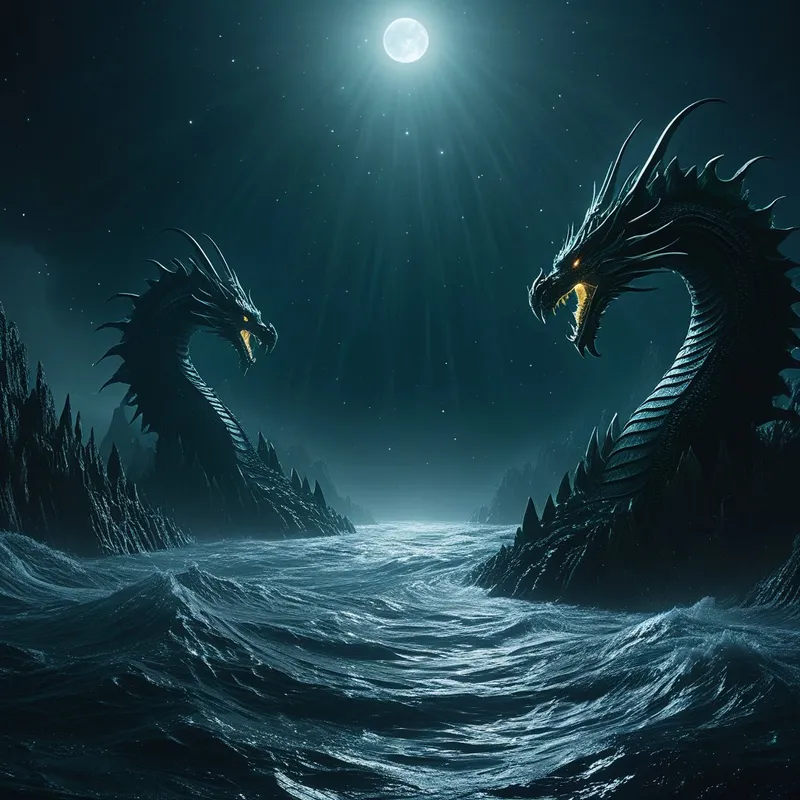
When the pattern of the Enuma Elish stirs in the modern dreamer, it signals a profound threshold in the psyche. It is not the stuff of small anxieties, but of existential re-creation. To dream of a vast, engulfing sea or a terrifying, multi-formed dragon is to feel the rising tide of the unconscious threatening to dissolve the familiar structures of one’s identity. This is Tiamat mobilizing. The dreamer may feel somatic sensations of drowning, of being crushed by immense weight, or of a chilling, formless dread.
Conversely, to dream of forging a weapon, receiving a mandate from a council, or facing a colossal beast is to feel the call of the inner Marduk—the nascent, central organizing principle of the Self. This is not the heroic ego seeking glory, but the psyche’s imperative to establish a new, more authentic order. The dreamer in this phase is undergoing a psychic civil war. The old, outmoded ways of being (the earlier, ineffective gods) are failing. A new center of authority, with the terrifying responsibility of ultimate choice and action, must be born and tested. The dream is the internal arena where this cosmic battle is fought, and its outcome determines whether the dreamer will be subsumed by chaos or will emerge with a more defined, sovereign, and resilient sense of self.

Alchemical Translation
The journey of the Enuma Elish is the alchemical opus of individuation mapped onto a cosmic scale. It begins in the massa confusa, the chaotic waters of the unio naturalis where all opposites are merged. The first separation (gods from the primordials) is the separatio, the initial stirring of distinction. The conflict and the forging of Marduk’s weapons represent the coagulatio—the effort to give solid, definite form to the spirit.
The ultimate goal is not the annihilation of the prima materia, but its sacred transformation into the vessel of the world. The dragon is not killed to be gone, but to become the architecture of the soul.
Marduk’s victory and his creative act are the supreme coniunctio oppositorum (union of opposites). He does not reject Tiamat; he integrates her. Her body becomes the very substance of the ordered cosmos. This is the alchemical stage where the defeated dragon’s body is transmuted into the Philosopher’s Stone. For the individual, this translates to the moment when overwhelming emotions, traumatic memories, or chaotic drives are not repressed or dissociated, but are consciously faced, "slain" in their monstrous, autonomous form, and then creatively re-assimilated.
The divided Tiamat becomes the stable ground (earth) and the inspiring expanse (sky) of the personality. The blood of the rebellion (Kingu) becomes the humble, serving ego, aware of its origin in conflict. The building of Babylon, the "Gate of the Gods," is the establishment of a conscious, functioning psyche where the transcendent (the gods) can communicate with the immanent (the human). The individual who undergoes this process achieves a kind of inner sovereignty. They do not rule a sterile kingdom of repression, but a vibrant, ordered world built upon and forever in dialogue with the vast, creative, and dangerous depths from which it was born. They hold their own Tablets of Destiny, authoring their fate from a place of integrated wholeness.
Associated Symbols
Explore related symbols from the CaleaDream lexicon: