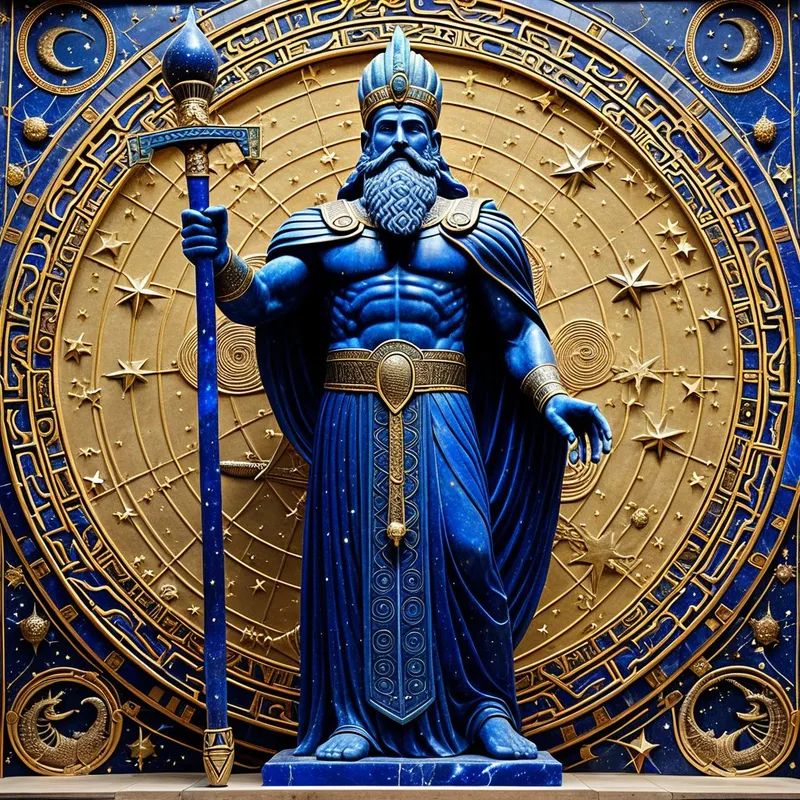
Enuma Anu Enlil Myth Meaning & Symbolism
A Babylonian celestial epic where the storm god Marduk battles primordial chaos, establishing cosmic order and the divine right of kings from the heavens.
The Tale of Enuma Anu Enlil
Listen. Before the naming of things, there was only the mingled, dark, sweet water—Apsu—and the salt, the roiling, tumultuous sea—Tiamat. They were one, a boundless, silent deep. And within their embrace, the first stirrings began. From their waters, Lahmu and Lahamu were silted into being. Then came Anshar and Kishar, and from them, the vault of the sky, Anu. The silence was broken by the rustling of generations, a divine family growing in power and noise within the very body of the primordials.
Their clamor was a torment to Apsu, who wished for the old quiet. He conspired with his vizier to destroy his own children, his own burgeoning creation. But the clever god Ea perceived the plot. He wove a powerful spell of sleep upon Apsu, and in that stillness, he slew the primordial father. Upon the quieted body of Apsu, Ea built his shining chamber, the Apsû. And there, with his consort Damkina, he begot a son of terrible radiance. Four were his eyes, four his ears; fire blazed from his lips when he spoke. This was Marduk, born already a king.
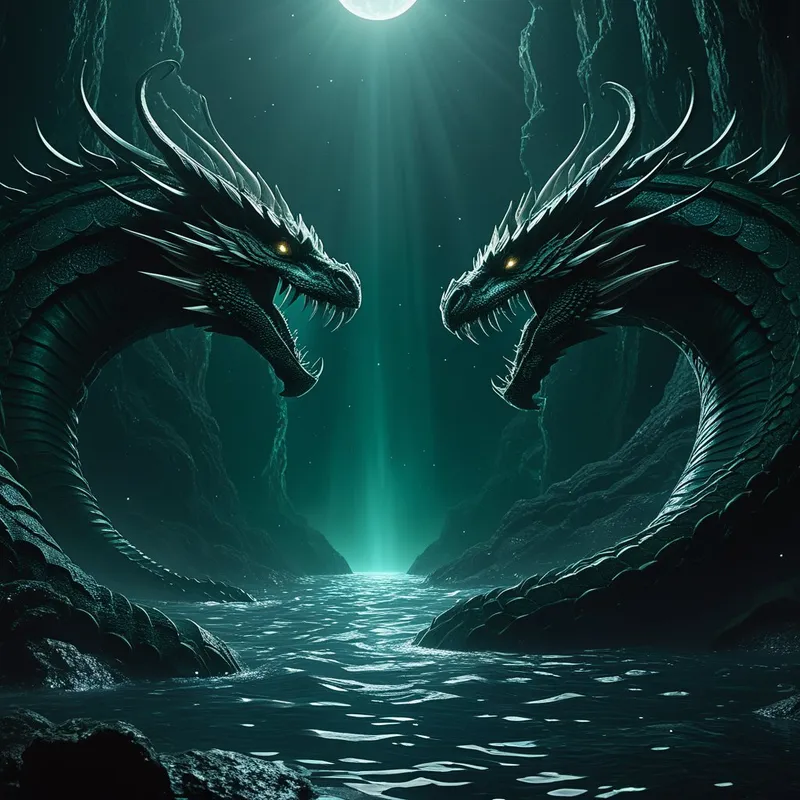
But a greater wrath was awakened. Tiamat, the salt-sea mother, roared in grief and fury at the murder of her consort. She raised a monstrous host: eleven kinds of terror, serpent-men, lion-demons, storm-scorpions. At their head, she placed her new champion, the fierce Kingu, and to him she gave the Tablet of Destinies. Chaos armed itself for war. The younger gods trembled. No one could face her rage.
Until Ea, and then Anu, returned defeated. Finally, the council of gods turned to the brilliant, young Marduk. He agreed to be their champion, but on one condition: "If I am to be your avenger, if I am to conquer Tiamat and save your lives, let my word, not yours, determine destinies. Let what I create remain unaltered. Let my command be irrevocable." In their terror, they agreed. They clothed him in terrifying armor, gave him a bow of lightning, a mace of hurricane, and a net to entrap the essence of chaos.
He rode forth on the storm-chariot of the four winds. He challenged Tiamat in the heart of the void. She roared, he unleashed the winds to fill her maw, distending her body. As she lay bloated and exposed, he shot the arrow of the storm down her throat, piercing her heart. He stood upon her carcass. He smashed her skull. He split her vast body like a clamshell. With one half, he arched the heavens; with the other, he founded the earth. He set the constellations in their places—The Seven Sisters, The True Shepherd of Anu—and decreed their movements and laws. He fashioned the seasons, the months, the days. From the blood of the defeated Kingu, he mixed clay and created humanity, to bear the labor of the gods so the gods could rest. And the gods, in gratitude, built for him the great city of Babylon, with its temple-tower reaching for the skies he had just fixed in place. Order was forged from the carcass of chaos, and Marduk, the ruler, sat upon his eternal throne.
Cultural Origins & Context
Enuma Anu Enlil is not merely a story; it is a cosmological charter and a political document written in the stars and on clay. Its most complete version comes from the Babylon of the first millennium BCE, though its roots tap into far older Sumerian traditions. It was recited, likely with profound ritual solemnity, during the Akitu festival. This annual event was the heartbeat of the state, a time to re-enact the myth, reaffirm Marduk’s kingship, and, by sacred extension, the legitimacy of the human king who ruled as Marduk’s steward on earth.
The myth functioned on multiple levels. Cosmologically, it answered fundamental questions: Why is there order instead of chaos? Why do the stars move as they do? Why must humans toil? Politically, it justified the supremacy of Babylon and its god over older Mesopotamian city-states and their deities (like Enlil of Nippur, whose name is tellingly in the title). Psychologically, for the ancient listener, it was a reassurance against the ever-present threat of existential chaos—floods, invasions, plagues—asserting that the very architecture of reality was founded on a victory for order.
Symbolic Architecture
At its core, the myth maps the painful, necessary transition from undifferentiated unity to structured consciousness. Tiamat and Apsu represent the unconscious, primal state—nurturing but ultimately static, a womb that becomes a tomb if one never leaves. The younger gods symbolize the emerging psyche: thoughts, drives, and energies that must eventually differentiate and assert themselves, causing a crisis with the old, unconscious order.
The birth of consciousness is an act of parricide against the sleeping, unconscious state. One must 'slay' the primal silence to have a voice.
Marduk represents the organizing principle of the ego-consciousness, the "I" that can say "no" to chaos and "yes" to form. His weapons are telling: the four winds (differentiation), the net (the ability to capture and define amorphous realities), and the bow (focused, directed will). His demand for sovereignty is the psyche’s need for a central, executive function. Tiamat’s defeat is not an eradication of the unconscious, but its structuring. Her body becomes the world; the chaotic deep is transformed into the container of life. The Tablet of Destinies is reclaimed, meaning fate and law are now administered by a conscious authority, not blind, primordial force.
The Dreamer's Resonance
When this myth stirs in the modern dreamer, it heralds a profound internal shift. To dream of tumultuous, overwhelming waters or a terrifying, all-encompassing feminine/maternal presence may signal an uprising of the personal or collective shadow—a Tiamat of repressed emotions, traumas, or chaotic life circumstances threatening to flood the conscious mind.
Dreams of receiving a powerful tool (a net, a special weapon) or of facing a great, formless beast suggest the ego is being called to its Marduk function. The somatic experience can be one of immense pressure in the chest (the weight of responsibility), a clenching of the jaw (the focus of will), or a sudden, clear-headed calm in the dream amidst terror (the emergence of the sovereign center). The dream is not about conquering a part of the self to destroy it, but about engaging in the necessary, terrifying battle to structure it—to transform a flooding emotion into a navigable river, a formless anxiety into a defined challenge.

Alchemical Translation
The individuation process mirrored here is the transmutation of chaos into cosmos within the individual soul. We all begin in a psychic Apsu and Tiamat—a state of unconscious identification with family, culture, and instinct. The first step (Ea slaying Apsu) is the development of wisdom and reflection that quiets the passive, regressive pull toward "how things have always been."
The crisis comes when the unconscious, in the form of a life disaster, depression, or existential rupture (Tiamat’s war), mobilizes against this nascent individuality. The ego feels annihilated. The alchemical work is Marduk’s demand: to consciously claim authority over one’s own inner world. This is the "king-making" of the psyche.
One does not become whole by returning to the primal sea, but by building a world from its substance. The dragon is not slain to be gone, but to provide the material for your heavens and your earth.
The hero’s tools are the faculties of consciousness: discrimination (the net), the forceful energy of will (the winds), and the commitment to a direction (the arrow). Victory results in an inner cosmogenesis: structuring time (habits, routines), space (personal boundaries, a sense of purpose), and creating a "living clay" from one’s own redeemed, instinctual energy (Kingu’s blood) to serve the now-integrated Self. The individual becomes the ruler of their own internal Babylon, no longer a subject to the chaotic whims of the unconscious, but a sovereign who administers the Tablet of Destinies of their own life, under the fixed stars of their deepest values.
Associated Symbols
Explore related symbols from the CaleaDream lexicon: