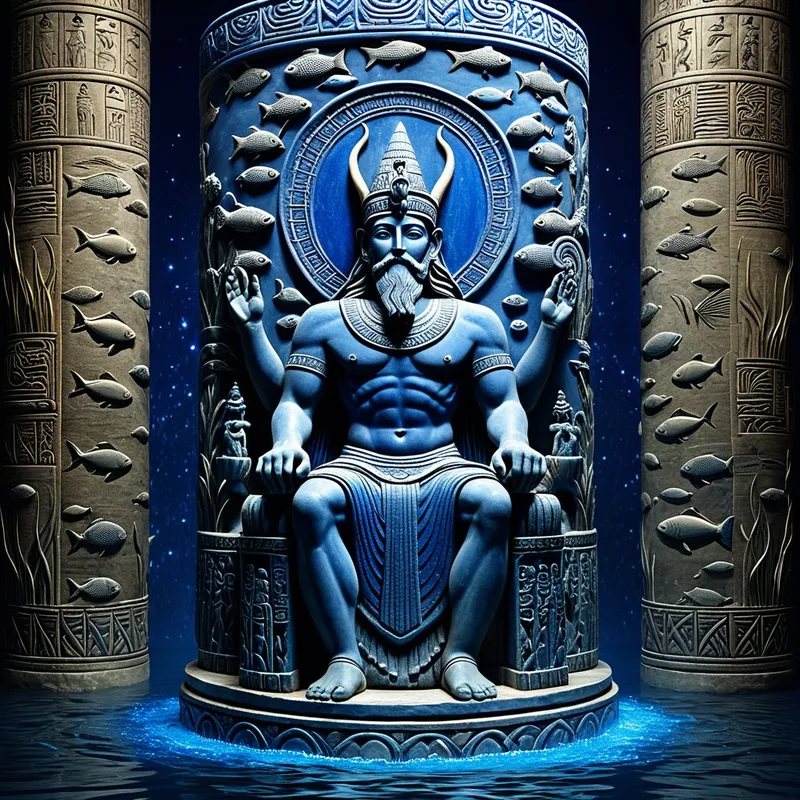
Enki/Ea Myth Meaning & Symbolism
The story of the cunning god of sweet waters, wisdom, and civilization, who shapes humanity and defies cosmic order to preserve life.
The Tale of Enki/Ea
In the beginning, before the naming of things, there was only the mingled waters. From the sweet, deep Apsu and the salt, chaotic Tiamat, the first gods were born. Their clamor was a storm in the womb of the world, a cacophony so great it disturbed the primordial sleep of Apsu. He desired silence, an end to the new, restless life. But one god heard his dark intent. This was Enki, the cunning one, whose domain was the sweet waters that run beneath the earth. He who knows the shape of things unseen.
With words smoother than polished lapis, Enki wove a spell of sleep upon Apsu. Then, with a fateful decision that would echo through all ages, he did not merely restrain—he ended. The sweet waters were stilled, and upon the body of Apsu, Enki built his shining abode, the deep Eridu. Here, in the quiet dark, he planted the first seed of order.
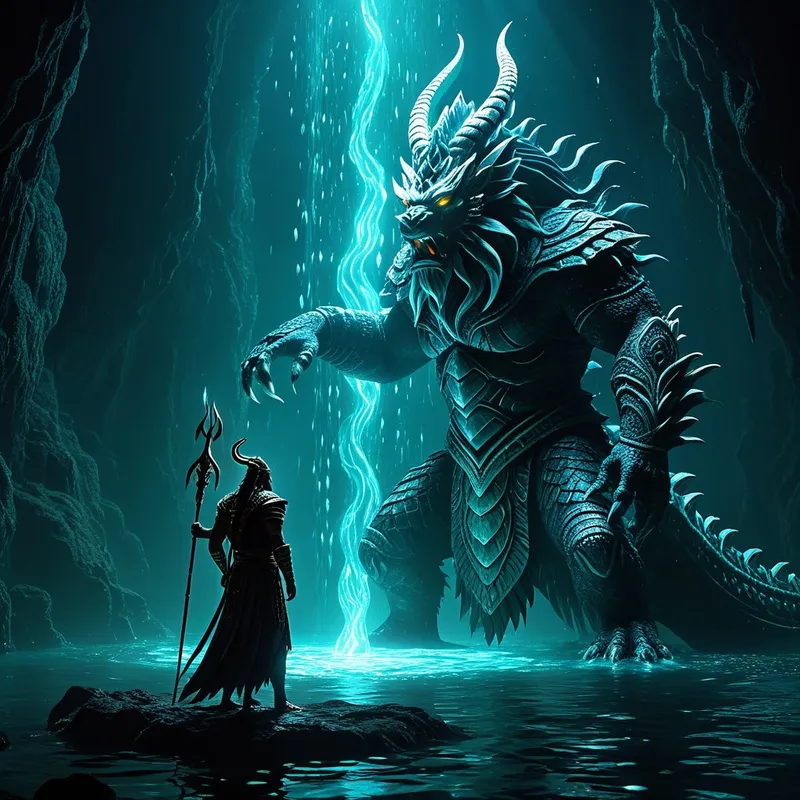
But the mother, Tiamat, raged. Her beloved was slain. From her torrential grief, she birthed an army of monsters: serpent-demons with venom for blood, raging hounds, and the fierce Mushussu. The younger gods trembled; no one could face her wrath. Until the champion Marduk stepped forth, but only after extracting a promise: supreme kingship. Enki, the wise grandfather, saw the necessity. He gave Marduk the weapons of destiny—the winds, a net, and his own profound cunning. The battle shook the foundations of the cosmos. When it was done, and Tiamat was split like a dried shellfish, Enki did not celebrate the victory of force. He turned to the work of creation.
From the blood of Tiamat’s slain commander, mixed with the clay of the earth, Enki and the mother-goddess Nintu fashioned humanity. He breathed into them the divine spark, but also the burden of toil, to serve the gods and maintain the world. He was their maker and their advocate.
His greatest defiance was yet to come. When the gods, in their celestial council, grew weary of humanity’s noise and resolved to send a great flood to wipe them clean from the earth, Enki could not abide it. He did not shout his rebellion. He went to the wall of a reed hut, where a righteous man, Utnapishtim, slept. And there, to the wall of reeds, Enki whispered. He spoke not in the language of gods, but in the sighing of the wind through the stalks, telling the secret of the coming deluge and the blueprint for an ark. Through this whispered treason, life was preserved. Enki, lord of the deep waters, became the savior from the waters, the one who remembers the value of the fragile thing he helped to create.
Cultural Origins & Context
The myths of Enki, known as Ea in later Akkadian tradition, are woven into the very fabric of Mesopotamian civilization, originating with the Sumerians in the 3rd millennium BCE. These stories were not mere entertainment; they were the sacred literature of the world’s first cities, like his own cult city of Eridu, considered the first city ever founded. His tales were recited by temple priests and scribes, the literate custodians of cosmic order, during important festivals and rituals meant to ensure the fertility of the land and the wisdom of the king.
The function of Enki’s mythology was multifaceted. It explained the origin of humanity and our fraught relationship with the divine. It established the god as the patron of the essential arts of civilization—the Me—which included everything from kingship and writing to metalworking and basket-weaving. By venerating Enki, the people of Mesopotamia affirmed the source of their technological and cultural prowess. His role in the flood narrative served as a theological cornerstone, explaining divine caprice and the possibility of merciful intervention, a crucial narrative for a society living at the mercy of the Tigris and Euphrates rivers.
Symbolic Architecture
Enki/Ea is the archetype of the deep, fluid intelligence that precedes and undercuts rigid order. He is not the king of the pantheon (that is the sky god Anu or the executive enforcer Marduk); he is its foundational sage. His domain is the Apsu, the subterranean freshwater ocean—a perfect symbol for the unconscious itself: the source of life, wisdom, and potential that lies beneath the surface of conscious reality.
The true rebel does not oppose with force, but with a deeper knowing. He dissolves the rigid structure from within, using the very waters that give it life.
His actions are a masterclass in symbolic process. He slays the primal father Apsu not out of malice, but to allow the dynamic process of creation (the younger gods) to continue. He then builds his house upon this subdued chaos, representing the necessity of establishing a conscious ego-structure (a "house") in relation to the unconscious, not in denial of it. His theft of the Me for humanity is the mythic representation of the awakening of cultural consciousness—the moment the raw potentials of the psyche become tools for building a world. Finally, his whispered warning about the flood is the ultimate symbol of the saving function of the deep Self. When the conscious attitude (the council of gods) becomes tyrannical and seeks to obliterate the living connection to instinct and humanity, it is the voice from the depths that finds a circuitous, creative path to preservation.
The Dreamer's Resonance
When the pattern of Enki stirs in the modern dreamer, it often manifests as an encounter with subterranean wisdom. One might dream of discovering a hidden spring or well in a familiar place, of receiving crucial information through an indirect or "leaking" source (a dripping faucet spelling out a message, a radio tuned between stations revealing a secret), or of crafting something profoundly meaningful from mud or clay.
Somatically, this can feel like a release of pressure, a "welling up" of insight or emotion that has been building beneath the surface. Psychologically, it signals a process where the dreamer’s conscious mind is being forced to contend with a deeper, more fluid intelligence from their own psyche. It is the Self intervening to solve a problem that the ego’s rigid plans cannot address. The dream may present a "flood" of overwhelming feeling or circumstance, and the Enki figure—perhaps a wise, unconventional guide, or even the dreamer themselves acting with uncharacteristic cunning—provides the ingenious, non-confrontational solution. This is the psyche’s innate move towards integration, using trickles of insight to avert an inner catastrophe.

Alchemical Translation
The alchemical journey modeled by Enki is not the hero’s conquest, but the sage’s cunning operation of solve et coagula—dissolve and coagulate. For the individual seeking wholeness (individuation), Enki represents the function that dissolves rigid, outworn complexes (the sleeping Apsu of our stubborn habits, the tyrannical decree of an inner critic demanding a "flood" of self-punishment) and re-coagulates the essential elements into a new, more fluid structure of being.
Individuation is not about storming heaven, but about listening to the whisper in the reeds—the intelligence of the deep Self that knows how to navigate the flood.
The first step is the descent into one’s own Apsu: confronting the unconscious, not to battle it, but to build a dwelling place there, to become familiar with its currents. This is the foundation of self-knowledge. The second is the acquisition of the inner Me—the conscious recognition and cultivation of one’s innate talents and capacities, "stealing" them from the realm of unconscious potential and bringing them into the light of day. The final, ongoing operation is the role of the advocate. As we build our conscious personality, there is always a risk it will become arrogant, disconnected, and seek to destroy its humble, human roots. The Enki within is that deep, ethical compass that rebels against this self-annihilation. It is the part of us that, when we are at our most rigidly judgmental or despairing, finds a back channel—a dream, a sudden intuition, a creative impulse—to whisper, "Build an ark. Save what is essential. The flood is not the end." In this way, the myth guides us to become not rulers of our psyche, but its wise, compassionate, and ingeniously resourceful stewards.
Associated Symbols
Explore related symbols from the CaleaDream lexicon: