Enheduanna Myth Meaning & Symbolism
The world's first known author, a high priestess, is cast out by a tyrant. Through poetry and divine fury, she reclaims her voice and her throne.
The Tale of Enheduanna
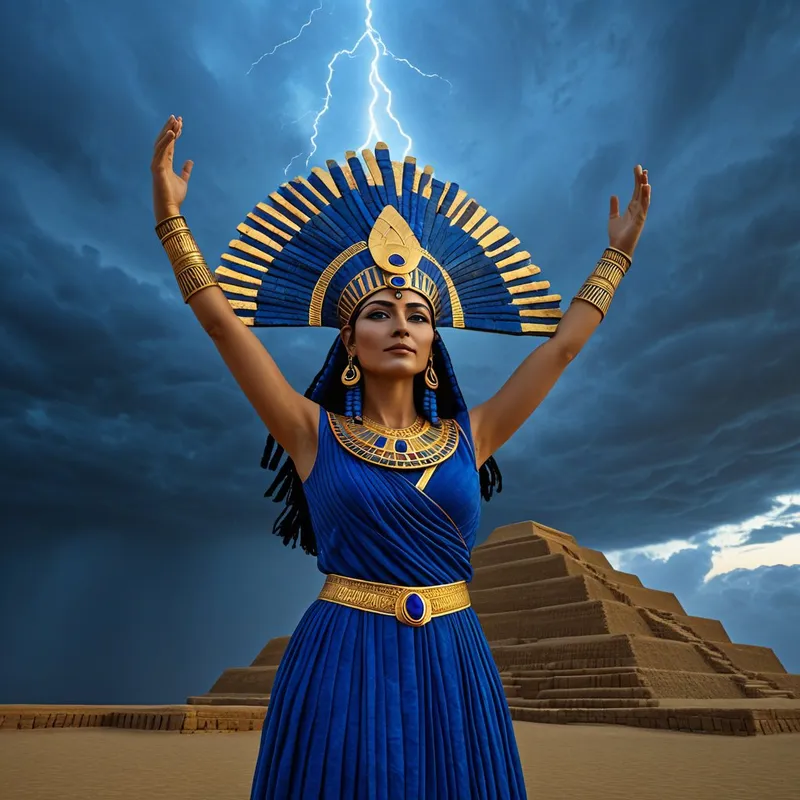
Hear now the voice that first broke the silence of history. In the sacred city of Ur, where the ziggurat scraped the belly of the heavens, there lived Enheduanna, daughter of the great king Sargon. She was the En of Nanna, the bridge between the dusty earth and the cool, distant moon. Her words were not her own; they were the vessel for Inanna, the Lady of Heaven, whose heart was a tempest and whose will was law.
But a shadow fell upon the land. Lugal-anne, a usurper with a heart of flint, rose in rebellion. He saw not a priestess, but a symbol of the old order. With cold decree, he tore her from the giparu, stripped her of the crescent-moon crown, and cast her out into the desolate marshes. The gates of Ur clanged shut behind her. The familiar scent of incense and baked brick was replaced by the rot of stagnant water and the cry of strange birds. Exile is a death of the known world.
In the reeds, under a foreign sky, a fire kindled—not of warmth, but of divine rage. Inanna abandoned her. The goddess’s face was turned away. This was the second, more profound exile: to be forsaken by the very power that defined you. Despair coiled around her heart. Yet, from that void, a new sound emerged. Not a prayer, but a confrontation. She took her stylus and a tablet of damp clay. She began to write. She did not plead; she accused. She composed the Nin-me-šara, a storm of words hurled at the absent goddess.
“You have become greater than yourself! You have abandoned me to the clutches of the dust!” she inscribed. She recounted Inanna’s terrible splendors, her chariot of lions, her battlefield fury. She made the goddess present in her very absence, describing her power so vividly that the clay itself seemed to tremble. The poem was a net, cast into the divine deep, and it caught the attention of the furious Queen of Heaven. The exile’s lament became a weapon, a spell of invocation. It is said the gods stirred. Sargon’s armies moved. The usurper’s power cracked like sun-baked mud.
And then, the return. Not as a reclaimed prize, but as a force reconsecrated. Enheduanna walked back through the gates of Ur, not just by royal decree, but by the power of her own uttered truth. She took up her seal, the symbol of her authority, and pressed it into clay, forever marking the words as her own. The one who was cast out had cast a line of poetry into the abyss, and pulled her whole world back into order.

Cultural Origins & Context
Enheduanna was not a mythical figure, but a historical one: the daughter of King Sargon of Akkad, who appointed her as High Priestess to the moon god Nanna in Ur around 2285 BCE. Her mythos is woven from the threads of history, politics, and revolutionary personal expression. In a world where authorship was anonymous, a act of collective cultural transmission, Enheduanna dared to say “I.” She signed her hymns. This “I” was a seismic event in human consciousness.
Her story, preserved on cuneiform tablets copied by scribal schools for centuries, functioned as potent political theology. It legitimized the Sargonic dynasty’s rule by framing it as divinely ordained and restored. For the priestly class and the literate, it modeled the ultimate function of the sacred office: the priestess as the necessary, vocal conduit of divine will, whose personal ordeal could secure cosmic and social balance. Her hymns were performed in temple rituals, making her lived experience of exile and restoration a recursive, re-enactable sacred drama for the culture.
Symbolic Architecture
At its core, Enheduanna’s myth is the archetypal drama of the Voice silenced, lost, and reborn through its own creative fury. She embodies the paradox of the liminal figure: vested with ultimate authority by the system (the priesthood), yet utterly vulnerable to that same system’s political upheavals.
The creative self is often born not in the temple of approval, but in the marshes of exile. It is the part of us that must be cast out to find its true, unmediated tongue.
Her exile represents the severing from assigned identity (“the priestess of Nanna”). The abandonment by Inanna symbolizes the terrifying withdrawal of what psychologists might call the animating numinosum—the inner source of passion and power that once defined us. What remains in that vacuum is not nothingness, but the raw, creative ego, forced to engage the archetype directly, through struggle rather than ceremony. The clay tablet and stylus become the tools of individuation. She does not simply write about Inanna; she writes to her, and in doing so, she reconstitutes their relationship on her own terms. The restored voice is not the same as the one that was silenced; it is harder, clearer, and self-authored.
The Dreamer's Resonance
When this myth stirs in the modern dreamer, it often manifests as dreams of profound silencing or institutional betrayal. You may dream of being locked out of your own home or office, your key no longer fitting the lock. You may see a powerful, radiant feminine figure (a mentor, a goddess, an ideal) turning her back and walking away, leaving you feeling utterly hollowed out. The setting is often a liminal space: a deserted parking garage, an empty school hallway after hours, a shoreline that is neither land nor sea.
Somatically, this process feels like a constriction in the throat, a weight on the chest, or a cold numbness in the hands—the body registering the suppression of expression and agency. The psychological process underway is the painful but necessary death of an identity that was contingent on external validation or structure. The dream-ego is in the marshes. The crucial turn in the dreaming, mirroring Enheduanna’s, occurs when the dreamer finds an object—a pen, a microphone, a child’s toy, a stone—and begins to use it, not for its intended purpose, but to make a mark, to create a sound, to alter the dreamscape itself. This is the unconscious signaling the birth of the assertive, creative will from within the despair.

Alchemical Translation
The alchemical journey of Enheduanna maps the nigredo of exile—the blackening, the dissolution of the old persona. The usurper, Lugal-anne, represents the hostile, rigid, power-obsessed complex within the psyche that seizes control, demanding conformity and silencing the soul’s authentic voice. The marshes are the prima materia, the chaotic psychic soup from which new consciousness is formed.
The tyrant within fears the poet, for the poet names the tyranny and thus begins its end.
The act of writing the hymn is the albedo. It is the distillation of raw suffering into precise, potent form. Here, lament is not passive weeping; it is an active, shaping force. By giving her despair a name and a structure (the hymn), she transforms it from a state that overwhelms her into an object she can present, even to the goddess. This is the quintessential act of psychic transmutation: taking the lead of suffering and turning it into the gold of meaningful expression.
The return to Ur is the rubedo, the integration. She does not return as the naive priestess, but as the author-priestess, a compound being. The restored authority is now imbued with the hard-won knowledge of its own fragility and its own creative source. For the modern individual, the “return” is not necessarily to a former job or relationship, but to a state of inner authority where one’s voice—forged in the struggle of its own recovery—is recognized as the central, non-negotiable instrument of one’s life. Enheduanna’s myth tells us that our deepest authority is not granted by the temple, but seized in the marsh, with a stylus in hand, in a furious and loving conversation with the very power that seems to have abandoned us.
Associated Symbols
Explore related symbols from the CaleaDream lexicon: