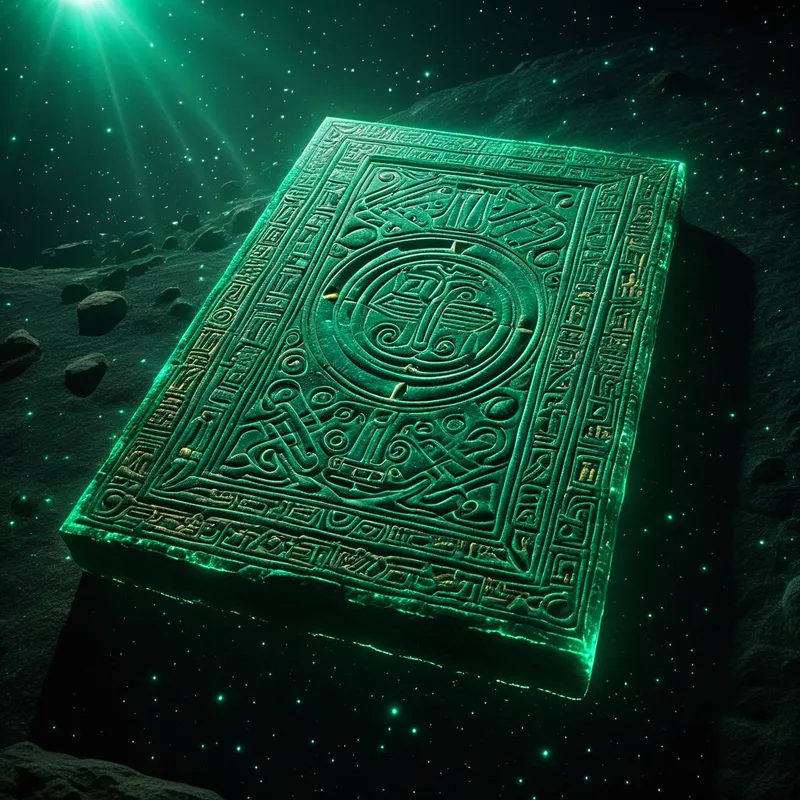
Emerald Tablet Myth Meaning & Symbolism
The myth of a tablet of emerald, inscribed with the secret principles of reality, revealing the unity of the cosmos and the path of inner transmutation.
The Tale of the Emerald Tablet
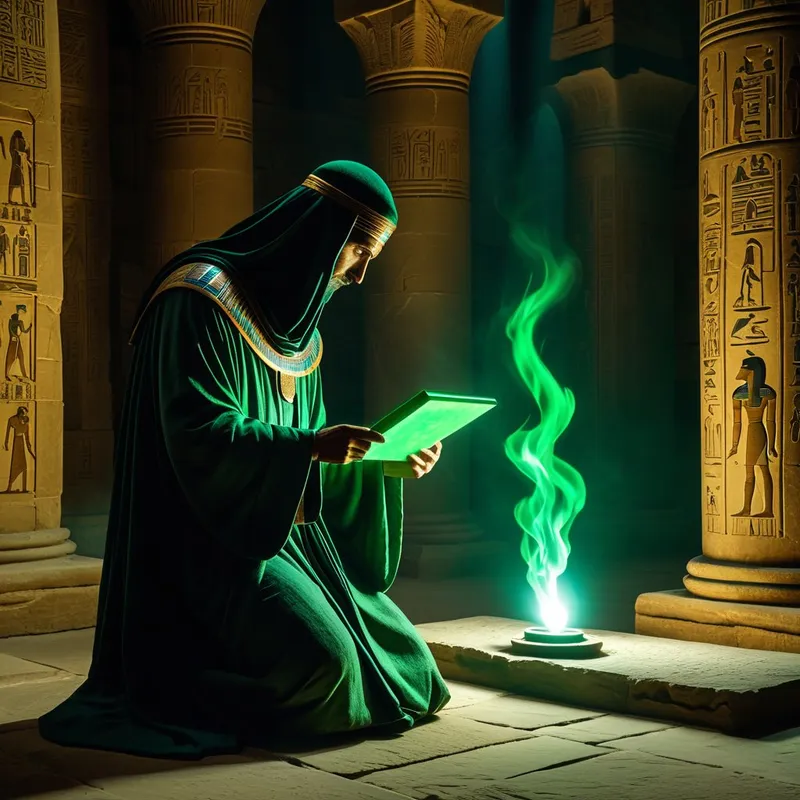
In the time before time was measured, when the sky was a cloak of indigo velvet and the sands whispered secrets to the stars, there walked a figure between the worlds. He was known by many names, but in the hushed halls of the most ancient temples, they called him Hermes Trismegistus. His sandals left no print on the desert floor, for he was a traveler not of land, but of the veils that separate the Above from the Below.
A great yearning filled his heart—a thirst not for water, but for the source from which all waters spring. He sought the First Word, the Logos that echoed in the birth of suns and the fall of a single leaf. His journey led him deep into the silent womb of the earth, to a chamber forgotten even by the pharaohs. The air was thick with the scent of myrrh and millennia. No torch was needed, for a faint, subterranean light, like that which glows in the heart of certain deep-sea creatures, pulsed from the walls.
In the center of the chamber stood an altar not of gold, but of a single, rough-hewn black stone. And upon it rested the object of all seeking. It was a tablet, but not of clay or wax. It was hewn from a single, profound emerald, its green so deep it seemed to hold the memory of all forests and the cold fire of distant nebulae. Its surface was not polished to a mirror sheen, but was vitreous and fathomless, like a frozen, vertical sea.
As Hermes approached, the silence deepened into a hum, a vibration that resonated in his very bones. The light within the stone brightened, and upon its face, lines of fire began to trace themselves. They were not carved, but revealed, as if the secrets were rising from the infinite depths of the gem itself. They formed characters in a primordial script, a language that spoke directly to the soul, bypassing the ear. This was not a text to be read, but a truth to be known.
The first line ignited: That which is Above is from that which is Below, and that which is Below is from that which is Above, for the performance of the miracles of the One Thing. The words were not sound, but a cascade of understanding that flooded his being. He saw the dance of atoms mirroring the dance of stars, the growth of a tree reflecting the unfolding of a destiny, the breath in his lungs as the wind in the celestial spheres. The tablet did not merely impart knowledge; it performed an alchemy upon the perceiver, dissolving the illusion of separation between the seeker and the sought, the microcosm and the macrocosm. In that timeless moment, standing before the verdant fire of the tablet, Hermes Trismegistus did not learn a secret. He became the secret, the living bridge between heaven and earth. The chamber held its breath, and the myth was born.
Cultural Origins & Context
The myth of the Emerald Tablet (Tabula Smaragdina) is the foundational narrative of the Hermetic tradition, a syncretic spiritual and philosophical current that emerged in the early centuries of the Common Era in Hellenistic Egypt. It represents the crystallized lore of Hermetica, blending Egyptian theological concepts with Greek philosophical thought, particularly Platonism and Stoicism.
The story was not "published" but transmitted as a sacred and secret teaching. It functioned as a powerful aition—a mythic origin story—for the entire Hermetic worldview. By attributing the ultimate cosmological and spiritual principles to a divine revelation received by the thrice-great sage in a primordial time, the tradition grounded its authority in antiquity and direct divine contact. It was likely told and retold in initiatory contexts, within small circles of seekers, where the story itself was a tool for altering consciousness. The societal function was not to govern behavior but to map reality; it provided a symbolic framework for understanding humanity's place in a living, intelligent, and interconnected cosmos. Its survival through Arabic translations into medieval Latin Europe ensured its transformation from an Egyptian Hellenistic mystery into the cornerstone of Western alchemy and esotericism.
Symbolic Architecture
The Emerald Tablet is not merely an object in a story; it is the central symbol of an entire metaphysical system. Its symbolism operates on multiple, interconnected levels.
The Tablet itself symbolizes the fixed, eternal law of the universe—the Logos made manifest in a tangible, yet mystical, form. Emerald, the stone, is symbolic of life, renewal, and the heart. Thus, the law of the cosmos is not a cold, mechanical rule but a living, verdant truth, the heart of reality itself.
The core revelation—"As above, so below; as below, so above"—establishes the principle of correspondence. This is the symbolic key that unlocks the universe, proposing that every pattern in the macrocosm (the cosmos, the divine) is reflected in the microcosm (the human being, the earthly realm), and vice versa.
Hermes Trismegistus symbolizes the awakened human consciousness, the mind that has developed the capacity to receive and comprehend this universal law. He is the archetype of the mediator, the messenger who can traverse the boundaries between realms. His discovery in a hidden chamber represents the truth that profound wisdom is not found in the external world of appearances, but by journeying inward, into the subterranean vaults of the soul and spirit.
The act of revelation, where the script appears as from within the stone, symbolizes that true wisdom is not implanted from without, but awakened from within. The tablet already contains the knowledge; the light of the seeker's consciousness makes it visible. This points to a profound psychological truth: the archetypal laws of the psyche are innate, awaiting the "light" of awareness to be read and understood.
The Dreamer's Resonance
When the motif of the Emerald Tablet surfaces in modern dreams, it signals a profound encounter with the archetype of wholeness and the fundamental patterns of the Self. The dreamer is not simply recalling a story; they are experiencing a direct, symbolic expression of a deep psychic process.
To dream of finding the tablet, perhaps in a basement, an attic, or a forgotten room, often coincides with a moment of major psychological synthesis. It suggests the dreamer is on the cusp of a powerful insight that promises to unify previously disparate aspects of their life or identity—perhaps reconciling spiritual beliefs with scientific understanding, or integrating a shadow aspect into conscious life. The somatic feeling is often one of awe, a hushed stillness, and a sense of profound "rightness."
Conversely, to dream of a shattered or illegible tablet speaks to a crisis of meaning. The foundational principles by which the dreamer understands their world and themselves feel compromised or obscured. This can occur during periods of severe disorientation, loss of faith, or deep depression, where the connecting threads between inner and outer reality seem severed. The somatic resonance here is typically anxiety, frustration, or a chilling emptiness.
The tablet in a dream acts as a psychic mirror. Its condition and legibility directly reflect the dreamer's current relationship to their own inner truth and their sense of connection to a larger, meaningful order.

Alchemical Translation
The myth of the Emerald Tablet is, in essence, a perfect allegory for the Jungian process of individuation—the psychic alchemy of becoming one's unique, whole Self. The entire narrative models the stages of this inner work.
The journey into the hidden chamber is the descent into the unconscious. It is the often difficult, shadowy work of introspection, therapy, or confronting repressed material. The black stone altar represents the prima materia, the chaotic, base, and unknown psychic substance with which the work begins.
The moment of revelation before the tablet is the coniunctio oppositorum—the sacred marriage of opposites. The conscious mind (Hermes) encounters the objective, archetypal law of the psyche (the Tablet), and in that meeting, the illusion of their separateness dissolves.
The inscription's central formula, "As above, so below," provides the operational principle for this inner alchemy. Psychologically, it means: the patterns you observe in your outer world (relationships, conflicts, successes) are reflections of inner, psychic structures. To change the "below" (your lived experience), you must work with the "above" (your archetypal patterns and unconscious complexes). Conversely, by consciously working on your inner world, you inevitably alter your perception of and engagement with the outer world.
The ultimate "miracle of the One Thing" that the text promises is the realization of the Self. It is the transmutation of the fragmented, leaden ego-state into the integrated, golden wholeness of an individual who understands they are both a unique creature and a living expression of cosmic law. The Emerald Tablet does not offer a secret for turning lead into physical gold, but a map for turning the lead of unconscious suffering into the gold of conscious, authentic being. The myth tells us that this secret law is not out there to be found, but in here, waiting to be revealed, in the deep, emerald heart of our own psyche.
Associated Symbols
Explore related symbols from the CaleaDream lexicon: