Embers of Muspelheim Myth Meaning & Symbolism
The primordial fire from which the cosmos was kindled, representing the raw, creative-destructive force that births worlds and consciousness from the void.
The Tale of the Embers of Muspelheim
Listen. Before [the wind](/myths/the-wind “Myth from Various culture.”/) blew, before a single stone knew its place, there was the Yawning Void—[Ginnungagap](/myths/ginnungagap “Myth from Norse culture.”/). And in that nothingness, two great powers slept: to the north, [Niflheim](/myths/niflheim “Myth from Norse culture.”/), a well of frost so deep it breathed glaciers into the dark. To the south, [Muspelheim](/myths/muspelheim “Myth from Norse culture.”/), a roaring furnace of creation, a realm where fire was not an element but the very substance of being.
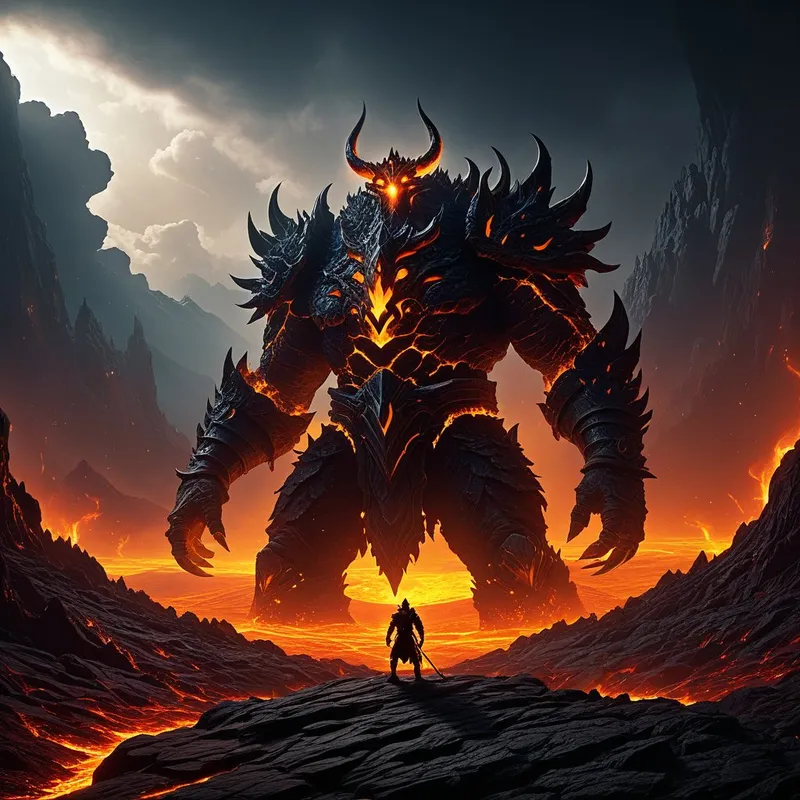
And from this southern forge came the first sentinel, Surt. He was not born; he was kindled. A being of living flame, his form etched in blackened obsidian and radiant magma, he stood at the borders of his realm, a blazing sword in his grasp. His was the thankless vigil at the edge of all things, holding back the conflagration that was his essence, for the time was not yet ripe.
But [the void](/myths/the-void “Myth from Buddhist culture.”/) is a patient sculptor. The icy rivers of Niflheim, Élivágar, crept ever southward, their rime and hoarfrost spreading like a silent plague. And from Muspelheim, the great heat breathed northward in waves of shimmering air and flying sparks—not mere sparks, but the very Embers of the First Fire. These were not destructive cinders; they were seeds of potential, fragments of pure, unformed becoming.
They crossed the unimaginable gulf of Ginnungagap.
And in the heart of the void, where the meeting of extremes could no longer be denied, it happened. A single, fate-tipped ember from Surt’s domain met a rising plume of glittering frost from the depths of Niflheim.
The sound was the first sound: a hiss that was also a sigh, a crack that was also a song. Where fire kissed ice, the ice wept. And from those weeping drops, stirred by the lingering heat of the ember, life stirred. The formless took form. From that primal sludge, heated by the enduring gift of Muspelheim’s embers, emerged Ymir, the progenitor of giants. And from the melting ice, the cow Audhumla appeared, whose licking of salty rime stones would unveil the first of the gods.
The embers did not die. Their heat became the animating pulse within Ymir’s colossal frame. Their light became the gleam in Audhumla’s eye. They were the catalytic spark in the cold laboratory of pre-creation. Later, when the gods Óðinn and his brothers slew Ymir and fashioned [the world](/myths/the-world “Myth from Tarot culture.”/) from his body, those embers were placed in [the sky](/myths/the-sky “Myth from Persian culture.”/) to become the sun and the stars, forever cycling, forever reminding the cosmos of its fiery origin. And Surt, the guardian, sheathed his sword once more, waiting. For he knew the embers he sent forth would one day return, and his final duty was not creation, but conclusion.

Cultural Origins & Context
This narrative of cosmic beginnings is preserved primarily in the Prose Edda, written by Snorri Sturluson in the 13th century. Snorri was a Christian scholar attempting to systematize the fading pagan lore of his ancestors. The myth of the Embers of Muspelheim is thus a reflection of a deeply ingrained Norse worldview, passed down through skalds (poets) and storytellers long before it was ever written.
Its societal function was foundational. It was not merely a “how-it-began” story, but a cosmological map that established the fundamental principles of existence: a universe born from dynamic, opposing forces (fire/ice, action/stasis), where creation is always a violent, catalytic process. It explained the inherent duality and tension in the world—the struggle between summer and winter, vitality and stagnation. The myth placed humanity in a cosmos that was fundamentally alive and combustible, shaped by forces of immense power, teaching resilience and acknowledging that both life and destruction originate from the same primal source.
Symbolic Architecture
The [Embers](/symbols/embers “Symbol: Embers symbolize the remnants of transformation, signifying the potential for rebirth and the lingering presence of passion or unresolved issues.”/) of Muspelheim are the ultimate [symbol](/symbols/symbol “Symbol: A symbol can represent an idea, concept, or belief, serving as a powerful tool for communication and understanding.”/) of the primordial creative [impulse](/symbols/impulse “Symbol: A sudden, powerful urge or drive that arises without conscious deliberation, often linked to primal instincts or emotional surges.”/). They represent the initial spark of [consciousness](/symbols/consciousness “Symbol: Consciousness represents the state of awareness and perception, encompassing thoughts, feelings, and experiences.”/) emerging from the unconscious, the first [idea](/symbols/idea “Symbol: An ‘Idea’ represents a spark of creativity, innovation, or realization, often emerging as a solution to a problem or a new outlook on life.”/) born from the [friction](/symbols/friction “Symbol: Friction represents resistance, conflict, or the necessary tension required for movement and transformation in dreams.”/) between opposing psychic states.
The ember is not the fully formed flame; it is the potential for all flame. It is the point of ignition where latent energy becomes kinetic destiny.
Muspelheim itself symbolizes the raw, undifferentiated libido or [life](/symbols/life “Symbol: The symbol of ‘Life’ represents a journey of growth, interconnectedness, and existential meaning, encompassing both the joys and challenges that define human experience.”/) force—the seething, passionate, and often chaotic [energy](/symbols/energy “Symbol: Energy symbolizes vitality, motivation, and the drive that fuels actions and ambitions.”/) of the [psyche](/myths/psyche “Myth from Greek culture.”/). Surt is its [guardian](/symbols/guardian “Symbol: A protector figure representing safety, authority, and guidance, often embodying parental, societal, or spiritual oversight.”/), the archetypal threshold figure who controls access to this tremendous power. The [journey](/symbols/journey “Symbol: A journey in dreams typically signifies adventure, growth, or a significant life transition.”/) of the embers across Ginnungagap to meet the ice of Niflheim is the archetypal journey of the creative act: a fragment of passionate inspiration (fire) must traverse the void of uncertainty and encounter the resistant, crystallized [material](/symbols/material “Symbol: Material signifies the tangible aspects of life, often representing physical resources, desires, and the physical world’s influence on our existence.”/) of the known world or the frozen patterns of habit (ice). Only in their [fusion](/symbols/fusion “Symbol: The merging of separate elements into a unified whole, often representing integration of self, relationships, or conflicting aspects of identity.”/) does something new—the tertium non datur, or the third [thing](/myths/thing “Myth from Norse culture.”/)—come into being: the animate world, the work of art, the transformed self.
The Dreamer’s Resonance
When this myth pattern stirs in the modern dreamer, it often manifests as dreams of profound inner heat or catalytic moments. One might dream of a small, contained fire in a vast, cold landscape, or of a crucial, glowing object that must be carried safely through a dangerous, shadowy space. Somatic sensations of sudden warmth, a racing heart, or the feeling of a “spark” igniting in the chest upon waking are common.
Psychologically, this signals the activation of a deep creative or transformative process. The dreamer is in a state analogous to Ginnungagap—a feeling of emptiness, potential, or being stuck between opposing life forces. The appearance of the “ember” symbolizes the emergence of a new passion, a long-dormant talent, a revolutionary idea, or the first stirrings of love. The dream is mapping the journey of this fragile, nascent potential from its origin in the unconscious (Muspelheim) into contact with the “frozen” structures of one’s current life or identity (Niflheim). It is a call to protect and nurture that spark, for it carries the blueprint for a new phase of being.
Alchemical Translation
In the alchemy of the psyche, the process of individuation—becoming one’s whole, integrated self—mirrors the myth precisely. The seeker begins in a state of massa confusa, a chaotic inner void where opposites (conscious and unconscious, [persona](/myths/persona “Myth from Greek culture.”/) and shadow) are separate and conflicting.
The alchemical rubedo, the reddening, is not the gentle blush of dawn but the fierce, transformative fire of Muspelheim brought under the soul’s own authority.
The “Ember” is the first recognition of the Self. It is the hot, central core of authentic identity that feels alien and powerful when first encountered. The alchemical work is to allow this ember to undertake its necessary journey: to engage with the “ice” of one’s rigid defenses, frozen traumas, and cold intellectualizations (Niflheim). This engagement is the [coniunctio oppositorum](/myths/coniunctio-oppositorum “Myth from Alchemical culture.”/)—[the sacred marriage](/myths/the-sacred-marriage “Myth from Various culture.”/) of opposites. It is not a peaceful merger, but a hissing, steamy, chaotic confrontation that produces the “primal sludge” from which a renewed personality is fashioned.
The individual becomes, like the Norse gods, a world-builder. They take the raw materials of their experience (the slain giant of old patterns) and, guided by the enduring light of their own central spark—now placed in the inner sky as a guiding sun—construct a more authentic, conscious, and resilient world within. They also must accept the Surt within, the part destined to one day cleanse this inner world through necessary endings, making way for new cycles of creation. The ember, therefore, is the eternal beginning, [the psychopomp](/myths/the-psychopomp “Myth from Various culture.”/) that guides us from chaos into form, and the promise that from our deepest, most fiery conflicts, our wholeness is born.
Associated Symbols
Explore related symbols from the CaleaDream lexicon: