Elysium Myth Meaning & Symbolism
The blessed afterlife realm where heroes and the virtuous find eternal peace, a verdant paradise beyond the sorrows of the mortal world.
The Tale of Elysium
Listen, and let your spirit travel beyond the sun’s chariot, beyond the wine-dark sea, to a shore where the air does not age. Here, at the edge of the world, where the great river Oceanus encircles all creation, lies a land untouched by the tears of mortals. It is not a kingdom of the dead, but a refuge for the deathless part of the soul.
The path here is not for all. It is not earned by gold or whispered prayers, but by the substance of a life. It is granted by the will of Zeus himself, often through the plea of a divine parent. Imagine Heracles, his mortal flesh consumed by fire on Mount Oeta, his agonies finally ceasing. His divine essence, the part inherited from his father, is not dragged before Hades for judgment. Instead, a gentle, unseen current carries him westward, past the Pillars of Heracles, to where the sun rests.
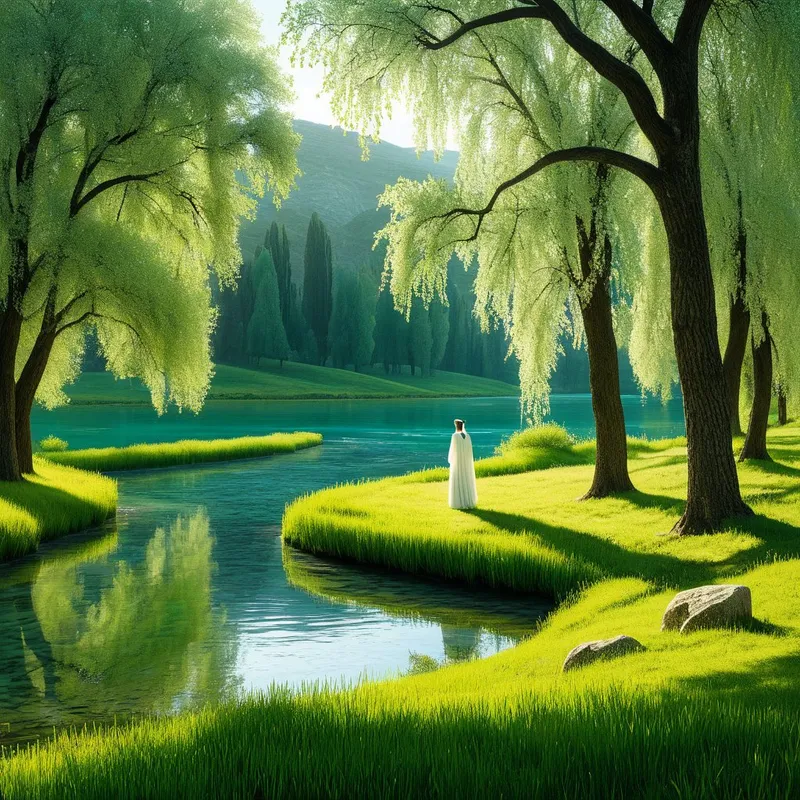
He arrives not in gloom, but in a soft, perpetual afternoon. The grass is eternally spring-green and yields to the foot without a sound. The air smells of ripening fruit and the salt of a calm sea. Groves of whispering asphodel are replaced by fragrant poplars and fruit-laden trees. Clear rivers, like liquid silver, wind through meadows where the dead—no, the blessed—walk and converse. Their forms are luminous, free from the aches of age and the pangs of hunger. There is no toil. The earth provides without sowing. The conflict is over; the resolution is this unending serenity.
Here, the great heroes of the Trojan War who were favored by the gods—Achilles, Ajax—practice their arts not for war, but for the pure joy of movement. Philosophers debate in shaded groves without rancor. The music of lyres hangs in the air, a sound that soothes rather than excites. Time is not a river here, but a still, deep lake. This is Elysium, the Elysian Fields. It is the final, gentle sigh after a life of storm, the everlasting reward for those whose blood or deeds have touched the divine.
Cultural Origins & Context
The vision of Elysium evolved within the rich tapestry of Greek thought, reflecting a deepening complexity in their conception of the afterlife. Its earliest mentions are in the epic poetry of Homer. In the Odyssey, it is described not as a universal reward, but as a very specific privilege for a select few—like Menelaus, who is told he will go there not for his virtue, but because he is the son-in-law of Zeus. This original Elysium was a geographical mystery, located at the ends of the earth.
Over centuries, through the works of poets like Pindar and the playwrights, the concept matured and became more integrated into the broader Greek underworld, or Hades. It transformed from an exclusive club for demigods and favorites into a potential destination for the virtuous and the initiated, particularly with the rise of mystery cults like the Eleusinian Mysteries. This shift mirrored societal changes, offering a glimmer of hope beyond the generally bleak Homeric afterlife of shadowy existence. Elysium served a crucial societal function: it provided a narrative of cosmic justice and divine reward, a powerful motivator for heroic action, pious living, and initiation into religious rites. It was the ultimate "happy ending" sanctioned by the gods, a story told to inspire and offer comfort in the face of life’s inevitable end.
Symbolic Architecture
Elysium is not merely a place; it is a state of being, a profound symbol of the psyche's highest aspiration for resolution and wholeness. Its architecture is built entirely from symbols of completion and harmonious balance.
Elysium represents the soul's final integration, where the battles of the ego are silenced and the self rests in its own perfected nature.
The eternal spring symbolizes the end of cyclical suffering—the personal winters of despair, the autumns of decline. It is life force preserved in its peak state, untouched by decay. The gentle rivers and breeze contrast sharply with the punishing rivers of the mainstream underworld (like Phlegethon), representing the calming of emotional and psychic turbulence. The absence of toil signifies liberation from the burdens of the persona, the daily grind of being someone in the world. Here, one simply is.
Most critically, Elysium symbolizes reward without struggle. Unlike the Christian heaven earned through faith and moral combat, or the Buddhist Nirvana achieved through the extinction of desire, Homeric Elysium is often granted. This speaks to a deep psychological truth: the recognition of an innate, inborn nobility or wholeness (symbolized by divine parentage) that the trials of life have revealed, not created. It is the psyche's destination for those elements of the self that have remained true to their deepest, often destined, nature.
The Dreamer's Resonance
When Elysium appears in the modern dreamscape, it rarely manifests as a literal Greek meadow. Instead, it surfaces as a profound feeling-toned image of arrival, peace, and resolution. The dreamer may find themselves in a stunningly beautiful, serene landscape—a silent beach at dawn, a perfect, empty garden, a sun-drenched library. The overwhelming somatic sensation is one of deep, often melancholic, peace. The conflict is over. The anxiety has lifted.
Psychologically, this dream motif signals a major transition. It often appears after a period of intense struggle, loss, or "death" of a former life chapter (a career, relationship, or identity). The psyche is processing the end of a heroic labor. The dreamer is not actively fighting or striving in this space; they are resting, observing, integrating. There may be a subtle sense of loneliness or nostalgia—the "melancholy of paradise"—because this state, while blissful, represents a disconnection from the dynamic, striving, and often messy vitality of ordinary life. It is the self congratulating the ego on a battle well-fought, offering it a temporary sanctuary in the inner world before the next cycle of engagement begins.
Alchemical Translation
The journey to Elysium models a specific, culminating phase of the individuation process: the achievement of the Self as a state of being, not just a goal. The alchemical parallel is the stage of Rubedo, the reddening, which signifies the attainment of the philosopher's stone—the fully integrated and actualized personality.
The mortal struggle (the hero's life of labors, the warrior's battles) represents the earlier alchemical stages: Nigredo (confronting the shadow in the underworld of Hades) and Albedo (purification through trials). Elysium is the reward for having endured and integrated those processes. It is the state where the opposites are finally reconciled. The hero's violent strength (Achilles' wrath) is transmuted into graceful sport. The thinker's contentious debate becomes harmonious dialogue. The laborer's toil becomes effortless receptivity.
The alchemy of Elysium is the transmutation of striving into being, of destiny into presence.
For the modern individual, this translates to those precious, often fleeting, moments of profound self-acceptance and inner peace that follow a period of intense growth or hardship. It is the feeling after completing a monumental creative work, after finally making peace with a deep-seated trauma, or after arriving at a hard-won insight that reorders one's entire worldview. In these moments, one dwells in a personal Elysium. The key lesson of the myth is that this state is not a permanent residence for the living. We are meant to visit, to be nourished, and then to return to the world of becoming, carrying the golden peace of Elysium as an inner compass, a reminder of the wholeness that is our ultimate, and perhaps destined, reward.
Associated Symbols
Explore related symbols from the CaleaDream lexicon: