Elijah's Still Small Voice Myth Meaning & Symbolism
A prophet, fleeing for his life, finds the divine not in cataclysm, but in a gentle whisper after the storm, revealing the power of inner silence.
The Tale of Elijah's Still Small Voice
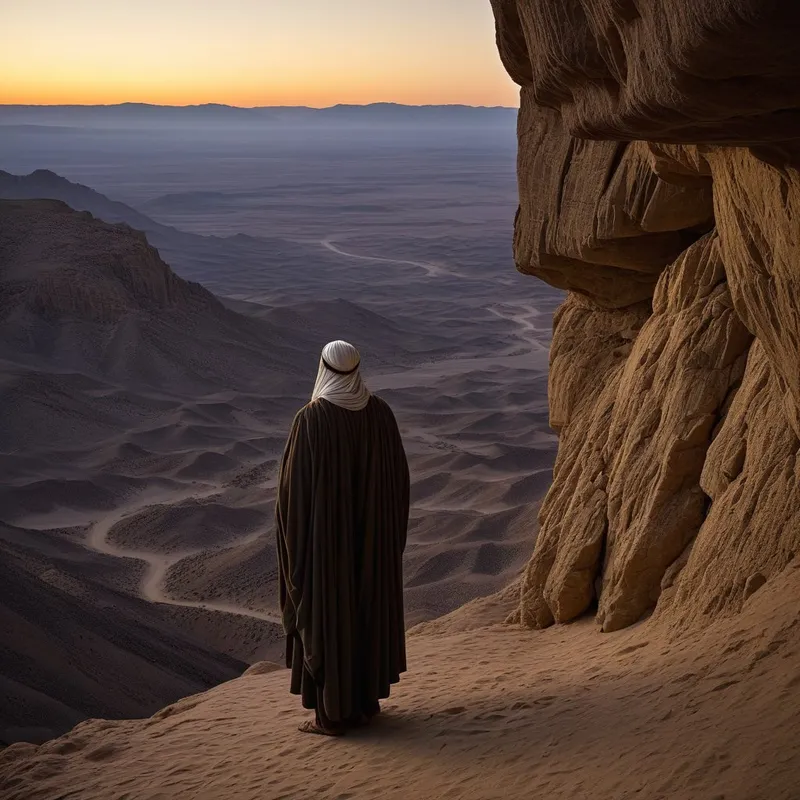
The wind came first. Not a breeze, but a scream torn from the throat of the world. It roared down the canyons of Horeb, a gale that could flay the skin from stone and snap the cedars of Lebanon like twigs. It scoured the mountain where the man, Elijah, stood trembling in the mouth of a cave. He had fled here, this prophet of the one God, a fugitive from the wrath of Queen Jezebel. He had called down fire from heaven, slain the prophets of Baal, and now he was alone, soul-sick, and begging for his own death beneath a broom tree. An angel had fed him, led him on a forty-day journey into this wilderness of revelation, and now commanded him to stand, for YHWH was about to pass by.
Elijah wrapped his mantle tight as the wind shrieked, tearing rocks from the mountain and hurling them into the void. He searched the fury for a face, a form, a voice. But YHWH was not in the wind.
Then the earth itself rebelled. A convulsion seized the bones of the mountain. The ground heaved and split, a deafening groan of grinding stone that shook Elijah to his teeth. Cracks like lightning fissured the cliff face; dust filled the air, thick and choking. In this primal tremor, the very foundation of the world seemed to undo itself. Surely, this was the presence of the Mighty One. But YHWH was not in the earthquake.
As the dust settled, fire descended. Not the controlled, altar-consuming fire of Carmel, but a ravenous, celestial inferno. It fell from a sky gone mad, licking the scorched rock, a blinding, roaring cascade of pure incineration. It was the essence of divine power Elijah had once invoked—purifying, terrifying, absolute. He shielded his eyes from the holocaust. But YHWH was not in the fire.
And then… silence.
A silence so profound it had weight and texture. It was not an absence, but a presence. The wind died. The earth stilled. The fire vanished, leaving only the scent of ozone and cooled stone. Into that vast, listening quiet came a sound. A qol demamah daqqah—a voice, a sound of thin silence. A still, small voice. It was no louder than the rustle of a thought, the whisper of a moth’s wing, the echo of a memory in a hollow heart.
And in that voice, barely audible yet piercing his soul with perfect clarity, Elijah heard the question: “What are you doing here, Elijah?” It was not in the cataclysm, but in the whisper after the storm, that the prophet finally found the presence he sought. He covered his face with his mantle, stepped to the cave’s mouth, and began to speak his truth into the gentle, terrifying quiet.

Cultural Origins & Context
This narrative is found in the First Book of Kings, Chapter 19, a text central to the prophetic tradition of ancient Israel. It emerges from a culture defined by covenant, conflict, and a profound theological struggle. Elijah’s story is set during the reign of King Ahab and Queen Jezebel in the 9th century BCE, a period marked by the intense pressure to assimilate the worship of Canaanite deities like Baal into Israelite life. The prophet represents the defiant voice of Yahwism, the insistence on the singularity and sovereignty of YHWH.
The myth was preserved and transmitted by scribal and priestly schools who saw in Elijah the archetype of the persecuted prophet. Its function was multifaceted: it was a theodicy for prophets facing failure and despair, a critique of equating divine power solely with spectacular displays (a temptation in the face of Baal’s storm-god imagery), and a profound theological statement. It taught that the God of cosmic power was also, and perhaps most intimately, the God of personal address—a deity who speaks not only through history-shaking events but through the intimate, interior space of conscience and call.
Symbolic Architecture
The myth’s power lies in its stark symbolic contrast. The wind, earthquake, and fire represent the expected modes of the numinous—external, overwhelming, coercive power. They are the archetypal symbols of cataclysmic revelation, the kind that forges nations and shatters idols. Psychologically, they mirror the tumultuous states of the psyche in crisis: the hurricane of anxiety (wind), the foundational shattering of identity (earthquake), and the purging, destructive rage or passion (fire).
The divine is not synonymous with the spectacular. The most profound truths often arrive not with a shout, but in the breath after the shout has faded.
The cave of Horeb is the womb of rebirth and the tomb of the old self. It is the sheltered, interior space one retreats to when the outer world becomes untenable. The journey to it—forty days in the wilderness—is a classic motif of dissolution and preparation, a stripping away of all societal supports.
The qol demamah daqqah, the “sound of thin silence,” is the central symbol. It represents the voice of the Self cutting through the noise of the persona (Elijah the public prophet) and the shadow (his despair and wish for death). It is intuition, conscience, and inner knowing. It signifies that ultimate meaning and guidance are not found by amplifying external chaos, but by cultivating an internal quiet robust enough to hear the subtle, guiding narrative beneath it.

The Dreamer's Resonance
When this myth pattern appears in modern dreams, it signals a critical juncture in the dreamer’s psychological process. One may dream of being deafened by storms, trapped in quakes, or blinded by fires—representing overwhelming life circumstances, emotional turmoil, or a psyche in the grip of powerful, undifferentiated archetypal energies.
The transition to the “still, small voice” in a dream is profound. It might manifest as: suddenly hearing a whisper in a soundproof room; finding a hidden, silent garden in the center of a warzone; or a loved one speaking a crucial truth with lips that move but make no audible sound, yet the message is understood perfectly. Somatically, the dreamer often reports a shift from tension to a deep, resonant calm upon waking.
This dream motif indicates the psyche is moving from a state of identification with the drama (the heroics, the victimization, the chaos) to a state of interior listening. The ego is being called away from the front lines of conflict to the command center of the Self. It is the beginning of discernment, where one learns to distinguish between the noise of complex-driven reactions and the quiet voice of authentic direction.

Alchemical Translation
The alchemical process mirrored here is solutio followed by coagulatio—dissolution and re-coagulation. Elijah’s flight into the wilderness is the solutio: his prophetic identity, his zeal, even his will to live, are dissolved in the acids of fear and failure. He is reduced to his bare essence beneath the broom tree.
The cataclysms at the mountain are the fiery and aqueous trials of the alchemical vessel, testing the matter (the prophet) to see if it will break or transform. They represent the temptation to find one’s worth and purpose in grand, dramatic struggles—the ego’s desire for a spectacular, defining confrontation.
Individuation is not a battle won with thunder, but a conversation heard in silence. The goal is not to become a wielder of the storm, but a vessel for the whisper.
The arrival of the “still, small voice” is the moment of separatio—the crucial separation of the subtle from the gross. The ego (Elijah) learns to separate the authentic voice of the Self from the thunderous projections of its own unmet needs and fears. The final instruction given to Elijah—to anoint new kings and a successor, Elisha—is the coagulatio. From the quiet center, a new, more conscious and less ego-driven purpose is formed. The energy that was once expended in solitary, dramatic battle is now channeled into legacy and succession.
For the modern individual, the myth teaches that the path to wholeness requires weathering the internal and external storms, not to conquer them, but to reach the silence they guard. Our deepest calling, our true mandate, does not scream for attention amidst our crises. It waits, patiently, in the quiet we must courageously cultivate after the world—and our own frantic minds—have finished their quaking and burning. The work is to stand at the cave’s mouth, mantle drawn against the allure of spectacle, and learn to listen for the sound of thin silence.
Associated Symbols
Explore related symbols from the CaleaDream lexicon: