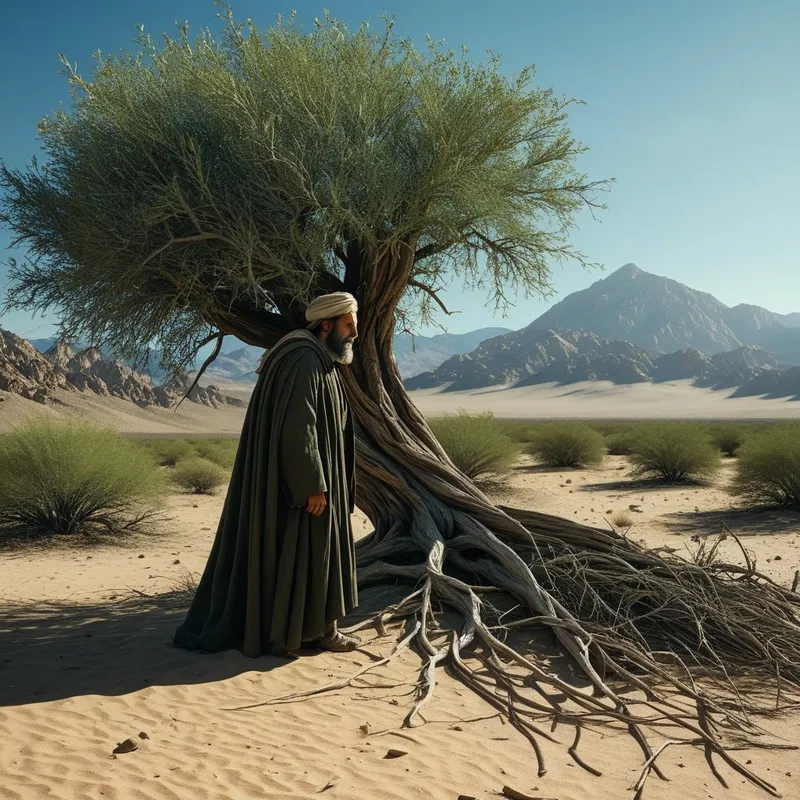
Elijah under the broom tree Myth Meaning & Symbolism
A prophet flees into the desert, prays for death under a solitary tree, and is met with a quiet miracle of sustenance and a voice in the silence.
The Tale of Elijah under the broom tree
Hear now the tale of the man of fire, whose words were lightning and whose zeal burned like the sun. His name was Elijah, and he stood alone against a tide of falsehood. On the heights of Mount Carmel, he called down the consuming fire of the heavens, and the people remembered their forgotten God. The rain, long withheld, broke upon the parched land at his word. It was his greatest triumph.
But triumph is a fleeting shadow. A single message, carried on the breath of a servant, undid him: “Jezebel seeks your life.” The fire in his bones turned to ash. The courage that defied hundreds fled from the threat of one. He did not stand. He ran.
He ran south, through the lands of Judah, past the last settlements, past the last wells, into the great, yawning mouth of the Negev. The sun was a hammer on an anvil of stone. The wind carried only the taste of dust. His soul was a dry cistern, cracked and empty. For a day he walked, until his strength was spent. He came upon a single, scraggly broom tree. Its grey branches were a fragile lattice against the blinding sky. It was enough.
He sank into its meager patch of shade. The weight of it all—the struggle, the loneliness, the fleeting victory—crushed him utterly. He was not a prophet here, only a man, broken. He prayed, but not for deliverance. His prayer was a sigh from the abyss: “It is enough; now, O Yahweh, take away my life, for I am no better than my fathers.” Then he lay down, and sleep, the brother of death, took him.
He did not know he was watched. As he slept, a touch—not a hand, but a presence—awoke him. There, at his head, was a cake of bread, baked on hot stones, and a jar of cool water. He ate. He drank. The simplicity of it was a shock to his system. Strength, not as a roaring flame, but as a quiet ember, began to glow. He slept again.
Once more, the touch. Once more, the humble feast. “Arise and eat,” a voice seemed to say, though the desert was silent, “for the journey is too great for you.” And he knew it was. He ate this second meal, and the sustenance worked in him not for a day, but for a pilgrimage. On that strength, he traveled forty days and forty nights, through the vastness of the desert, to the mountain of God, Horeb. He went not in fiery zeal, but in hollowed-out readiness. He came to the sacred mountain not to conquer, but to listen. And there, in the heart of a cave, he would wait for the voice that comes not in the wind, the earthquake, or the fire, but in the sound of a gentle, whispering silence.

Cultural Origins & Context
This story is preserved in the nineteenth chapter of the First Book of Kings, a text that forms part of the Tanakh and the Christian Old Testament. It belongs to the cycle of narratives concerning the “former prophets,” historical accounts infused with theological meaning. Composed during a period of national reflection, likely after the Babylonian exile, these stories served to explain Israel’s fate through the lens of covenant faithfulness.
The tale of Elijah’s flight would have been told not as a mere biography, but as a paradigmatic story for a community intimately acquainted with despair, exile, and the silence of God. The audience knew the desert; it was the place of testing, of the Exodus, of wandering. Elijah’s journey retraced the steps of Moses back to Sinai/Horeb, consciously linking his prophetic crisis to the foundational crisis of the nation. The storytellers—priests, scribes, and wisdom teachers—used this narrative to offer a complex theology of prophetic ministry: it is not defined solely by public victory, but often by private collapse, and is sustained not by spectacular power alone, but by simple, divine grace that meets basic human need. It functioned as a permission slip for despair and a map for the journey back to revelation.
Symbolic Architecture
The myth’s power lies in its stark, minimalist symbolism. Elijah is the archetype of the ego that has over-identified with its heroic role. He is the “man of God” who has forgotten he is also a man. His flight is not cowardice, but the inevitable collapse of a psyche that has burned its resources in a single, glorious, unsustainable act.
The broom tree is the symbol of the soul’s absolute limit. It is not an oak of strength, but the last, fragile shelter one can find before the abyss. It marks the point where the conscious project ends and the unconscious process must begin.
The desert is the nigredo, the necessary barrenness where all illusions are stripped away. The request for death is not literal suicide, but the ego’s honest admission that its current form cannot continue; a psychic structure must die. The angelic provision is the first gesture of the Self toward the exhausted ego. It is not a grand vision, but the basics: nourishment and rest. The “journey too great” is the path of individuation itself, which cannot be walked on the fuel of willpower alone. The forty-day trek to Horeb is the liminal period of incubation, guided by the sustenance received in the moment of surrender.

The Dreamer's Resonance
When this myth patterns a modern dream, the dreamer is in a state of profound psychic depletion. They may dream of collapsing at their desk, in an empty parking lot, or under a strange, withered tree in a featureless landscape. The feeling is one of utter defeat, of having given everything and having it amount to nothing.
Somatically, this is the body-mind signaling a critical systems overload. The “Jezebel” figure in the dream may not be a person, but an internalized pressure—a relentless inner critic, an impossible standard, or a life structure that has become toxic. The dream is not a sign of failure, but a crucial act of self-preservation. The psyche is forcing a “flight into the desert,” a withdrawal from the outer demands that are killing the spirit. The appearance of simple, elemental nourishment in the dream—a glass of water, a piece of bread, a blanket—points to the soul’s deepest, most non-negotiable needs: safety, sustenance, and sleep. The dream is the angel’s touch, initiating the first phase of recovery by commanding a total stop.

Alchemical Translation
The alchemy modeled here is the transmutation of heroic burnout into humble receptivity. The initial state is identificatio—Elijah is identical with his prophetic persona. The confrontation with Jezebel (the rejected shadow of ruthless power) triggers the mortificatio, the death under the broom tree. This is not the end, but the essential beginning.
The cake and water are the prima materia of the new consciousness. They represent the acceptance of one’s fragile humanity, the basic self-care that feels insultingly simple compared to the grandiosity of the former mission.
This acceptance is the solutio, a dissolving of the hardened ego in the waters of its own need. The forty-day journey is the separatio, a walking away from the old identity and the old battlegrounds. It leads to the cave of Horeb, which symbolizes the womb of the unconscious. Here, the old ways of perceiving the divine—the wind, earthquake, and fire of dramatic intervention—are passed by. The culmination is the coniunctio, the union with the divine not as external power, but as inner voice found in the “sound of sheer silence” (qol demamah daqqah). The prophet is re-commissioned, but his instructions are quieter, and he is told he is not alone. The process transforms the psychic orientation from doing for God to listening to the Self. For the modern individual, the myth charts the path from breakdown through basic self-compassion to a renewed, deeper, and more authentic sense of purpose, born not of frenzy, but of quiet communion.
Associated Symbols
Explore related symbols from the CaleaDream lexicon: