Elder Mother Myth Meaning & Symbolism
A myth of the spirit within the elder tree, teaching that life's deepest gifts require reverence, not force, and that true power is rooted in relationship.
The Tale of Elder Mother
Listen, and hear the whisper in the wind through the leaves. It speaks of a time when the world was closer to the bone, when every thicket held a secret and every tree a soul.
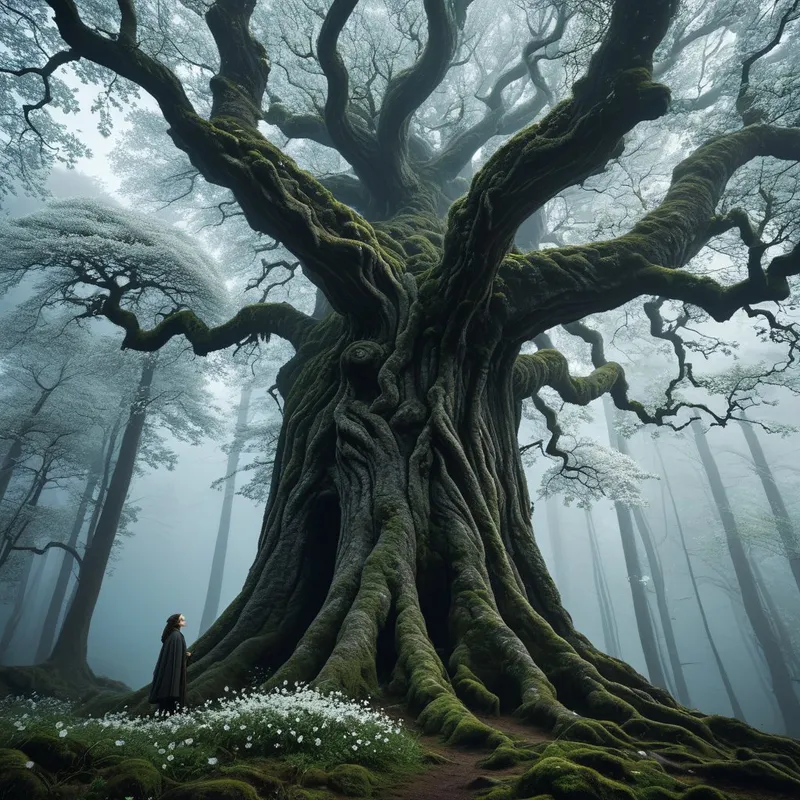
In the deep, shadowed forests of the North, where the Yggdrasil’s roots drank from hidden wells, there grew a tree unlike others. The elder. To the careless eye, it was but a shrubby thing, its wood soft, its branches tangled. But to those who knew the old ways, it was a threshold. Its creamy blossoms smelled of summer’s promise, and its dark berries held the blood of autumn. And within it dwelt the Hyldemoer, the Elder Mother.
The tale tells of a harsh season. A family, their hearth cold, their bellies emptier than a winter sky, sought shelter. They came upon a clearing where a great elder stood, its branches offering a canopy. Without a thought, the man of the house took his axe. “This wood will burn hot and fast,” he said, and raised the blade to strike.
But his wife stayed his hand. Her eyes, sharpened by hunger, saw more. She saw the trembling of the leaves, not from wind, but from a presence. She felt the watchfulness in the clearing. “Hold,” she whispered, her voice a dry leaf. “This tree is not ours to take. It is a home.”
The man scoffed, his need a sharper master than her caution. The axe bit into the trunk. A sound like a sigh echoed, not through the air, but through the very ground. He chopped again, gathering the pale wood.
That night, they built their fire. The elder wood crackled, casting long, dancing shadows that seemed to twist into shapes of anguish. They warmed their hands and slept. But as the wife drifted into dreams, a figure emerged from the smoke. She was ancient and immense, her form woven from bark and shadow, her eyes like deep pools in a forest floor. It was the Elder Mother. Her voice was the creak of a thousand branches.
“You took from my body without leave,” she intoned. “You gave no offering, spoke no word of honor. For this, you will know my grief.”
The wife awoke to a scream. Her child, her precious babe, was burning with a fever no water could quench, its skin hot as the embers of the felled tree. Desperation, cold and sharp, pierced her heart. She knew the cause. She knew the price.
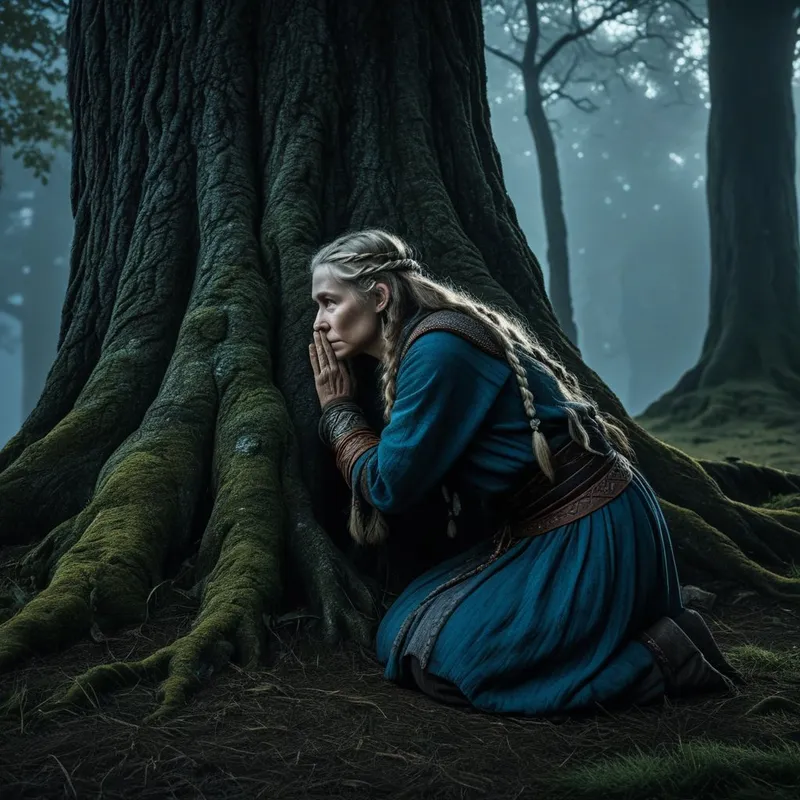
At first light, while her husband cursed the gods, the wife returned to the clearing. She fell to her knees before the wounded stump. She did not plead to the sky, but to the earth. She placed her palms upon the raw, weeping wood. Her tears fell upon the roots.
“Forgive our blindness, Great Mother,” she murmured, her breath a mist in the chill air. “We took in hunger, but we forgot the law of the gift. We see you now. We honor you. Spare my child, and I swear by the roots of the World Tree, our kin will never take from your children without asking. We will pour out milk for your roots and speak your name with respect.”
A silence fell, deeper than before. A single, perfect elder blossom, out of season, drifted down and settled upon the stump. The fever in her child broke like a spell. From that day, the law was given: No branch shall be cut, no flower picked, without a whispered request to the Hyldemoer. For she is the guardian, and her gift is protection, but her wrath is the sickness that comes from a hollow heart.
Cultural Origins & Context
This myth, surviving in Scandinavian and later Anglo-Saxon folk belief, was not a tale for the grand mead-halls of kings, but for the hearths and fields. It was a “folk” or “household” myth, passed from mother to daughter, from farmer to woodcutter. Its custodians were the women, the keepers of herbal lore and home medicine, for the elder tree was their profound ally. Its flowers eased fevers, its berries fortified blood, and its wood, carefully petitioned, could cradle an infant or fashion a flute to charm away ill spirits.
The myth functioned as a vital piece of practical and spiritual ecology. It encoded a core ørlög of reciprocity. In a worldview where every spring, hill, and tree could house a landvættir, the Elder Mother myth taught that survival was not a matter of conquest, but of negotiation. It was a reminder that the natural world was not inert matter, but a community of conscious beings. To take without acknowledgment was not merely rude; it was a dangerous rupture of cosmic law, inviting a retribution that was as somatic as a child’s fever.
Symbolic Architecture
At its heart, the Elder Mother is an archetype of the Anima Mundi—the World Soul—as it manifests in a specific, local form. She is the indwelling spirit of place and life, the conscious intelligence within nature that modern perception has often rendered unconscious.
The myth teaches that consciousness is not a human monopoly, but a field in which we participate. To recognize the spirit in the tree is to recognize the tree in the spirit of oneself.
The “fever” inflicted is not a random punishment, but a symbolic truth: violation of this sacred relationship results in a sickness of disconnection. The child, representing the future and the most vulnerable part of the self, falls ill. The healing comes not through force or appeals to higher, distant gods, but through a humble, direct, and somatic act of reconciliation with the very entity wronged. The wife’s offering is one of presence, tears, and spoken word—the currencies of relationship.
The elder tree itself is a perfect symbol of this hidden, feminine potency. Its wood is soft and seemingly useless for great works, yet it contains powerful medicinal virtues. It represents the wisdom that is not loud, dominant, or hard, but resilient, nurturing, and accessible only through respect.
The Dreamer's Resonance
When this myth stirs in the modern dreamer, it often surfaces in times of profound psychic or creative depletion. You may dream of cutting down a beautiful, living tree for kindling, only to feel a wave of profound, inexplicable guilt upon waking. Or you may dream of a mysterious illness—a burning fever, a rash, a weakness—that doctors cannot diagnose.
These dreams point to a violation of an inner “Elder Mother” principle. Have you been exploiting your own vitality—your creative sap, your emotional reserves—without reverence? Have you taken from your own body or psyche (the “land” you inhabit) without offering gratitude or rest? The fever is the somatic cry of an ignored aspect of the Self, the animating spirit of your own life, now demanding recognition.
The dream may also offer the solution: a figure of an old, wise woman made of natural elements, or the simple, potent act of kneeling and apologizing to a plant or an animal in the dreamscape. This is the psyche initiating its own ritual of reconciliation.

Alchemical Translation
The process modeled here is the alchemy of relationship transforming exploitation into symbiosis. The initial state is one of identification with the ego’s need—the hungry family sees only resource. This is the nigredo, the blackening, the moment of violent separation that causes the “fever” of psychic distress.
The wife’s realization is the albedo, the whitening, the moment of reflective clarity. She sees the autonomous life in the other (the tree, the inner resource) and recognizes the law of connection. Her act of kneeling, speaking, and offering is the sacred ritual—the rubedo, the reddening. It is not a grand heroic feat, but a humble, relational one.
Individuation is not just about integrating the shadow within, but about recognizing the soul without—in the world around us and the resources we draw upon. The Self is realized in the quality of its relationships.
For the modern individual, the “Elder Mother” ritual translates to a practice of conscious reciprocity. Before taking—be it time, energy, inspiration, or a physical resource—we are asked to “pour out the milk.” To pause, acknowledge the source, and give thanks. This transforms consumption into communion, and exploitation into a sacred exchange. It is the process by which we stop seeing the world as a dead thing to be used, and begin to experience it, and ourselves within it, as a living, soulful whole, where every act of taking is balanced by an act of honoring. In this way, we heal the fever of disconnection and are granted, not just what we need to survive, but the deeper gift of belonging.
Associated Symbols
Explore related symbols from the CaleaDream lexicon: