Eirene Myth Meaning & Symbolism
The myth of Eirene, goddess of peace, reveals peace not as an absence of conflict but as a living, fertile state of wholeness and divine order.
The Tale of Eirene
Listen, and let the stillness settle. In the time after the great thunder of the gods had quieted, when Zeus ruled from his cloudy throne, there walked among mortals and immortals a presence more felt than seen. Her name was Eirene, and she was a daughter of Themis, she of divine order, and sister to Dike and Eunomia. Where her sisters brought the scales and the law, Eirene brought the condition that made them possible.
She did not arrive with fanfare, but with the gentle closing of a door against a storm. Her footsteps did not echo on the marble; they were the silence between echoes. Men would be on the brink, spears raised, voices raw with the fury of Ares, when a sudden, profound exhaustion would wash over them. Not a weakness, but a remembering. They would lower their shields, and in the ringing quiet, they would hear the distant, hopeful cry of a child from a village they had forgotten they were defending. That was Eirene passing by.
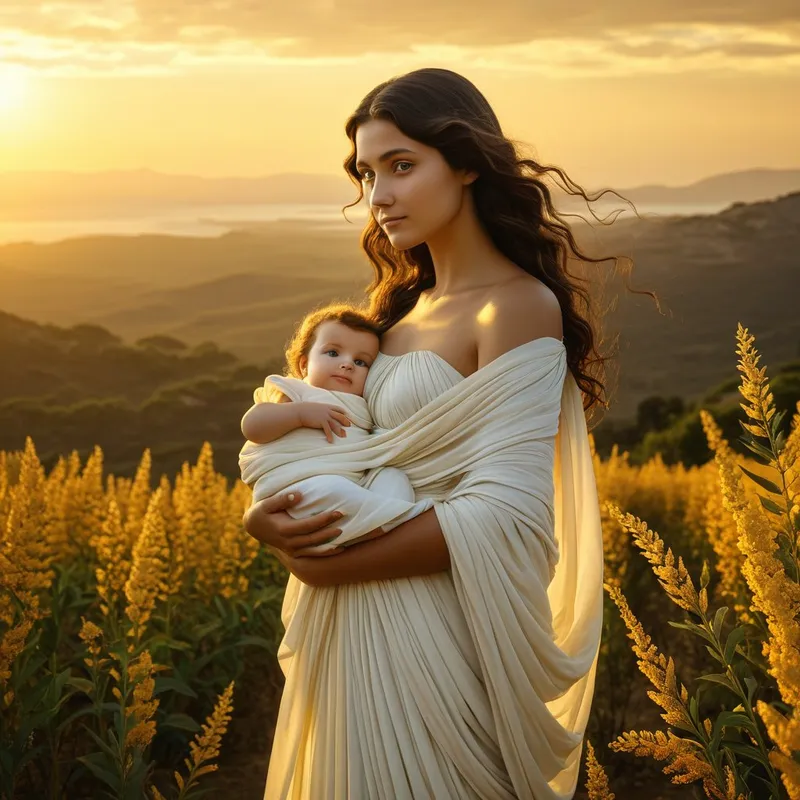
Her most sacred charge, her living symbol, was the infant Ploutos, the god of wealth and agricultural abundance. In the most famous tale sung of her, she is not depicted in battle or debate. She is shown standing, eternally serene, cradling the chubby, thriving child in her arms. This was her great work: to hold and nurture the potential for prosperity. For the poets knew a bitter truth—wealth in the hands of strife is but plunder, quick to dust. True wealth, the kind that fills granaries and children’s bellies, can only grow in the arms of Peace. She made the soil remember its purpose, to nurture seed, not to drink blood. She made the seasons turn in their proper order, not to the drumbeat of march, but to the rhythm of sowing and reaping.
Her presence was the resolution itself. It was the unspoken treaty in the eyes of former enemies, the shared labor to rebuild a broken wall, the first festival where old songs were sung without the taste of ashes. She was the rising of the morning star over a field where no one stood watch, a field that was simply a field again, waiting for the plough.
Cultural Origins & Context
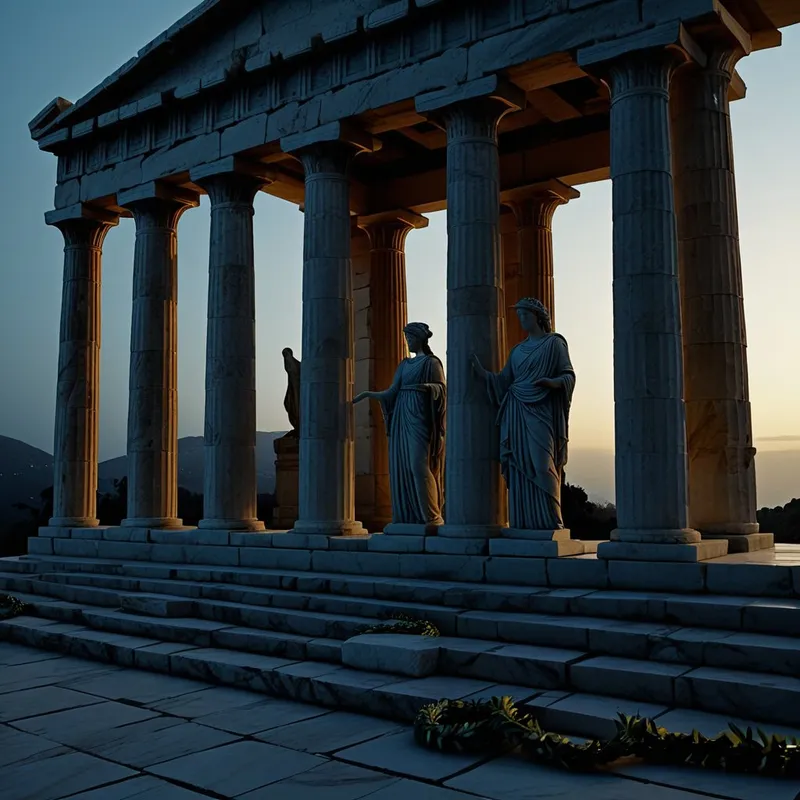
Eirene was not a major protagonist in epic cycles like the Iliad, where her absence is the very subject. Instead, her worship flourished in the conscious, civic-minded world of the city-state, particularly in Athens after the Persian Wars. Her rise in public veneration is a profound psychological shift from a worldview dominated by epic strife to one aspiring to self-governed stability.
She was one of the Horai, deities of the seasons and the right ordering of time and society. This placement is critical. Peace was not seen as a passive, static state, but as a season—a necessary, fertile phase in the natural and social cycle. Her cult was intrinsically linked to civic ideology. The great comic playwright Aristophanes staged a play titled Peace, where the hero ascends to heaven to rescue the goddess from a pit where the war god had imprisoned her. This was art serving a direct societal function: wish-fulfillment and political satire during the prolonged agony of the Peloponnesian War.
Her most famous physical representation was a statue by the sculptor Kephisodotos, erected in the Agora of Athens. This public art was not mere decoration; it was a civic prayer in bronze, a constant visual reminder to the assembly and the people of the state they were meant to cultivate and protect. The myth was passed down not only through poetry but through ritual, procession, and this daily, tangible presence in the heart of the city.
Symbolic Architecture
Eirene’s symbolism is deceptively simple, which is the mark of a foundational archetype. She represents Peace not as the end of conflict, but as the condition that follows it. She is the embodiment of the positive, creative state that becomes possible when destructive forces are integrated or subdued.
Peace is not an empty silence; it is the fullness that rushes in to fill the void left by strife.
Her primary symbol, the infant Ploutos, is the master key. It signifies that peace and prosperity are not just correlated but are mother and child. One nurtures the other. This challenges modern notions of peace as mere ceasefire or non-aggression. Eirene’s peace is generative. It is the psychological state where energy, previously bound in defense, projection, and conflict, is freed for creation, nurture, and growth. She symbolizes the transformation of raw, chaotic energy (the battlefield) into structured, life-giving energy (the fertile field).
As a Hora, she symbolizes the season of spring and harvest—the fruitful period of the cycle. Psychologically, this represents those periods in an individual’s life, or a society’s history, dedicated not to battling external demons or internal shadows, but to consolidation, enjoyment, and building upon hard-won ground. She is the archetype of integration, where opposing forces are not destroyed but brought into a tense, vital equilibrium that allows for new life.
The Dreamer's Resonance
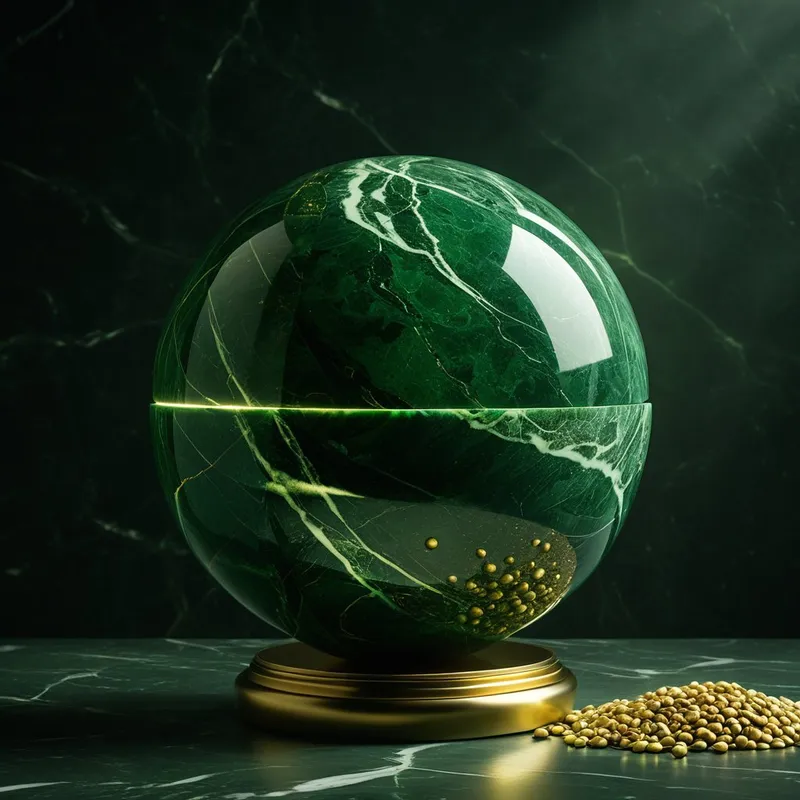
When the pattern of Eirene stirs in the modern dreamer, it often follows a period of intense inner or outer conflict. The dreams are not typically dramatic narratives, but potent, symbolic images carrying a specific somatic quality—a profound sense of relief, spaciousness, or quiet joy.
A dreamer might find themselves holding something precious and vulnerable—a baby, a delicate plant, a healed animal. The emotional tone is one of protective, calm nurture. They may dream of overgrown gardens suddenly bursting with ripe fruit, or of a long-locked room in their house now open, clean, and filled with soft light. There is a somatic shift from clenched tension to an open, breathable calm. The body in the dream feels capable, grounded, and gentle.
These dreams signal that a period of psychic warfare—perhaps with a critical inner voice, a difficult life transition, or a relationship conflict—is subsiding. The psyche is beginning to reallocate energy. The dream is the first bloom of what Carl Jung called the transcendent function: the emergence of a new, reconciling attitude from the tension of opposites. The dreamer is not just ceasing to fight; they are beginning to cultivate. The appearance of the nurturing figure or the fertile space is the psyche’s symbol for the birth of this new capacity.
Alchemical Translation
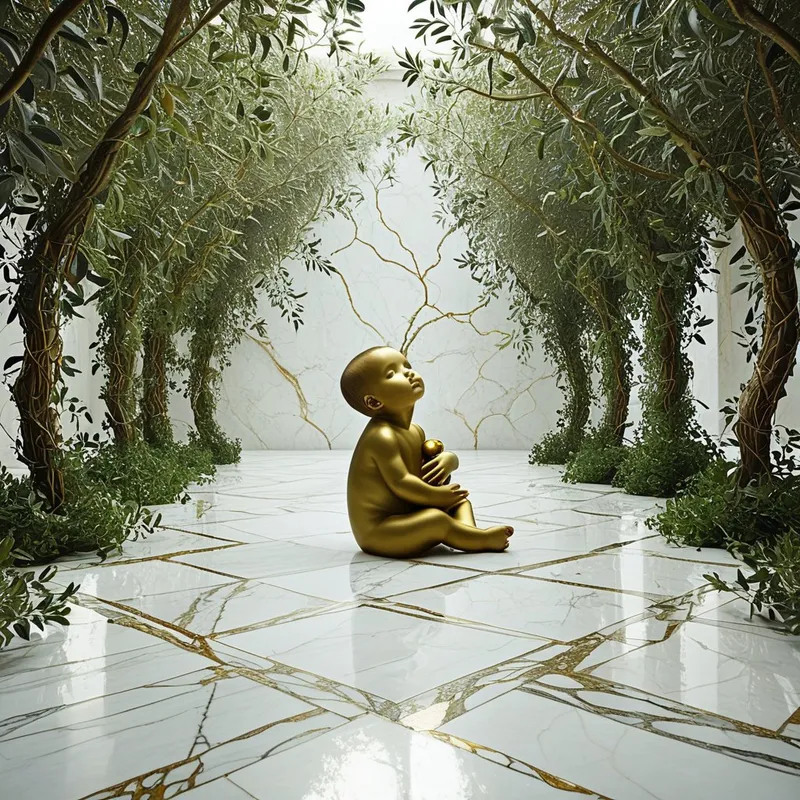
The alchemical process mirrored in Eirene’s myth is that of coagulatio—the stage following the dissolution (solutio) of conflict. In the alchemical vessel of the soul, after the fiery battles of separation and the watery dissolution of old identities, the matter must settle and re-solidify into a new, more integrated form. Eirene is the archetypal force of this coagulation.
For the modern individual on the path of individuation, the struggle is not to achieve a conflict-free life—an impossibility—but to learn to hold the tension of opposites until a third, reconciling element emerges. The “victory” is not over an enemy, but the attainment of a state where one’s inner resources are no longer wasted on civil war.
The individuated state is not one of perfect calm, but of productive tension, where energy flows toward creation rather than destruction.
The “infant Ploutos” one must learn to hold is the nascent, vulnerable new potential born from this inner reconciliation. It could be a creative project, a deeper capacity for relationship, a more authentic vocation, or simply a sustained inner contentment. This new potential is incredibly fragile at first; it can be shattered by a return to old, hostile patterns. The alchemical work is to become Eirene for oneself: to provide the serene, protected, and nourishing inner environment where this new wealth of the spirit can grow to maturity.
Thus, the myth instructs us that peace is an active, nurturing discipline. It is the daily choice to cradle the fragile new growth within and around us, to defend the quiet space where it can take root, and to understand that true abundance, in all its forms, is always the child of that profound and courageous stillness.
Associated Symbols
Explore related symbols from the CaleaDream lexicon: