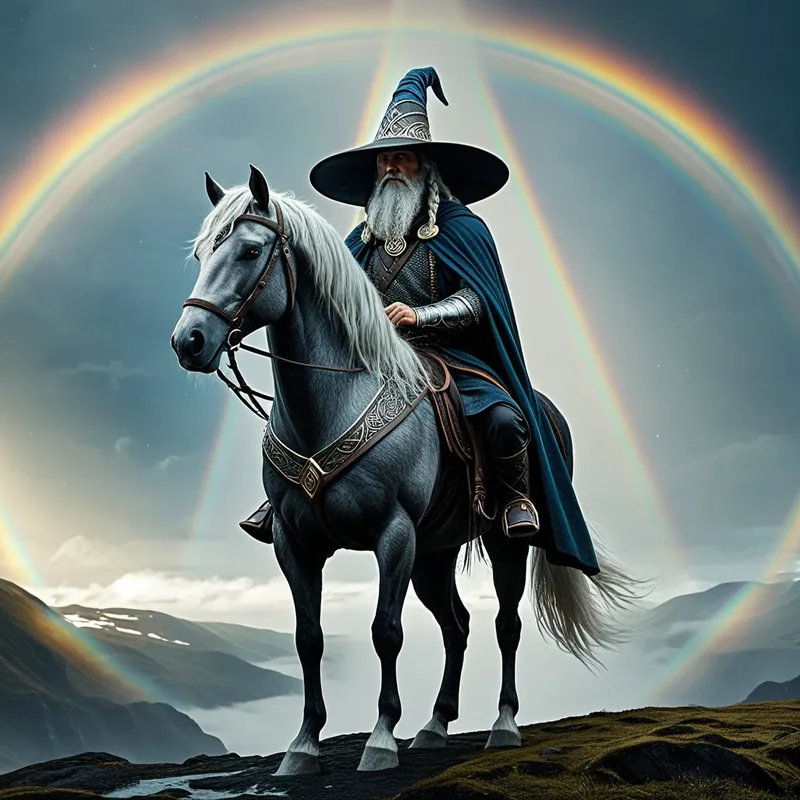
Eight-legged Sleipnir Myth Meaning & Symbolism
The story of Loki's monstrous, magnificent offspring, who becomes the steed that carries Odin between all worlds, embodying a union of opposites.
The Tale of Eight-legged Sleipnir
Listen, and hear a tale not of a god’s [triumph](/myths/triumph “Myth from Roman culture.”/), but of a trickster’s travail. It begins not in the golden halls of Asgard, but in the realm of stone and muscle, where the clang of hammer on anvil was the only song. A master builder, a giant of uncanny skill, came to the gods with an offer. He would build for them a fortress so mighty, so impregnable, that no jotun, no force of chaos, could ever breach it. His price? The sun, [the moon](/myths/the-moon “Myth from Tarot culture.”/), and the goddess [Freyja](/myths/freyja “Myth from Norse culture.”/) as his bride.
The gods laughed, a sound like cracking ice. Impossible, they said. The task could not be done in the single season he proposed. But the builder had a secret: his stallion, Svadilfari, a beast of tireless strength who hauled stones so massive they made the mountains tremble. As the weeks bled into months, the gods watched in dread. The walls rose, impossibly fast, perfect and seamless. The bargain, made in arrogance, was becoming a snare. They would lose the lights of [the sky](/myths/the-sky “Myth from Persian culture.”/) and the heart of their kin.
The air in Idavoll grew thick with panic and blame. It was then that Loki, the silvertongue, the weaver of schemes, was called to account. “You who counseled this pact,” Odin’s one eye burned into him, “you will find its unraveling. Or your own blood will seal it.”
Loki’s mind, a nest of serpents, coiled and struck. That night, as the builder drove Svadilfari to haul the final, capstone rocks, a marvel appeared at the forest’s edge. A mare, slender and fair, her coat like polished [moonstone](/myths/moonstone “Myth from Various culture.”/), her eyes deep pools of invitation. She whinnied, a sound that cut through the stallion’s duty. Svadilfari’s discipline shattered. With a roar that split the night, he broke his traces, chasing the phantom mare into the dark, tangled woods. The builder raged, helpless, his great work unfinished. The gods, seizing their technicality, called upon Thor, whose hammer [Mjölnir](/myths/mjlnir “Myth from Norse culture.”/) fell not on stone, but on the builder’s skull, returning him to the dust of his ancestors.
But Loki’s story was not done. He had run, and run, and in the running, a new life had been kindled. Seasons later, he returned to the gates of Asgard, not with a smirk, but with a creature trotting beside him. A foal, yet not a foal. Its coat was the grey of a gathering storm, its eyes held the calm of deep space, and from its shoulders sprang eight powerful, slender legs. It was a being of impossible anatomy, a child of deceit and divine strength, of trickster and titan-steed. The gods fell silent. Then Odin, the All-Father, the seeker of hidden roads, stepped forward. He saw not a monster, but a key. He named the creature [Sleipnir](/myths/sleipnir “Myth from Norse culture.”/), “the Slipper.” And with that naming, the creature of boundary and betrayal became the steed that would carry its rider beyond all boundaries.
Cultural Origins & Context
The myth of Sleipnir is preserved primarily in the Prose Edda of Snorri Sturluson, a Christian scholar writing centuries after the Viking Age. It is a story that would have been told in the longhouses, a narrative woven from the same cultural fabric as seafaring, oath-making, and facing an unforgiving world. The Norse worldview was not one of static heavens but of dynamic, interconnected realms—[Midgard](/myths/midgard “Myth from Norse culture.”/), Asgard, Hel—all held in the branches and roots of the great [Yggdrasil](/myths/yggdrasil “Myth from Global/Universal culture.”/).
In this context, the function of myth was not merely entertainment but cognitive mapping. The story of Sleipnir served multiple purposes. It was an etiological tale, explaining the origin of Odin’s famed mount. It reinforced the archetype of the cunning Loki as a necessary, if dangerous, problem-solver for the gods—the one who creates the mess and the means to escape it. Most importantly, it modeled a profound cultural value: utility over purity. Sleipnir is born of a shameful, bestial deception, a child of chaos. Yet, this very “flaw” is the source of his ultimate power. The Norse [psyche](/myths/psyche “Myth from Greek culture.”/), pragmatic and fierce, understood that strength often emerges from compromised, tangled origins. The tale validates the use of what is at hand, no matter its strange provenance, to survive and to traverse the great unknowns.
Symbolic Architecture
Sleipnir is not merely a fast horse. He is a living [symbol](/symbols/symbol “Symbol: A symbol can represent an idea, concept, or belief, serving as a powerful tool for communication and understanding.”/) of liminality—the state of being betwixt and between. His eight [legs](/symbols/legs “Symbol: Legs in dreams often symbolize movement, freedom, and the ability to progress in life, representing both physical and emotional support.”/) are the core of his [mystery](/symbols/mystery “Symbol: An enigmatic, unresolved element that invites curiosity and exploration, often representing the unknown or hidden aspects of existence.”/). They represent a doubling of the foundational four, the [number](/symbols/number “Symbol: Numbers in dreams often symbolize meaning, balance, and the quest for understanding in the dreamer’s life, reflecting their mental state or concerns.”/) of [stability](/symbols/stability “Symbol: A state of firmness, balance, and resistance to change, often represented by solid objects, foundations, or steady tools.”/), the [earth](/symbols/earth “Symbol: The symbol of Earth often represents grounding, stability, and the physical realm, embodying a connection to nature and the innate support it provides.”/), the cardinal directions. Eight is four transcended.
Sleipnir is the embodied paradox: the stable vehicle for unstable journeys, the born of deceit who enables the search for truth.
His eight legs suggest a [capacity](/symbols/capacity “Symbol: A measure of one’s potential, limits, or ability to contain, process, or achieve something, often reflecting self-assessment or external demands.”/) for [motion](/symbols/motion “Symbol: Represents change, progress, or the flow of life energy. Often signifies transition, personal growth, or the passage of time.”/) on a different order of [reality](/symbols/reality “Symbol: Reality signifies the state of existence and perception, often reflecting one’s understanding of truth and life experiences.”/). He can traverse not just land, but the elements themselves, moving between the worlds of the living (Midgard), the gods (Asgard), and the dead (Hel). He is [the psychopomp](/myths/the-psychopomp “Myth from Various culture.”/), the [conductor](/symbols/conductor “Symbol: A conductor represents guidance, leadership, and the orchestration of life’s various elements toward harmony.”/) of souls, but specifically for the god who seeks wisdom at any cost. Odin, who sacrificed an eye at [Mímir’s Well](/myths/mmirs-well “Myth from Norse culture.”/) and himself to himself on [the World](/myths/the-world “Myth from Tarot culture.”/) [Tree](/symbols/tree “Symbol: In dreams, the tree often symbolizes growth, stability, and the interconnectedness of life.”/), is the only rider worthy of such a steed. Together, they form a complete [unit](/symbols/unit “Symbol: Represents wholeness or completeness within the dream narrative.”/) of seeking: the [consciousness](/symbols/consciousness “Symbol: Consciousness represents the state of awareness and perception, encompassing thoughts, feelings, and experiences.”/) willing to pay the price (Odin) and the instinctual, trans-psychic [capacity](/symbols/capacity “Symbol: A measure of one’s potential, limits, or ability to contain, process, or achieve something, often reflecting self-assessment or external demands.”/) to travel to where the price is demanded (Sleipnir).
Sleipnir is also the ultimate symbol of Loki’s ambiguous “gift.” Loki’s actions are almost always catastrophically creative. He solves immediate crises by sowing the seeds of future ones (the binding of [Fenrir](/myths/fenrir “Myth from Norse culture.”/), the [death](/symbols/death “Symbol: Symbolizes transformation, endings, and new beginnings; often associated with fear of the unknown.”/) of Baldr). Sleipnir is perhaps his only creation that is an unadulterated boon, a pure [instrument](/symbols/instrument “Symbol: An instrument symbolizes creativity, communication, and the means by which one expresses oneself or influences the world.”/) of transcendence born from an act of profound deception. This encapsulates the [trickster](/symbols/trickster “Symbol: A boundary-crossing archetype representing chaos, transformation, and the subversion of norms through cunning and humor.”/)’s [role](/symbols/role “Symbol: The concept of ‘role’ in dreams often reflects one’s identity or how individuals perceive their place within various social structures.”/) in the psyche: to break frames, to cross forbidden boundaries, and in doing so, sometimes accidentally create the very tool needed for higher consciousness.
The Dreamer’s Resonance
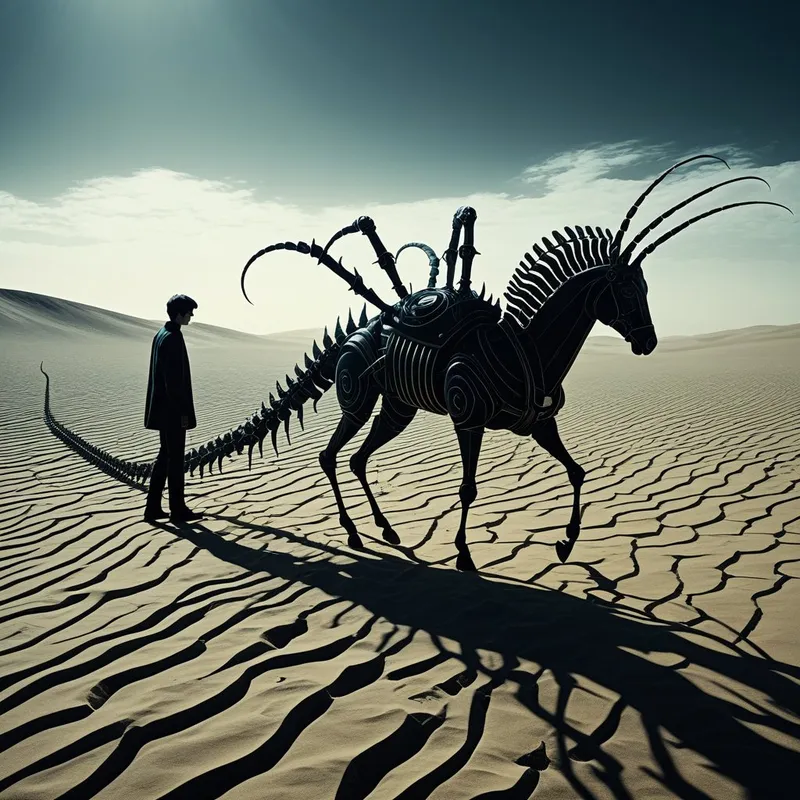
When the image of an eight-legged creature—horse, [spider](/myths/spider “Myth from Native American culture.”/), or something more abstract—gallops through the modern dreamscape, it signals a profound somatic and psychological process. It is the psyche announcing a readiness, or a necessity, to travel beyond binary thinking.
The dreamer may be stuck in a rigid either/or dilemma: stay or go, speak or stay silent, embrace a passion or uphold a duty. The eight-legged form emerges as a third option, a synthesis. It feels alien, “too much,” perhaps monstrous. This is the somatic reaction—the instinctive recoil from that which transcends our comfortable, four-square reality. The dream is presenting the vehicle for a journey the conscious ego is afraid to make: into [the underworld](/myths/the-underworld “Myth from Greek culture.”/) of repressed emotions (a journey to Hel), into the dizzying heights of new perspective (a ride to Asgard), or across the chasm between a past self and a future one.
The process is one of integration. The extra legs symbolize latent capacities, untapped energies, or conflicting aspects of [the self](/myths/the-self “Myth from Jungian culture.”/) that, rather than needing to be trimmed away, need to be coordinated into a new, more powerful gait. The dream asks: What seemingly “excessive” or “unnatural” part of you is actually the key to moving forward? What path can only be walked—or galloped—by embracing your own paradoxical nature?
Alchemical Translation
In the alchemy of the soul, the individuation process, Sleipnir models the stage of [coniunctio oppositorum](/myths/coniunctio-oppositorum “Myth from Alchemical culture.”/)—[the conjunction](/myths/the-conjunction “Myth from Alchemical culture.”/) of opposites. [The prima materia](/myths/the-prima-materia “Myth from Alchemical culture.”/), the base matter of the psyche, is the chaotic, shameful, or “monstrous” event: Loki’s shape-shifting coupling with Svadilfari. This represents those experiences we disown—traumas, compromises, instincts we consider beneath us—that feel like a betrayal of our self-image.
The steed of transcendence is always foaled in the stable of our deepest compromises.
The alchemical work is not to reject this offspring but to recognize its latent divinity. Odin’s act of claiming Sleipnir is [the ego](/myths/the-ego “Myth from Jungian culture.”/)’s conscious decision to mount and direct this powerful, born-of-chaos energy. The eight legs become the coordinated powers of the unconscious, now in service to the seeking consciousness. Riding Sleipnir means moving through life with a doubled stability, not because the path is easier, but because the vehicle is capable of navigating multiple levels of reality simultaneously.
For the modern individual, this translates to the hard-won ability to hold paradox. To be both strong and vulnerable, professional and playful, grieving and grateful. The “Sleipnir function” in the psyche allows us to travel to our own inner Hel (confront depression, loss, shadow) and return, to ride to our personal Asgard (aspire, create, envision) without losing grounding. It is the psychic organ that understands that our most profound forward motion depends on embracing the full, strange, multi-limbed story of our becoming. We do not transcend our nature by denying its messy origins; we transcend by saddling up the magnificent, eight-legged creature that those origins produced, and riding it toward the horizons of our own wisdom.
Associated Symbols
Explore related symbols from the CaleaDream lexicon: