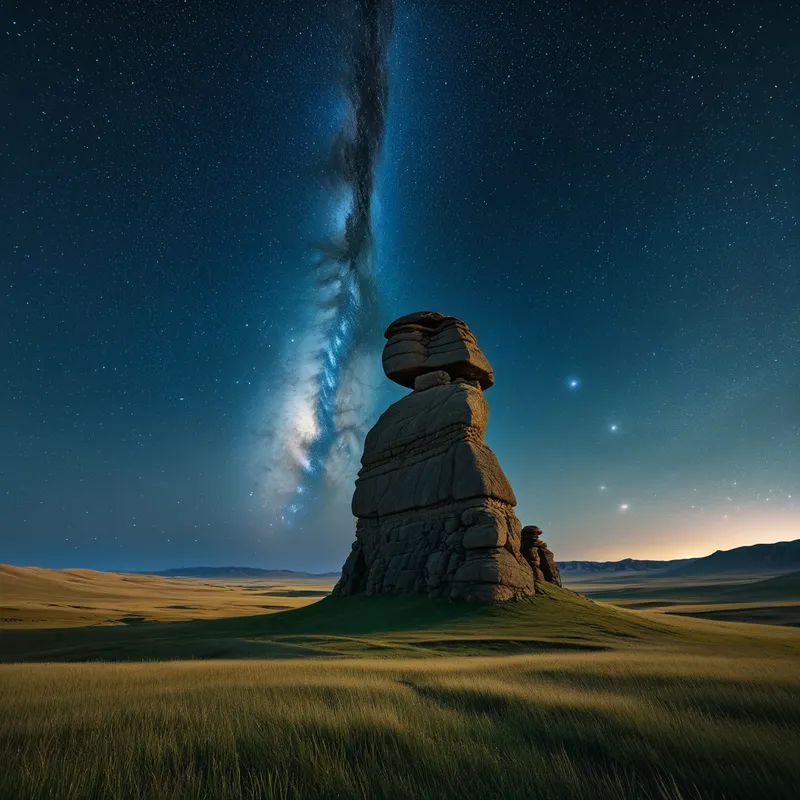
Eej Khad Mother Rock Myth Meaning & Symbolism
A myth of a sentient mountain, a grieving mother turned to stone, embodying the eternal, watchful spirit of the Mongolian landscape and its people.
The Tale of Eej Khad Mother Rock
Listen, and let the wind carry you back. Before the time of cities, when the world was a great, breathing expanse of grass and sky, there lived a woman. She was not a queen of palaces, but a sovereign of the steppe, her heart as wide as the horizon. Her name is lost to the whispering grass, but her title remains: Eej. She had children, bright sparks of life who laughed and ran like young foals across the green sea.
But the sky, that great blue Tengri, can turn its face. A shadow fell, borne on a cold wind from the north. It was a time of great wandering, a fracturing. Some say it was war, others say a famine that scattered the herds like dust. Her children, driven by need or destiny, had to leave. One by one, they mounted their horses and rode towards the four directions, their figures growing smaller until they were swallowed by the curve of the earth.
Eej stood on the highest hill, the place where she had watched over them all their days. She did not weep, for her sorrow was too vast for tears. It was a solid thing, a weight in her chest heavier than any stone. Day after day, she returned to that spot. She would lift her hand to shield her eyes from the glinting sun, searching the endless land for a sign of their return. She called their names into the wind, but the wind only carried her voice away and gave back silence.
The seasons wheeled. The grass turned gold, then white with snow, then green again. Her feet, planted firm upon the hill, began to sink into the soil. The wind, carrying the grit of centuries, began to coat her. The sun baked her skin; the rain etched lines into her face. Still, she watched. Her longing did not diminish; it concentrated. It became the very core of her being. Her flesh hardened. Her flowing deel stiffened into ridges of rock. Her outstretched arm became a steadfast promontory. Her watchful eyes became dark hollows in the stone, facing forever east, whence the sun—and hope—is born.
She did not die. She became. The hill itself reshaped itself to her vigil. Where once stood a woman of flesh and blood, now stood a great, silent sentinel of rock: Eej Khad. The people who passed by would touch her weathered surface and feel not cold stone, but a patient, abiding presence. They would leave offerings of milk or khadag, whispering their own hopes and sorrows to her. They knew she was listening. For in her stony silence was the memory of all farewells and the timeless hope for return.
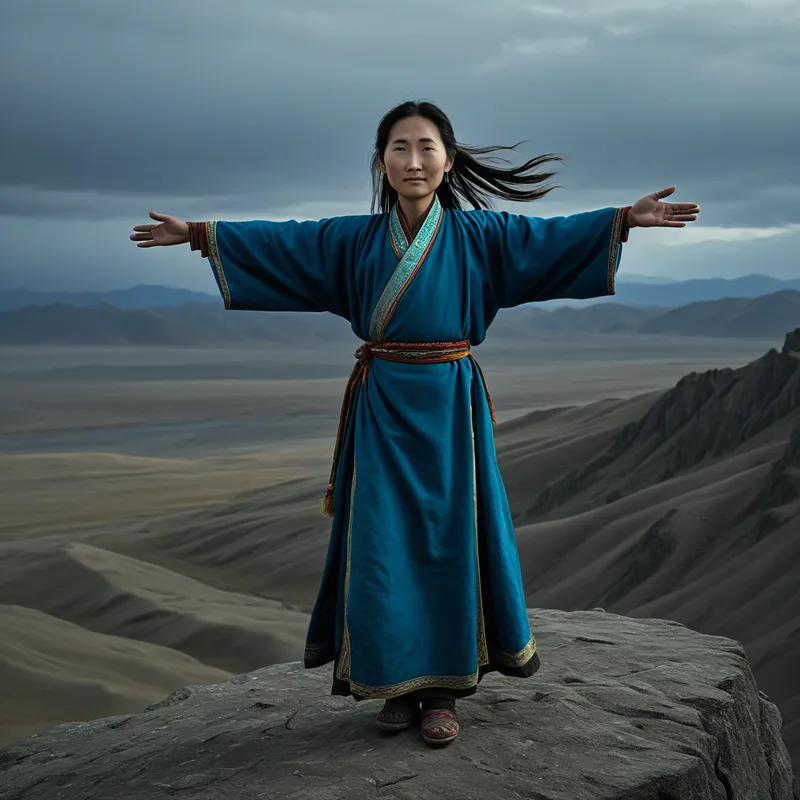
Cultural Origins & Context
The myth of Eej Khad is not a tale confined to a single scroll or epic poem; it is a landscape myth, born from the intimate, animistic relationship between the Mongolian people and their environment. In the tradition of Tengrism and Mongolian shamanism, the natural world is profoundly alive, imbued with spirit (ezen). Mountains, rivers, and unusual rock formations are not mere scenery; they are embodiments of history, memory, and spiritual power.
Eej Khad stories are local and specific, attached to particular, often woman-shaped, rock formations found across Mongolia and surrounding regions like Buryatia. They were passed down orally, not by professional bards, but within families and by herders moving with the seasons. The telling was often situational: a child would ask about a strange rock on the horizon, and a grandmother would recount the story, weaving the land itself into the family’s and the tribe’s narrative tapestry. Its societal function was multifaceted: it explained the sacredness of the landscape, encoded the values of maternal fidelity and endurance, and served as a psychological container for the universal experiences of separation, loss, and the hope that binds families across distance—a critical reality in a nomadic culture.
Symbolic Architecture
At its core, Eej Khad is a symbol of the psyche’s response to unbearable loss. The transformation from flesh to stone is not a punishment, but a profound metamorphosis of the soul’s substance. The mother does not collapse from grief; she consolidates. Her personal, human sorrow is alchemized into a universal, geological presence.
The most profound endurance is not defiance, but a willing transmutation into a vessel that can hold the ache of time itself.
The Rock symbolizes the eternal, the unchanging witness. In a world of flux—of migrating herds, shifting camps, and fleeting human lives—the rock stands firm. It becomes an anchor for memory, a literal touchstone for identity and continuity. Psychologically, Eej Khad represents the formation of the psychic backbone. When emotional reality is too fluid and painful to bear, a part of the psyche petrifies—not to die, but to create a permanent, reliable structure from which the rest of the self can orient. She is the internal mother who, even in her absence or silence, provides a constant, watchful point of reference.
The Dreamer's Resonance
When this myth stirs in the modern dreamer, it often manifests as dreams of profound stillness or immobility within emotional turmoil. One might dream of being rooted to the spot, unable to move or speak, while a storm rages or loved ones depart. The somatic sensation is often one of density, weight, or a hardening in the chest—the literal feeling of a heart turning to stone.
This is not a nightmare of paralysis, but a deep, unconscious process of psychic fortification. The dream ego is undergoing the Eej Khad process: facing a separation, a loss, or a grief that feels absolute. The unconscious responds by initiating a ritual of endurance. The dreamer is being shown the initial stages of building an inner monument, a part of the self that will become a permanent, unshakeable record of what was loved and what was lost. It is the psyche’s way of saying, "This feeling will not be forgotten; it will be made eternal within you." The discomfort is the friction of transformation, of soft tissue becoming resilient structure.
Alchemical Translation
The individuation journey modeled by Eej Khad is one of sacred petrification. In our modern alchemy, we are taught to seek fluidity, release, and letting go. Eej Khad presents a different, vital path: the art of holding on in the most profound way possible—not through clinging, but through transmutation.
The first stage is the Separation, the necessary exile of parts of ourselves (our inner children, our dreams, our vulnerabilities) due to the "famines" and "wars" of life—trauma, societal pressure, necessity. The second is the Vigil, the often agonizing period of waiting, hoping, and watching at the borders of consciousness for their return. The modern temptation is to abandon the hill, to numb the watch. The myth insists we stay.
The alchemical goal is not to dissolve the stone back into flesh, but to discover the luminous consciousness that can inhabit the stone.
The final, transformative stage is the Embodiment. This is where personal grief is offered up to the archetypal. The individual’s pain is slowly, organically merged with the substance of the Self—the eternal, foundational layer of the psyche. One becomes a landmark in one’s own inner landscape. This is not emotional calcification, but the creation of an inner sülde—a spirit-talisman of endurance. The person who has integrated this myth does not "get over" their loss; they become a sanctuary for it. They gain the rock-like quality of presence, offering silent, steadfast witness not only to their own history but, like Eej Khad, to the journeys of others who pass by their steadied soul.
Associated Symbols
Explore related symbols from the CaleaDream lexicon:
- Mother — The archetypal source of nurturance and protection, here transformed into an eternal, geological presence that watches over the psychic landscape.
- Rock — The core symbol of endurance, permanence, and memory, representing the psyche's ability to solidify profound experience into lasting structure.
- Mountain — The grand, immovable witness of time and human story, of which Eej Khad is a specific, maternal embodiment.
- Earth — The foundational element that receives and transforms the grieving mother, highlighting the myth's roots in animistic reverence for the land.
- Journey — The necessary departure of the children, representing the fragmenting forces of life that compel parts of the self to travel away from the core.
- Memory — The primary function of the petrified mother; she becomes a living monument to love and loss, preventing precious connections from being erased by time.
- Grief — The catalytic emotion that initiates the alchemical process, whose immense weight and pressure cause the transformation of flesh into stone.
- Stone — The end result of the process, symbolizing achieved stability, sacred silence, and the ability to hold a charge of meaning across eons.
- Heart — The organ of feeling that undergoes the most critical transformation, hardening not to stop feeling, but to feel in a permanent, crystalline way.
- Sky — The vast, often indifferent expanse of Tengri, representing the cosmic scale of fate and time against which the human drama of waiting is set.
- Wind — The carrier of voices and names into emptiness, and the elemental sculptor that slowly, patiently shapes the woman into her final, eternal form.
- Destiny — The force that calls the children away, and the same force that dictates the mother's transformation into an eternal landmark of the steppe.