Edelweiss Myth Meaning & Symbolism
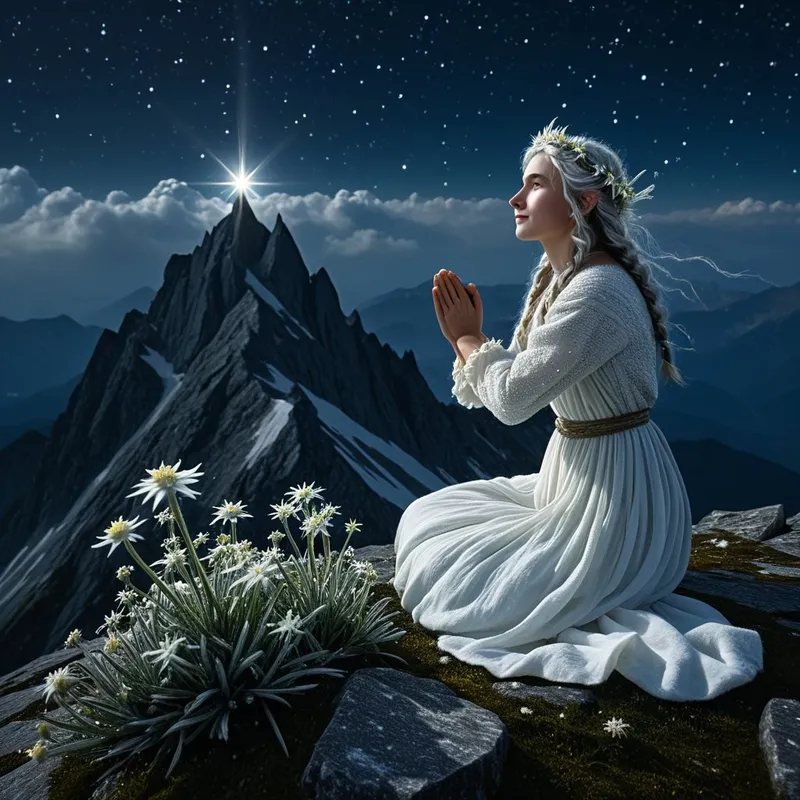
A celestial maiden, mourning her lost love, weeps stars into the stone, creating the Edelweiss as a testament to enduring love and purity.
The Tale of Edelweiss
Hear now a tale not of the valley’s soft green, but of the realm where stone meets sky, where the air is thin and the silence is a living thing. This is the domain of the Himmelsfrau, the Lady of the Heavens, who walks the razor-edged ridges and combs the clouds with her fingers of mist.
She was a being of luminous solitude, her heart a mirror to the cold, clear stars. Yet, in her eternal wandering, she beheld a mortal—a shepherd whose songs to his flock carried a melody so pure it echoed the harmony of the spheres. His eyes held the steady warmth of an earth-bound sun. A forbidden love bloomed, a bridge woven between the celestial and the terrestrial. For a season of alpine roses, they met in secret meadows above the timberline, where his mortal warmth met her star-chilled grace.
But the fabric of such a union is fragile. The shepherd, in his mortal daring, pursued a stray lamb across a crumbling cornice. The stone gave way. The Himmelsfrau’s cry was the sound of a glacier cracking. She raced to the edge, but found only empty air and the fading echo of his song. The mountains, her ancient home, had taken him. Her grief was a storm that froze in its first breath. No rain fell; no wind howled. A perfect, terrible stillness descended.
Then, she knelt upon the highest, most barren spur of rock, a place untouched by soil or seed. Looking up at the cold stars—her former kin—she did not plead. She began to weep. But these were not tears of water. They were tears of solidified starlight, of hoarfrost and moonlight. Each drop that fell upon the barren grey stone did not roll away. It clung. It crystallized. From each salted, stellar tear, a small, defiant form emerged: a tight cluster of woolly, white petals, arranged like a star itself, nestled against a bed of silvery, felt-like leaves. It was a flower born of absolute loss and eternal love, a living memory woven from celestial sorrow and mountain bone. She named it Edelweiss, the noble white one, and decreed it would grow only where the world is hardest, where the air bites, and where love is tested unto death. A beacon of purity, and a ward against the easy path.

Cultural Origins & Context
This myth, in its many localized variations, is the soul-song of the Alpine pastoral communities—the herdsmen, farmers, and hunters of Switzerland, Austria, Bavaria, and the Dolomites. It was not written in books but breathed into existence around hearth fires during the long, isolating winter months, or shared as cautionary wisdom during the ascent to the high pastures in spring. The tellers were the elders, the Sennen (alpine herdsmen), who spent months in the sublime and terrifying solitude of the high Alps.
Its function was multifaceted. Primarily, it was an etiological myth, explaining the origin of the enigmatic Edelweiss: why it grows in such inaccessible places and possesses its unique, almost otherworldly appearance. More deeply, it served as a narrative container for the profound respect and fear the mountains commanded. It taught that the high peaks were not just physical challenges but spiritual realms, inhabited by forces—like the Himmelsfrau—that were beautiful, austere, and utterly indifferent to human frailty. The myth encoded the very real dangers of alpine life (avalanches, falls, exposure) into a poetic framework, making the peril meaningful. To seek the Edelweiss was, therefore, to engage in a sacred, perilous quest that mirrored the soul’s own difficult ascent.
Symbolic Architecture
The Edelweiss is a perfect symbol of the coniunctio oppositorum—the marriage of opposites. It is a soft flower born from hard stone, a terrestrial plant woven from celestial substance (starlight tears), a symbol of love (the Himmelsfrau’s heart) existing in the realm of death (the shepherd’s fall).
The soul’s most profound purity is not born in comfort, but forged in the crucible of irreparable loss and anchored to the unyielding rock of reality.
The Himmelsfrau represents the archetypal Anima, the feminine soul-image of the mountains themselves—eternal, beautiful, distant, and potentially fatal. Her love for the shepherd symbolizes the momentary, glorious, and tragic connection between the human spirit and the transcendent, a connection that cannot be sustained in ordinary life. The shepherd embodies the mortal yearning for the sublime, a yearning that inevitably leads to a fall, a sacrifice, or a fundamental transformation. The flower itself is the symbol, the tangible, living residue of that transcendent encounter. It is not the union, but its beautiful, enduring memorial.
The Dreamer's Resonance
When the Edelweiss blooms in the modern dreamscape, it rarely appears in a sunny meadow. It is found on a precarious ledge, in a crack in a dream-city’s concrete wall, or floating in the void of a dark night sky. To dream of seeking it signifies a soul-navigation towards something perceived as pristine, noble, and achingly out of reach—a state of inner purity, a lost love, a spiritual ideal, or a core truth of the self.
The somatic feeling is one of elevation and exposure. The dreamer may feel the thinness of the air, the chill, the vertigo. This is the psyche signaling that it is approaching a high, defended value within itself. The arduous climb represents the difficult, often lonely, psychological work required to integrate a complex—perhaps a grief (the Himmelsfrau’s) or an ideal (the shepherd’s song). Finding the flower and the potential danger of picking it mirrors the dilemma of integration: to claim this pure, hard-won aspect of the self is a triumphant act of individuation, but it also risks a “fall” back into old patterns, a sacrilege against the sacred solitude of that inner truth. The dream is a map of the psyche’s most treacherous and rewarding terrain.
Alchemical Translation
The myth of the Edelweiss is a precise allegory for the alchemical process of individuation. The initial state is one of separation: the celestial (spirit) and the earthly (ego-consciousness) exist apart. Their union—the mysterium coniunctionis—is the glorious, fleeting experience of Self-realization, often triggered by love, art, or a peak experience. But this union cannot be held; the mortal vessel (the shepherd/ego) must “fall,” must be sacrificed.
The true alchemical gold is not the eternal union, but the enduring symbol that is created in its aftermath—the tangible proof that the transformation occurred.
This “fall” is not a failure, but a necessary mortificatio, a dissolution. From this dissolution, the Himmelsfrau’s conscious, enduring grief—the acceptance of the loss—becomes the prima materia for the new creation. Her tears, the conscious suffering of the psyche, are the solvent. The barren rock is the hardened, resistant core of the personality. The act of weeping upon it is the painful, patient work of applying conscious suffering to our inner resistances.
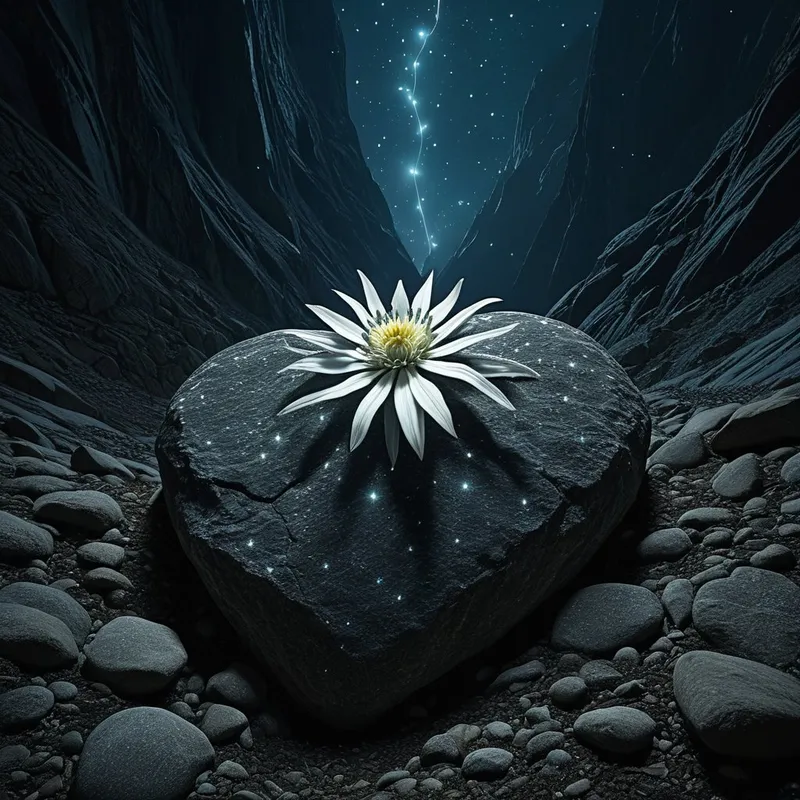
The Edelweiss that results is the lapis philosophorum, the philosopher’s stone, of this personal myth. It is the integrated symbol. It is not the transcendent experience itself, but the durable, beautiful, and unique complex of meaning we construct from it. It becomes a part of our inner landscape, growing in the highest, most defended reaches of our being—a testament that we loved, we lost, and we created something eternally noble from the ache. To undertake the quest for one’s own Edelweiss is to commit to the most arduous and sacred of journeys: the ascent to meet one’s deepest sorrow and, from it, to weave a star.
Associated Symbols
Explore related symbols from the CaleaDream lexicon: