
Earthly Paradise Myth Meaning & Symbolism
A primordial world of perfect harmony is fractured by a choice, casting humanity into a world of striving and memory, forever longing for a lost home.
The Tale of Earthly Paradise
Listen. Before the first word was spoken, before the first tear was shed, there was a place. Not a kingdom in the sky or a realm beneath the waves, but a garden woven into the very fabric of the world. They called it the Primal Unity. Here, the sun and moon danced together in a sky of soft pearl, casting no harsh shadows, only a gentle, dappled gold. The air was the breath of life itself, sweet with the scent of soil that had never known decay and blossoms that never fell.
In this garden, the Awakened Ones walked. They did not toil, for the earth offered its bounty freely. They did not hunger, for the fruits of the Tree of the Center nourished spirit and body as one. They did not know loneliness, for their thoughts flowed like the clear rivers, mingling with the songs of the birds and the whispers of the wind. There was no "I," only a vast, humming "We." Time was not a river carrying them away, but a deep, still pool in which they rested.
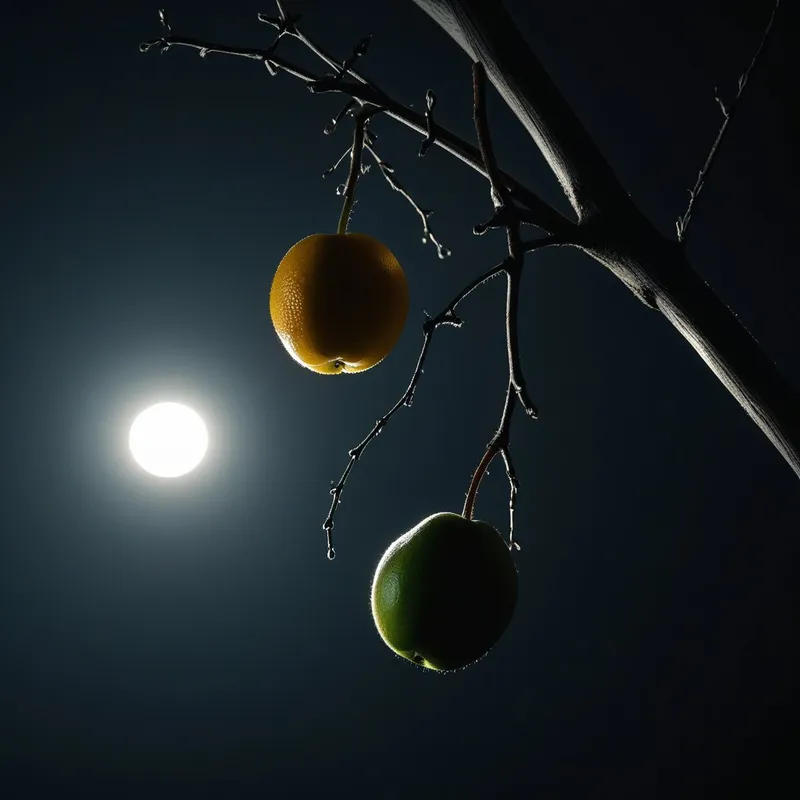
But at the very heart of the garden, where the two gentle suns crossed paths, grew a second tree. Its bark was dark as a starless midnight, yet its leaves shimmered with a cold, silver light. This was the Tree of the Veil. Its fruit was not forbidden, but it was… silent. It did not sing with the chorus of the garden. It held a profound quiet, a stillness that felt like a question. The guardians of the place, the Weavers of Harmony, spoke of it in hushed tones. "To partake," they said, "is to see the threads that make the tapestry. To know the pattern is also to see how it might be undone, and rewoven."
For ages uncounted, the Awakened Ones were content. But a whisper began, not from outside, but from within the harmony itself—a faint pulse of curiosity, a stirring like the first itch of a new sense. One among them, let us call them The One Who Turned, found their gaze returning to the Veil Tree. The perfect chorus of the garden began to feel… complete. And in that completeness, a strange, quiet hunger was born.
The day it happened, the twin suns hesitated. The One Who Turned approached the silver-leaved tree. The air grew thick and resonant. They reached out, and as their fingers brushed the cool, enigmatic fruit, a shock ran through the garden—a silent, seismic tremor in the realm of spirit. They tasted it.
The world did not shatter with a roar, but with a sigh. The single, luminous note of existence fractured into a symphony of distinct tones. The One Who Turned saw, for the first time, their own hand as separate from the branch, their own breath as distinct from the wind. They saw the beautiful, terrifying individuality of every leaf, every stone, every other Awakened One. With this knowledge came a flood of new words: "mine," "yours," "alone," "future," "past."
The Primal Unity was irrevocably altered. The garden remained, but it was now perceived through a veil of separation. The path back to unconscious unity was closed, replaced by a winding road forward into a world of time, choice, effort, and longing. The Awakened Ones, now truly awake as individuals, walked out of the eternal dawn into the rising and setting sun, carrying within them the memory of a lost home, and the seed of a new world to be built.
Cultural Origins & Context
The myth of the Earthly Paradise is perhaps the most ubiquitous story humanity tells itself. It is not the property of any one tribe or scripture, but a foundational layer of the human psyche, emerging in countless forms across epochs and continents. We find it in the Garden of Eden, in the Greek Golden Age, in the Persian Pairidaeza, in the Buddhist Shambhala, and in the countless "lands of youth" and "isles of the blessed" in Celtic and other folklore.
Its primary societal function was not to document history, but to explain a profound psychological and existential condition. It was told by shamans, bards, and elders around fires, not as a simple morality tale, but as an answer to the most piercing questions: Why do we feel a sense of loss in the midst of beauty? Why must we work and suffer? Why are we conscious of our own mortality? The myth served as a container for this collective nostalgia, this "anamnesis" or remembrance of a state of being that feels both utterly alien and deeply familiar. It established the human condition as one of departure, framing our entire journey as a potential return to a transformed wholeness, not a regression to innocence.
Symbolic Architecture
The Earthly Paradise is not a place on a map, but a map of the original, undifferentiated psyche. It represents the pre-conscious state of infancy, both personal and species-wide, where the ego is not yet formed, and the self exists in seamless union with the mother-world.
The Paradise is the psychic womb; the Fall is the trauma and triumph of birth into consciousness.
The Tree of the Center symbolizes the Self in its total, nourishing completeness. The Tree of the Veil is the archetype of consciousness itself—the terrifying gift of discernment that separates subject from object, enabling knowledge, choice, and ultimately, responsibility. The fruit is not "sin," but the catalyst for individuation. The Weavers of Harmony represent the innate, conservative ordering principles of the psyche that resist the chaotic, creative force of emerging consciousness.
The myth’s core drama is the inevitable, necessary rupture of the unconscious paradise. It posits that wholeness without consciousness is not a sustainable state for a developing being. The "fall" is, symbolically, the first step toward becoming an individual.
The Dreamer's Resonance
When this myth stirs in the modern dreamer, it rarely appears as a literal garden. It manifests as a profound, often melancholic, sense of recognition. You dream of a house with a room you had forgotten, filled with a perfect, peaceful light. You dream of a landscape of impossible beauty that you know, with aching certainty, is your true home, just as you wake and lose it.
These dreams often surface during life transitions: leaving home, ending a relationship, becoming a parent, or facing one's own mortality. They signal a psychological process of separation from an old, comfortable state of being—a psychic "paradise" that may have been a dependent relationship, a rigid identity, or a period of naive certainty. The somatic feeling is one of deep longing, often located in the chest or solar plexus—a "heartache" for a unity that is dissolving. The dream is the psyche mourning the loss of an old wholeness, preparing the ground for a new, more conscious one to be earned.
Alchemical Translation
The alchemical journey, like the myth, begins with the prima materia—the original, unconscious state (the Paradise). The crucial first operation is separatio, the division of the unified substance into its constituent parts (the tasting of the fruit). This is not an error, but the essential, painful beginning of the Great Work.
The goal of the individuation process is not to crawl back into the Garden, but to cultivate a conscious paradise within the field of one's own experienced life.
For the modern individual, the "Earthly Paradise" is the state of psychological projection, where we expect the outer world (a partner, a job, a ideology) to provide perfect, unconscious harmony. The "fall" is the disillusionment when that projection fails. This crisis is the invitation to the alchemical work: to withdraw those projections and integrate their contents.
The fruit of the Tree of the Veil is the bitter medicine of self-knowledge. To undergo this transmutation is to stop seeking paradise out there and begin recognizing that the elements of the lost garden—the unity, the nourishment, the harmony—exist as disowned potentials within. The Tree of the Center is then rediscovered not as a location, but as the core of the integrated psyche, the Self, which can only be approached after one has courageously journeyed through the world of separation, time, and choice. We are not exiled from Paradise; we are exiled for Paradise's sake, so that we may one day return to it bearing the hard-won gift of our own conscious awareness.
Associated Symbols
Explore related symbols from the CaleaDream lexicon: