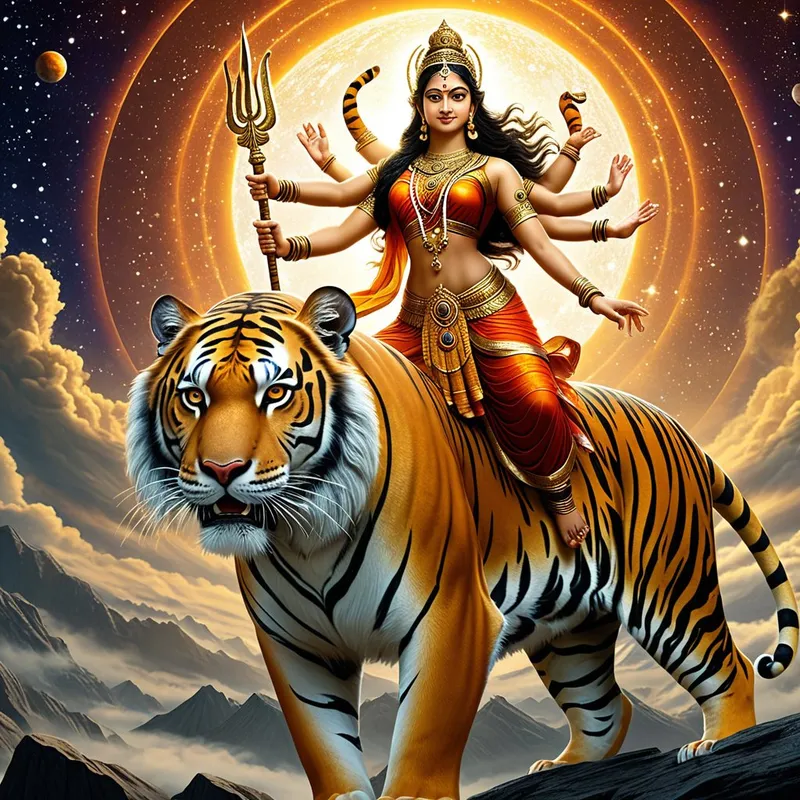
Durga's Tiger Myth Meaning & Symbolism
The myth of the goddess Durga and her tiger mount, a story of primal feminine power taming chaos to restore cosmic and psychic order.
The Tale of Durga's Tiger
Listen. Before the worlds were set in their courses, when the breath of creation was still hot upon the void, a terror was born. Not from the dark between stars, but from the very substance of chaos itself. His name was Mahishasura. Through terrible austerities, he had wrested a boon from Brahma: no man, no god, no beast born of male seed could slay him. Drunk on this invincibility, he swelled. His shadow fell across the heavens. He drove the devas from their thrones, scattering them like dust. The cosmos groaned under the weight of his unchecked tyranny. The axis of dharma tilted, threatening to snap.
In their desperation, the exiled gods gathered on a wind-scoured peak. Their rage, their fear, their divine light—it coalesced into a searing point of agony. And from that collective anguish, a form began to take shape. Not from a womb, but from the very essence of their being. Fire from Agni became her skin. The fierce glow of the sun, from Surya, became her eyes. The mountains gave their unshakeable firmness to her limbs. The oceans, their relentless depth to her voice. From the combined shakti of all that is, she emerged. Durga. She was beauty that blinded, power that humbled. Ten arms held the distilled weapons of the gods: Vishnu's discus, Shiva's trident, the thunderbolt of Indra.
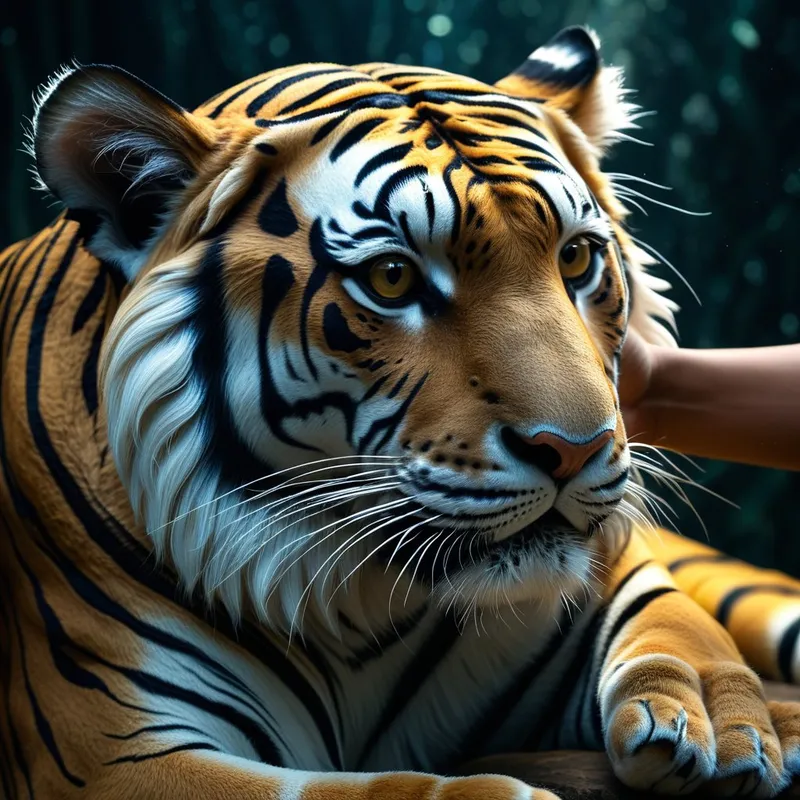
But a goddess of such magnitude required a mount worthy of her mission. The gods turned to the lord of the wild, the king of the untamed earth. From the deepest jungles of the psyche, from the realm of raw, instinctual power, he came. Not as a servant, but as a partner chosen. A tiger. His stripes were shadows of ancient forests, his muscles coiled like mountain ranges. His breath was the hot wind before a storm, his roar the sound of tectonic plates shifting. He approached the radiant goddess, and in a moment of silent understanding that shook the foundations of the world, he bowed his great head. She laid a hand upon his brow, not to break his spirit, but to align it. Her will became his direction; his ferocity became her vehicle.
Then began the cataclysm. Durga, astride her tiger, descended upon the demon's realm. The battle was not of armies, but of principles. Mahishasura shifted forms—a raging buffalo, a lion, an elephant—each a metaphor for a different facet of brute, shape-shifting ego. Durga, unwavering, met each transformation. Her tiger was a blur of orange and black, a living storm beneath her. He was not merely transport; he was the embodiment of her focused, righteous fury. When the demon, in his buffalo form, charged with the force of a world-ending deluge, it was the tiger who sprang, pinning the beast with claws of diamond resolve. And in that suspended moment, as chaos was held at bay by disciplined power, Durga drove her trident deep, piercing the illusion of invincibility. The demon fell. The cosmos sighed, its balance restored. The tiger let out a roar that was not of conquest, but of completion. The goddess dismounted, her hand once again resting on his head. The war was over. The partnership, eternal.
Cultural Origins & Context
The myth of Durga and her tiger is central to the Shakta tradition of Hinduism, which venerates the Goddess as the ultimate reality. Its most famous textual recounting is in the Devi Mahatmyam, part of the Markandeya Purana, composed roughly between the 5th and 7th centuries CE. This was not a story confined to parchment; it was, and remains, a living narrative performed and celebrated during the festival of Navaratri or Durga Puja.
For centuries, the story was transmitted by village storytellers, temple priests, and through dramatic folk performances. Its societal function was multifaceted. On one level, it was a cosmic charter, explaining the necessity of divine intervention to restore order (dharma). On another, it served as a powerful metaphor for kingship and righteous rule—the sovereign must master the chaotic forces within and without the kingdom. Most profoundly, for the common person, it provided a template for confronting personal and collective adversity. The goddess, born from the combined energy of the powerless, demonstrated that the solution to overwhelming tyranny lies not in scattered resistance, but in the unified, conscious channeling of one's own latent, primal power—the shakti within.
Symbolic Architecture
At its heart, this myth is an intricate map of psychic integration. Durga represents supreme, conscious intelligence—the unified Self. She is not born of duality (male and female), but from the convergence of all divine attributes, symbolizing a consciousness that has integrated all aspects of the psyche.
The tiger is the myth's most potent and complex symbol. It is not evil, nor is it merely "wild nature." It is raw, instinctual life-force—the libido, the aggressive drive, the survival instinct, the immense energy of the unconscious. Untamed, this force is dangerous and chaotic, capable of destroying the delicate structures of the psyche (the exiled gods). But denied or repressed, the individual becomes weak, unable to act decisively in the world.
The tiger is the unlit fire of the soul; Durga is the consciousness that kindles it into a guiding flame, not a consuming wildfire.
Mahishasura, the shape-shifting buffalo-demon, embodies the inflated, tyrannical ego. His boon—that no male can kill him—is the ultimate trick of the unintegrated psyche: the conscious, logos-driven, "masculine" principle alone cannot defeat the demon of egoic possession. It requires the intervention of the feminine principle, not as gender, but as the archetypal force of relatedness, embodiment, and transformative power (shakti). Durga's victory signifies the triumph of the holistic Self over the fragmented, despotic ego. Her riding the tiger is the critical image: conscious will does not annihilate instinct; it directs it. The power is mastered, not murdered, and in that mastery, becomes the very vehicle for the heroic task.
The Dreamer's Resonance
When the motif of Durga's Tiger surfaces in modern dreams, it signals a critical juncture in the dreamer's psychological process. It is rarely a peaceful image. One may dream of being chased by a tiger through an urban labyrinth, representing a terrifying confrontation with one's own repressed aggression or vital energy. Alternatively, one might dream of trying to calm or approach a powerful, caged tiger—a symbol of instinctual power that is recognized but not yet integrated, feeling both alluring and dangerous.
Somatically, this dream pattern often correlates with a feeling of being "ridden" by intense emotions—anger, passion, or a drive for change that feels bigger than the conscious self. There may be physical sensations of heat, tension in the solar plexus (the seat of personal power), or a restless, prowling energy. Psychologically, the dreamer is likely facing a situation that demands they access a deeper, more potent, and perhaps more ferocious part of themselves to overcome an internal or external "demon"—be it a oppressive situation, a toxic pattern, or a profound self-doubt. The dream is an invitation from the unconscious to stop running from one's own power and to learn, like Durga, to mount it.

Alchemical Translation
The myth of Durga's Tiger is a perfect allegory for the Jungian process of individuation—the alchemical work of becoming a whole, integrated individual. The initial state is one of possession: the ego (Mahishasura) has seized control of the psyche, promising invincibility but creating exile and disorder. The gods—the other archetypal potentials within us—are scattered and powerless.
The first alchemical stage, the nigredo or darkening, is the collective anguish of the gods. It is the depressive, chaotic feeling that the current conscious attitude is leading to ruin. From this darkness, the new unifying principle is born: the Self (Durga). This is not an act of willful creation, but a spontaneous emergence from the depths of the psyche when the old order fails.
Individuation is not about becoming perfect, but about becoming responsible for the tiger within—to direct its ferocity with the grace of consciousness.
The core alchemical operation is the coniunctio, the sacred marriage, depicted as Durga mounting the tiger. This is the integration of the shadow—the acceptance and conscious direction of one's instinctual, animal nature. The tiger's energy, once a latent threat, is now the fuel for the heroic journey. The final battle represents the enduring work of confronting the ego's endless shapeshifting defenses (doubt, grandiosity, victimhood). The victory is the establishment of a new, more authentic center of personality, where consciousness (Durga) is in a dynamic, respectful partnership with life-force (the tiger).
For the modern individual, this translates to the courage to face one's own raw, sometimes frightening, capacities—for anger, for desire, for fierce protection of what one loves. It is the process of moving from being possessed by these energies to being in possession of them. To ride one's tiger is to move through the world not as a tamed creature, but as a sovereign being, whose power is vast, focused, and ultimately in service of a harmony greater than the self.
Associated Symbols
Explore related symbols from the CaleaDream lexicon: