Durga riding her tiger Myth Meaning & Symbolism
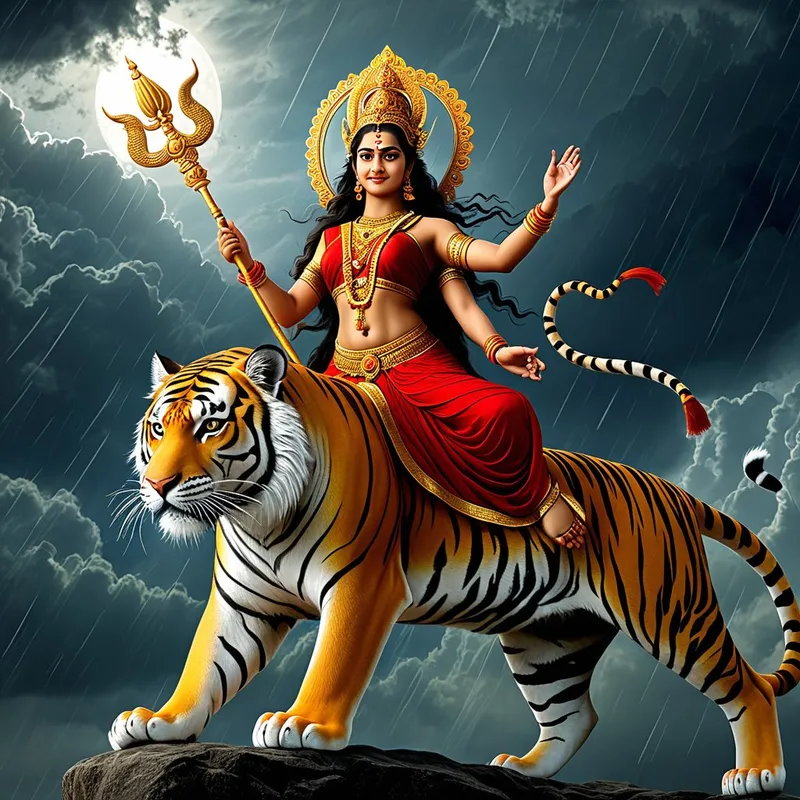
The goddess Durga, astride her tiger, descends to vanquish the buffalo demon Mahishasura, embodying the triumph of integrated consciousness over primal chaos.
The Tale of Durga riding her tiger
Listen. Before time was counted, when the worlds trembled on the edge of a scream, a shadow grew. It was not [the shadow](/myths/the-shadow “Myth from Jungian culture.”/) of night, but of a roaring, shape-shifting hunger named Mahishasura. Through terrible austerities, he had wrested a boon from Brahma: no god, no man, no beast could slay him. Armed with this arrogance, he unleashed his fury. He stormed the heavens, his buffalo form blotting out the sun, his demon hordes like a plague of locusts. The gods were cast out, their light dimmed, their celestial cities fallen into uproar. The universe itself held its breath, choked by the stench of tyranny.
From this collective despair, a light was forged. It did not dawn; it concentrated. The fury of [Vishnu](/myths/vishnu “Myth from Hindu culture.”/), the rage of [Shiva](/myths/shiva “Myth from Hindu culture.”/), the brilliance of Agni, the might of Vayu—all the potent energies of the deposed divinities streamed forth from their beings. It was a river of furious light, a whirlwind of divine intent. And from this cosmic crucible, she coalesced. The light took form: three eyes that saw past, present, and future, a complexion like the dawn, and arms—countless arms—each hand accepting a weapon offered by a god. [Varuna](/myths/varuna “Myth from Hindu culture.”/) gave the conch, [Indra](/myths/indra “Myth from Hindu culture.”/) the thunderbolt, [Shiva](/myths/shiva “Myth from Hindu culture.”/) the trident. She was [Durga](/myths/durga “Myth from Hindu culture.”/), the Inaccessible One, the Fortress.
But a goddess of such power does not walk. She needed a mount worthy of her terrible grace. And from the mountains, a answer came—not a tame steed, but a sovereign force of nature. The great tiger, its stripes like shadows of ancient trees, its muscles coiled like mountain ranges, approached. It did not bow; it presented its back, an alliance forged in silent understanding. She mounted, and in that moment, the tiger was no longer merely a beast. It became her embodied will, her [Shakti](/myths/shakti “Myth from Hindu culture.”/) in motion, its roar the sound of her purpose.
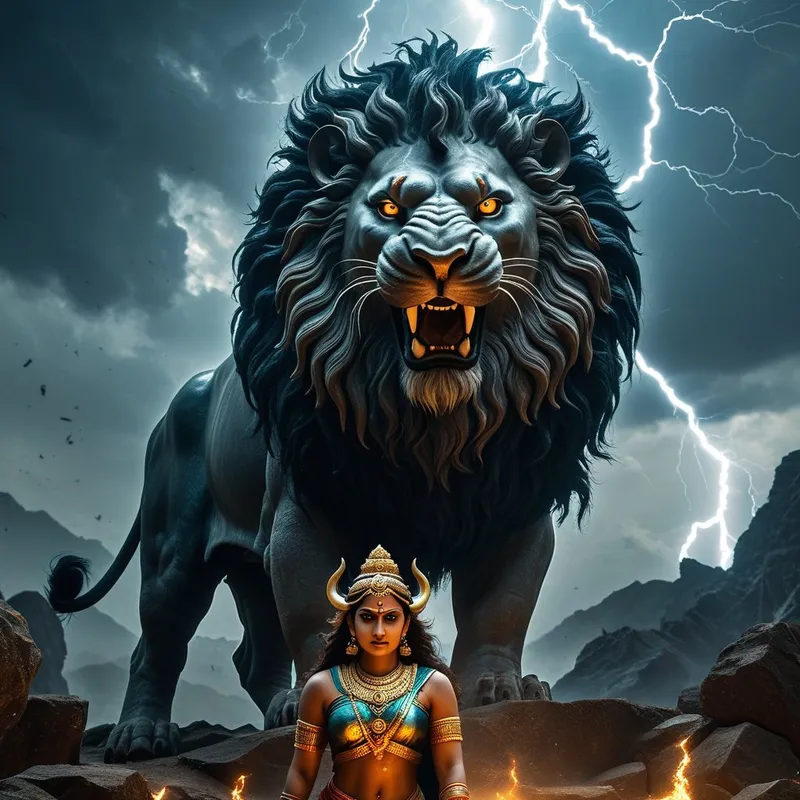
For nine nights and ten days, the battle raged. Mahishasura shifted forms—from buffalo to lion, from lion to elephant, from elephant back to a wily demon with a sword. [The earth](/myths/the-earth “Myth from Hindu culture.”/) shook. Durga, serene upon her tiger, met each assault. Her tiger pounced, a golden streak of fury, pinning demonic hordes. Her weapons flashed, parrying every blow. Finally, as the demon lunged in his primal buffalo form, Durga’s tiger leapt, seizing him. With one foot planted on his neck, pinning him to the mud of existence, and with Shiva’s trident poised, she ended his tyranny. The universe exhaled. The first light of a new dawn touched her brow, and the tiger at her feet let out a low, rumbling purr that vibrated through the roots of [the world](/myths/the-world “Myth from Tarot culture.”/). Order was not restored; it was reborn, fiercer and more compassionate than before.
Cultural Origins & Context
The myth of Durga and Mahishasura is most famously enshrined in the Devi Mahatmya, a seminal text of the Shakta tradition within Hinduism, dating to roughly the 5th-6th century CE. This narrative was not merely a story but a liturgical and philosophical [cornerstone](/myths/cornerstone “Myth from Biblical culture.”/), recited during the major festival of Navaratri, the “Nine Nights.”
Its societal function was multifaceted. On a communal level, it modeled the [triumph](/myths/triumph “Myth from Roman culture.”/) of [dharma](/myths/dharma “Myth from Hindu culture.”/) over adharma, providing a cosmic template for resisting oppression. For the individual, it was a map of inner conquest. Recited by priests and village storytellers alike, it was passed down not just as theology but as a somatic experience—the rhythm of the chants, the drama of the ritual reenactments during Durga Puja, and the communal immersion in the story’s emotional arc forged a powerful collective identity. It positioned the feminine divine not as a consort or a secondary power, but as the singular, supreme force capable of resolving a crisis the male gods could not.
Symbolic Architecture
The myth is a masterclass in symbolic [psychology](/symbols/psychology “Symbol: Psychology in dreams often represents the exploration of the self, the subconscious mind, and emotional conflicts.”/). Durga is not a personified [goddess](/symbols/goddess “Symbol: The goddess symbolizes feminine power, divinity, and the nurturing aspects of life, embodying creation and wisdom.”/) in the Western sense; she is the personification of a process—the process of integrated [consciousness](/symbols/consciousness “Symbol: Consciousness represents the state of awareness and perception, encompassing thoughts, feelings, and experiences.”/) confronting and assimilating undifferentiated, chaotic [energy](/symbols/energy “Symbol: Energy symbolizes vitality, motivation, and the drive that fuels actions and ambitions.”/).
The tiger is not Durga’s pet; it is her own wild nature, fully conscious, fully harnessed, and utterly fearless.
Mahishasura represents the [shadow](/symbols/shadow “Symbol: The ‘shadow’ embodies the unconscious, repressed aspects of the self and often represents fears or hidden emotions.”/) in its most potent and inflated form: the brute force of the unconscious, the shape-shifting [demon](/symbols/demon “Symbol: Demons often symbolize inner fears, repressed emotions, or negative aspects of oneself that the dreamer is struggling to confront.”/) of unrecognized desire, rage, and ambition that believes itself invincible (“no man or god can kill me”). He is [the tyranny](/symbols/the-tyranny “Symbol: A symbol of oppressive control, unjust authority, and systemic domination that suppresses individual freedom and collective well-being.”/) of the unexamined [life](/symbols/life “Symbol: The symbol of ‘Life’ represents a journey of growth, interconnectedness, and existential meaning, encompassing both the joys and challenges that define human experience.”/). Durga’ genesis from the combined energies of the gods symbolizes that no single faculty—not intellect (Brahma), not tradition (Vishnu), not asceticism (Shiva)—can overcome this [chaos](/symbols/chaos “Symbol: In Arts & Music, chaos represents raw creative potential, uncontrolled expression, and the breakdown of order to forge new artistic forms.”/). Only a [synthesis](/symbols/synthesis “Symbol: The process of combining separate elements into a unified whole, representing integration, resolution, and the completion of a personal journey.”/), a [coniunctio](/myths/coniunctio “Myth from Alchemical culture.”/) of all psychic forces, gives [birth](/symbols/birth “Symbol: Birth symbolizes new beginnings, transformation, and the potential for growth and development.”/) to the sovereign Self.
Her multiple arms signify the [ability](/symbols/ability “Symbol: In dreams, ‘ability’ often denotes a recognition of skills or potential that one possesses, whether acknowledged or suppressed.”/) to act [multi](/symbols/multi “Symbol: Multi signifies multiplicity and diversity, often representing various aspects of life or identity in dreams.”/)-directionally, to hold multiple realities and responsibilities without [fragmentation](/symbols/fragmentation “Symbol: The experience of breaking apart, losing cohesion, or being separated into pieces. Often represents disintegration of self, relationships, or reality.”/). Each [weapon](/symbols/weapon “Symbol: A weapon in dreams often symbolizes power, aggression, and the need for protection or defense.”/) represents a distinct power of consciousness: the discus (discrimination), the trident (control over the three states of being), the sword (discernment), [the lotus](/myths/the-lotus “Myth from Hindu culture.”/) (spiritual purity amid the mud of conflict). Riding the [tiger](/symbols/tiger “Symbol: The tiger symbolizes power, courage, and primal instincts, often representing untamed energy and aggression.”/) signifies the ultimate [achievement](/symbols/achievement “Symbol: Symbolizes success, mastery, or reaching a goal, often reflecting personal validation, social recognition, or overcoming challenges.”/): [the ego](/myths/the-ego “Myth from Jungian culture.”/) is no longer at war with its own instinctual, animal power. It is in a dynamic, cooperative [relationship](/symbols/relationship “Symbol: A representation of connections we have with others in our lives, often reflecting our emotional state.”/) with it. The [tiger](/symbols/tiger “Symbol: The tiger symbolizes power, courage, and primal instincts, often representing untamed energy and aggression.”/)’s ferocity is directed, its energy channeled by the goddess’s serene [awareness](/symbols/awareness “Symbol: Conscious perception of self, surroundings, or internal states. Often signifies awakening, insight, or heightened sensitivity.”/).
The Dreamer’s Resonance
When this myth pattern stirs in the modern dreamer, it often heralds a critical phase of individuation. To dream of riding a tiger, especially with a sense of calm mastery amidst danger, suggests the dreamer is successfully navigating a period of intense inner or outer conflict. The somatic feeling is one of powerful, surging energy under perfect control—a thrilling, awake calm.
Conversely, dreaming of being chased by a tiger may indicate the dreamer is being pursued by their own unintegrated power or rage, the “Durga energy” still in shadow, perceived as a threat. Dreaming of a tiger that is wounded, caged, or hostile reflects a profound disconnection from one’s vital life force and instinctual wisdom. The [psyche](/myths/psyche “Myth from Greek culture.”/) is signaling that the primal Self is in revolt against a too-rigid conscious attitude. The battle with Mahishasura in a dream might manifest as a struggle with a monstrous, shape-shifting problem in one’s life—an addiction, a toxic relationship, or a career impasse—that seems to change form each time one confronts it. The dream is rehearsing the synthesis needed for victory.
Alchemical Translation
The alchemy of this myth is the transmutation of chaos into cosmos, of brute force into sovereign power. For the modern individual, the process follows the myth’s exact stages.
First, the Inflation of the Shadow (Mahishasura’s Boon): A part of the psyche, often an ambition, a trauma, or a repressed desire, gains undue power. It convinces us it is invincible, that our conscious values (“gods”) cannot touch it. It takes over, creating inner and outer turmoil.
Second, the Concentration of Forces (The [Emanation](/myths/emanation “Myth from Neoplatonic/Gnostic culture.”/) of Durga): In crisis, we are forced to call upon all our resources—not just logic, but intuition (Shakti), not just patience, but righteous anger (Agni), not just flexibility, but unwavering core principles (the mountain). This is the painful, glorious birth of a more complete Self.
Third, the Alliance with the Instinct (Mounting the Tiger): This is the critical, often misunderstood step. It is not about taming or dominating one’s animal nature. It is about forming a conscious partnership with it. The tiger’s raw energy becomes the vehicle for [the Self](/myths/the-self “Myth from Jungian culture.”/)’s purpose. In life, this translates to channeling passion into creativity, anger into boundaries, sexual energy into vitality for all endeavors.
The victory is not the killing of the demon, but the reclamation of the energy he possessed. Mahishasura’s force is reintegrated into Durga’s being.
Finally, the Sovereign Rest (The Tiger’s Purr): After the battle, the integrated Self does not disband. Durga remains upon her tiger. The achieved state is one of dynamic equilibrium, where consciousness and instinct, power and compassion, are in harmonious, awake relationship. The individual is no longer at war within. They have become a fortress (Durga), inaccessible to petty chaos, yet profoundly connected to the roaring, beautiful, and untamed truth of their own existence.
Associated Symbols
Explore related symbols from the CaleaDream lexicon: