Durga Myth Meaning & Symbolism
The supreme goddess, forged from divine light, descends to battle the shape-shifting buffalo demon, restoring cosmic order through righteous, invincible fury.
The Tale of Durga
Listen. The cosmos had forgotten how to breathe.
A tyranny of laughter, coarse and cruel, echoed through the three worlds. It was the laughter of Mahishasura, whose boon had made him invincible to god or man. He had stormed the gates of Svarga, scattering the devas like autumn leaves. Indra’s thunderbolt fell silent. Agni’s flames guttered low. The wind itself grew still under the demon’s oppressive weight. The world was trapped in the belly of a buffalo, dark, stagnant, and without hope.
The defeated devas fled to the primordial silence where the Trimurti dwell. Their words were not pleas, but a confession of collective failure. From their despair, from their righteous fury, a terrible light began to coalesce. It streamed from their eyes, their hearts, their very spirits—a searing, concentrated essence of divine power. The light did not simply gather; it forged. It became a furnace, and from that furnace of collective will, a form took shape.
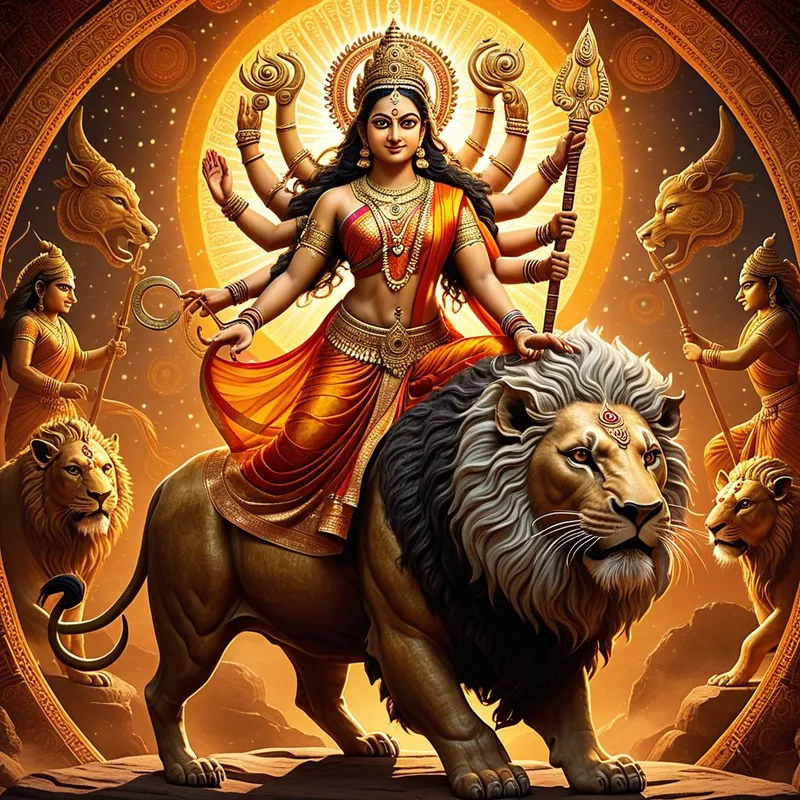
She was born fully formed, a symphony of cosmic power given feminine shape. Her name was Durga. The light became her skin, the devas’ weapons flew to her countless hands: Shiva’s trident, Vishnu’s discus, Indra’s thunderbolt, Agni’s spear. The Himalayas gave her a lion, its roar shattering the silence of despair. She was not born of womb, but of necessity. She was the answer to a question the universe had screamed.
She descended to the battlefield where Mahishasura reveled. He did not see a goddess at first; he saw a woman of impossible beauty and laughed his crushing laugh. He sent his vast asura legions, a tide of darkness against her solitary form. Durga did not move from her lion. She breathed, and from her breath, a million warrior forms sprang forth, Matrikas, who met the demon horde with a fury that turned the sky red.
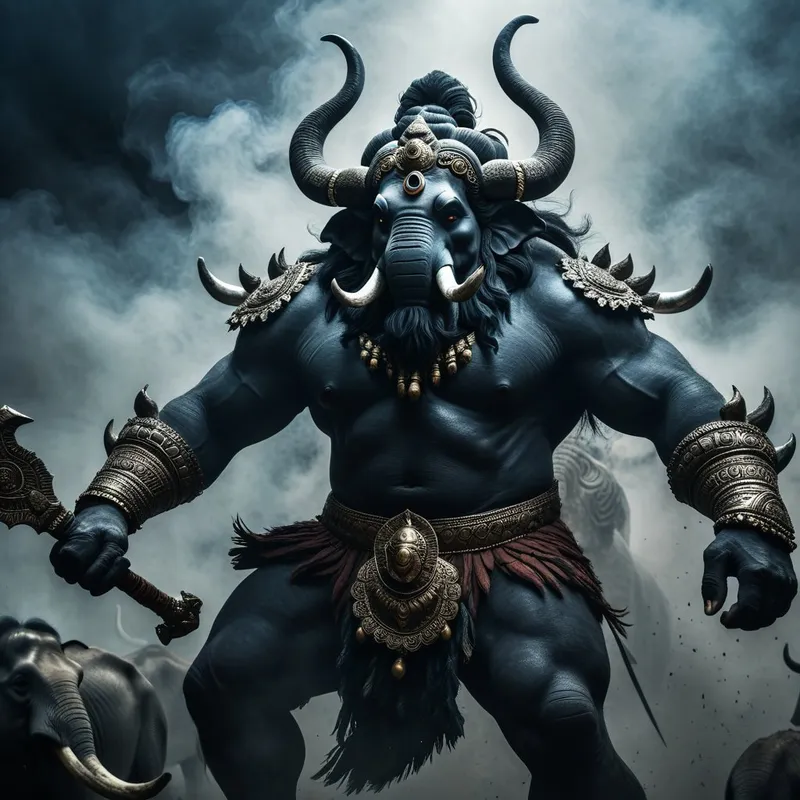
Enraged, Mahishasura took his true form—a mountain-sized buffalo demon, his horns ready to gore the heavens. He charged, shaking the earth. Durga’s lion leaped, meeting force with ferocity. The battle was a cataclysm. The demon shifted shapes—from buffalo to lion, from lion to elephant, from elephant to a giant wielding a mountain—trying to evade the inevitable. But Durga was the hunter of all forms. She lassoed him, her noose a strand of cosmic law. As he struggled, trapped between beast and man, she leaped from her lion, planted a foot upon his neck, and with a final, transcendent thrust, drove the trident deep into his heart.
The demon’s roar became a sigh. The darkness dissolved, not into nothing, but into the ground, absorbed. The goddess did not smile in triumph; she simply was, serene and terrible. The first breath of a freed world was the sound of her lion’s purr. Order was not restored; it was remembered, and she was its memory.
Cultural Origins & Context
The myth of Durga is central to the Shakta tradition of Hinduism, which views the feminine divine principle, Shakti, as the source and substance of all creation. Her story is most famously detailed in the Devi Mahatmya (circa 400-600 CE), a text recited with immense devotion during the festival of Navaratri.
This was not merely a story for priests; it was a societal narrative engine. Recited in temples and village squares, it functioned as a cosmic drama reinforcing dharma. It explained the necessity of divine intervention when the balance of the world tips toward chaos (adharma). The myth was told to empower, to remind communities that the forces of order are inherent in the universe, but they must be invoked, concentrated, and wielded with conscious intent. Durga’s creation from the combined energies of all the male gods is a profound theological statement: the masculine powers are inert without the feminine force to activate and direct them. Her myth provided a template for resilience, a story that said when all established powers fail, a deeper, more integrated power can and will emerge.
Symbolic Architecture
Durga is not a goddess of war in a simplistic sense; she is the embodiment of righteous fury, the precise, focused energy required to annihilate that which threatens the integrity of the self and the cosmos. Her enemy, Mahishasura, represents the shape-shifting, intractable nature of the unintegrated ego and primal ignorance (avidya). His boon—invincibility to god or man—symbolizes a problem that cannot be solved by our known, categorized faculties (the "gods" of our inner pantheon) or by our mundane human strategies.
Durga represents the psyche’s ultimate defense and integration mechanism. She is the Self that emerges when the ego surrenders its solitary struggle and pools all its disparate resources.
Her multiple arms signify omnipotent capacity, the ability to handle multiple challenges simultaneously without losing centeredness. Each weapon, donated by a different god, symbolizes a specialized power of consciousness: discernment (the sword), spiritual sound (the conch), the cutting of attachment (the discus), the destruction of ignorance (the trident). Her lion mount is untamed power, instinct, and courage, now completely in service to the divine Self. Crucially, her face remains serene amidst the fury of battle, representing the non-attached witness consciousness that must oversee any true inner transformation. She does not hate the demon; she addresses the imbalance it represents.
The Dreamer's Resonance
When the archetype of Durga stirs in the modern dreamer, it often manifests as a profound somatic and psychological confrontation. One may dream of being attacked by a monstrous, shape-shifting force—a boss who becomes a suffocating parent, a flood that turns into grasping hands, a faceless pursuer in a labyrinthine office. This is the Mahishasura of the psyche: an adaptive, entrenched complex (of oppression, addiction, or paralyzing fear) that has resisted all previous attempts at negotiation or suppression.
The dream-ego typically feels powerless, cornered. But then, a shift occurs. The dreamer may find a strange, potent object—a glowing tool, a key, a forgotten piece of art they themselves made. They may feel a surge of energy, or see a formidable feminine figure in the periphery, not fighting for them, but as them. This is the Durga process igniting. It is the psyche marshaling resources the dreamer didn’t know they had—repressed anger transformed into boundaries, creative insight sharpened into a weapon of discernment, ancestral strength rising as a roar from within. The battle is fierce, visceral. Upon waking, one might feel exhausted yet cleansed, having somatically experienced the dissolution of an inner tyranny.

Alchemical Translation
The alchemy of the Durga myth models the process of individuation at its most critical juncture: the confrontation with the shadow in its most autonomous, "demonically" empowered form. First, there is the honest acknowledgment of defeat: our conscious attitudes (the devas) are powerless against this deep-seated complex. We must cease the futile frontal assault.
The next step is the crucial, often overlooked, surrender and synthesis. We do not fight the demon with our old, fragmented tools. Instead, we withdraw and consciously call upon every facet of our being—our intellect, our intuition, our compassion, our rage—and forge them into a new, integral consciousness. This is the birth of Durga within. She is the Self as warrior.
The victory is not the destruction of a part of oneself, but the forceful integration of raw, chaotic energy (the demon) back into the wholeness of the psyche. The demon is not annihilated into nothingness; it is pinned, transformed, and absorbed under the foot of the sovereign Self.
To engage this alchemy is to stop fighting your darkness with willpower alone. It is to assemble your full being—light and shadow, strength and vulnerability—into a conscious, focused force of nature. You become the goddess on the lion, not eradicating your demons, but mastering them, turning their once-tyrannical power into the very ground upon which you stand, serene and unshakable. The battle’s end is not peace as absence of conflict, but peace as the dynamic, integrated order of a self that has remembered its own invincible, composite nature.
Associated Symbols
Explore related symbols from the CaleaDream lexicon: