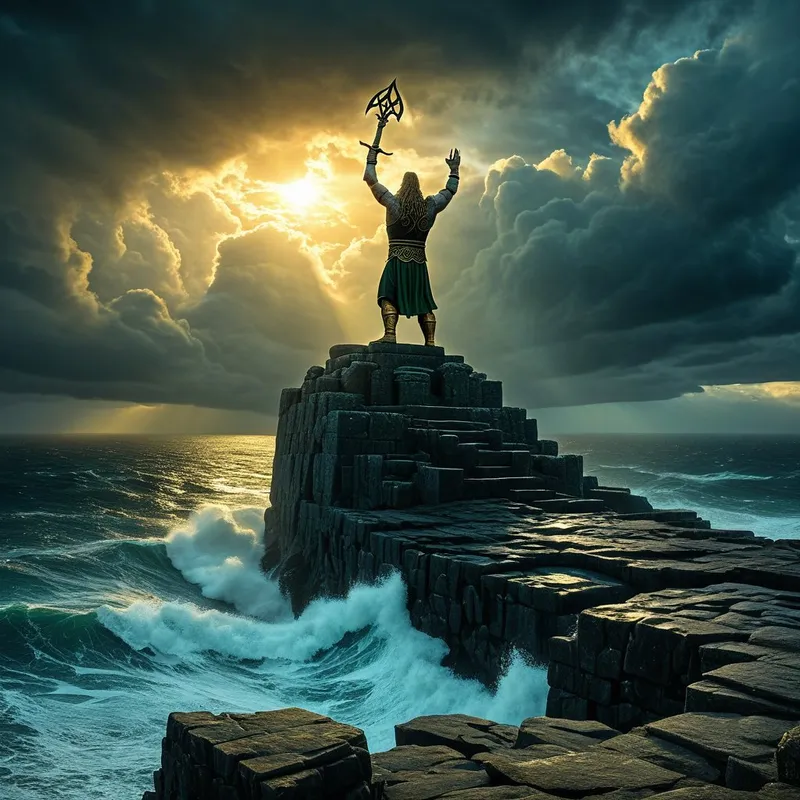
Dun Aengus Myth Meaning & Symbolism
A hero's desperate quest to build a fortress against the endless sea, forging a kingdom from will and sacrifice on the edge of the world.
The Tale of Dun Aengus
Listen. [The wind](/myths/the-wind “Myth from Various culture.”/) on the edge of [the world](/myths/the-world “Myth from Tarot culture.”/) has a memory, and it sings of Aengus. In a time when the land was young and [the sea](/myths/the-sea “Myth from Greek culture.”/) was a hungry god, there lived a king whose spirit was as fierce as the western gale. He was of the Fir Bolg, those who wrested the green earth from the primal wild.
Aengus looked upon his kingdom on Inis Mór and saw it was soft, vulnerable to the crashing teeth of the ocean and the covetous eyes of those from beyond the waves. A dread settled in his bones, a cold tide of fear that whispered of dissolution, of his people being swept back into the formless grey from which all things came. This fear was not a coward’s tremor, but a prophet’s vision. He saw the end of things.
So, he made a vow to the hard sky and the harder stone. He would build not a fort, but a statement. A cry in stone against the chaos. He gathered his people and led them to the very lip of the world, where the cliffs fell away into the roaring throat of the Muir Mhanann. “Here,” he shouted over the wind, “we will draw a line.”
The work was a torment. The stone, the ancient bones of the island, resisted. It cut their hands and broke their backs. The sea mocked them with salt spray and keening winds. Seasons turned, and the people faltered, their will eroding like the cliff face. But Aengus’s will was unyielding. He did not just command; he bled into the mortar. It is said he lifted stones that ten men could not move, driven by a fire that was half vision, half desperation.
Finally, it rose: a vast, sweeping crescent of drystone, a colossal jaw of granite biting into the cliff’s edge. Three rings of walls, each higher and more formidable than the last, culminating in a precipice that dropped sheer into [the abyss](/myths/the-abyss “Myth from Kabbalistic culture.”/). There was no wall on the ocean side. Only the cliff. This was the final, terrifying masterstroke. Dun Aengus was not a complete circle. It was a defiant semicircle, an embrace turned to a confrontation. It said: Here I stand. The world ends with me. Behind is order, hearth, tribe. Before is the infinite, the unknown, the all-devouring. Choose.
And when Aengus stood on the highest point, the wind tearing at his hair, he faced the raging sea and let out a roar that was not of victory, but of recognition. He had built his kingdom not in spite of the abyss, but because of it. The fortress was not a shield from the terror, but an altar to it, and in building it, he had forged himself into the king the edge of the world required.
Cultural Origins & Context
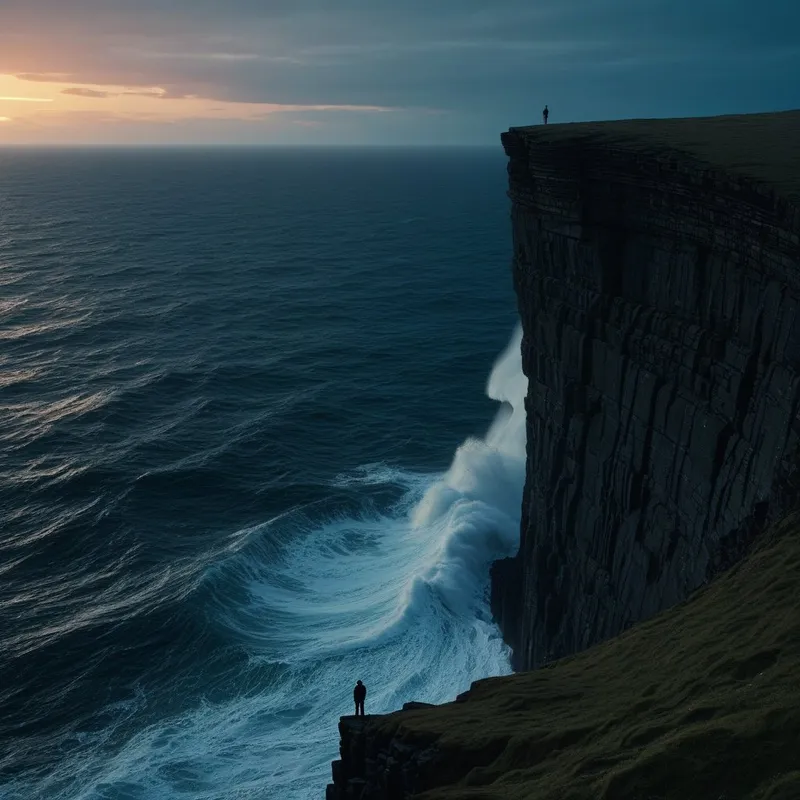
The story of Dun Aengus is not preserved in a single, canonical text like the Ulster Cycle. It lives in the older, darker stratum of The Mythological Cycle, intertwined with the tales of the Fir Bolg and the Tuatha Dé Danann. Its primary text is the stone itself—the monumental fort on Inis Mór in the Aran Islands. The myth is the oral history crafted to explain the inexplicable: who could have built such a [thing](/myths/thing “Myth from Norse culture.”/), and why there, on the most terrifying and impractical edge imaginable?
It was likely a tale told by the filí and seanchaí (storytellers) not merely as history, but as a foundational psycho-geography. The story encoded a core Celtic relationship with landscape, where place is sacred and meaning is inscribed upon it through heroic action. The societal function was multifaceted: it justified sovereignty (Aengus’s right to rule through transformative labor), it served as a moral lesson on perseverance and sacrifice, and most profoundly, it was a collective meditation on the existential condition of an island people. It answered the silent, pervasive question of a culture surrounded by a vast, powerful ocean: How do we define ourselves against the infinite?
Symbolic Architecture
At its [heart](/symbols/heart “Symbol: The heart symbolizes love, emotion, and the core of one’s existence, representing deep connections with others and self.”/), Dun Aengus is a myth about the [architecture](/symbols/architecture “Symbol: Architecture in dreams often signifies structure, stability, and the framing of personal identity or life’s journey.”/) of [the self](/myths/the-self “Myth from Jungian culture.”/). The [fortress](/symbols/fortress “Symbol: A fortress symbolizes security and protection, representing both physical and psychological safety from external threats.”/) is a profound [symbol](/symbols/symbol “Symbol: A symbol can represent an idea, concept, or belief, serving as a powerful tool for communication and understanding.”/) of the ego constructed in conscious, agonizing [effort](/symbols/effort “Symbol: Effort signifies the physical, mental, and emotional energy invested toward achieving goals and personal growth.”/) against the pressures of the unconscious—represented by the boundless, chaotic sea.
The conscious mind builds its citadel of identity stone by hard-won stone, always on the precipice of the vast, unknown deep from which it emerged.
The three concentric walls mirror the stages of psychological development and [defense](/symbols/defense “Symbol: A protective mechanism or barrier against perceived threats, representing boundaries, security, and resistance to external or internal challenges.”/): the outer [wall](/symbols/wall “Symbol: Walls in dreams often symbolize boundaries, protection, or obstacles in one’s life, reflecting the dreamer’s feelings of confinement or security.”/) of social [persona](/symbols/persona “Symbol: The social mask or outward identity one presents to the world, often concealing the true self.”/) and custom, the middle [wall](/symbols/wall “Symbol: Walls in dreams often symbolize boundaries, protection, or obstacles in one’s life, reflecting the dreamer’s feelings of confinement or security.”/) of personal will and intellect, and the innermost sanctum of the core self. The missing fourth wall, open to the [cliff](/symbols/cliff “Symbol: Dreaming of a cliff often symbolizes a significant decision point or a transition, representing both the fear of failure and the potential for growth.”/), is the myth’s most brilliant symbolic stroke. It represents the necessary openness to the Self and the transpersonal. A complete, sealed circle would be a [prison](/symbols/prison “Symbol: Prison in dreams typically represents feelings of restriction, confinement, or a lack of freedom in one’s life or mind.”/) of solipsism. The open edge acknowledges that true [strength](/symbols/strength “Symbol: ‘Strength’ symbolizes resilience, courage, and the ability to overcome challenges.”/) does not come from barricading against the unknown, but from having the courage to stand at its very brink, in a state of conscious [vulnerability](/symbols/vulnerability “Symbol: A state of emotional or physical exposure, often involving risk of harm, that reveals authentic self beneath protective layers.”/) and awe. Aengus’s labor is the heroic effort of individuation—forging a coherent [identity](/symbols/identity “Symbol: Identity represents the sense of self, encompassing personal beliefs, cultural background, and social roles.”/) from the raw materials of one’s [nature](/symbols/nature “Symbol: Nature symbolizes growth, connectivity, and the primal forces of existence.”/) and experience, directly facing the inner sea of the unconscious.
The Dreamer’s Resonance
When the pattern of Dun Aengus arises in the modern dreamscape, it signals a critical phase of boundary-creation and self-definition. The dreamer may find themselves building a wall, fortifying a house on a shore, or standing on a high place against an encroaching flood. The somatic feeling is often one of exhausting, urgent labor mixed with profound anxiety.
Psychologically, this dream motif emerges when [the ego](/myths/the-ego “Myth from Jungian culture.”/) is under pressure—from external demands, internal chaos, or a dissolving sense of self. The unconscious is communicating the need for deliberate, conscious structuring. The dream is not about building a permanent barricade, but about the act of defining a limit. The “sea” might be overwhelming emotion, a life transition, or a surge of unconscious content. The dream asks: Where is your cliff edge? What are you willing to labor for, to bleed for, to create a space for your own existence? The anxiety in the dream is the friction of becoming, the necessary struggle of the [psyche](/myths/psyche “Myth from Greek culture.”/) to differentiate itself from the formless.
Alchemical Translation
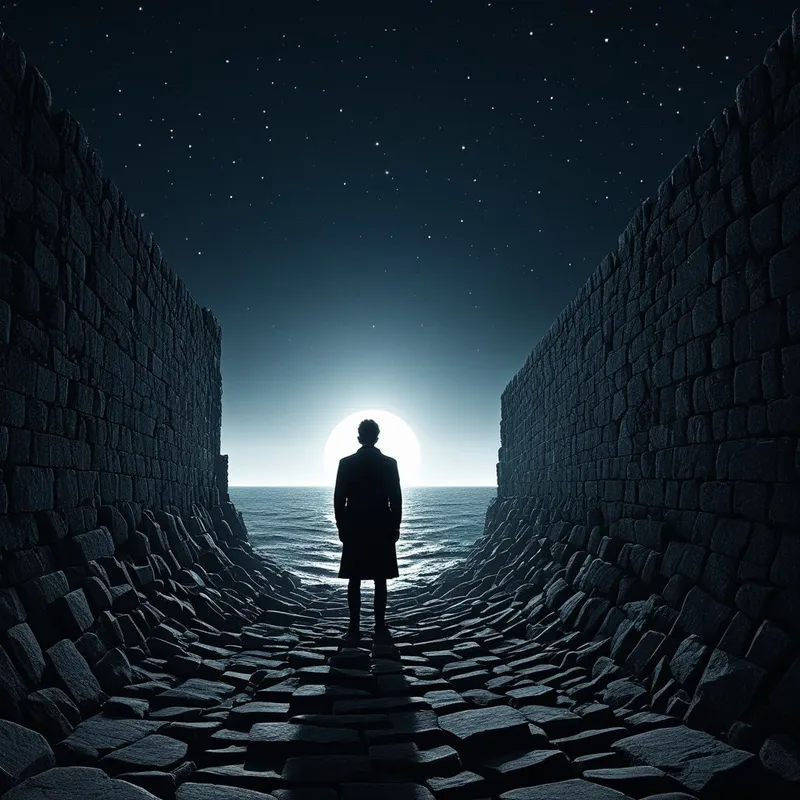
The alchemical journey modeled by Dun Aengus is that of [coagulatio](/myths/coagulatio “Myth from Alchemical culture.”/)—the process of making the volatile spirit solid, of giving form to the formless. The primal, watery state of the massa confusa (the chaotic sea) is confronted by the will of [the adept](/myths/the-adept “Myth from Alchemical culture.”/) (Aengus). Through the opus ([the great work](/myths/the-great-work “Myth from Alchemical culture.”/)) of sustained effort and sacrifice, the stone of the inner citadel is quarried and shaped.
The alchemy of the soul occurs not in escape from the primal waters, but in the construction of a sacred space where one can behold them without being dissolved.
For the modern individual, this translates to the often-grueling work of self-knowledge and integration. It is the discipline of therapy, the practice of art, the commitment to a relationship or a value—any sustained effort that builds a structure of meaning in one’s life. The “cliff” is the accepted limit of our understanding, [the horizon](/myths/the-horizon “Myth from Various culture.”/) of the known personality. The [triumph](/myths/triumph “Myth from Roman culture.”/) is not in conquering the sea, which is impossible, but in achieving the stable standpoint from which to engage with it. One becomes, like Aengus, the sovereign of a precarious but authentic realm, having earned the right to stand on the edge, facing the infinite with a hard-won, defiant grace. The fortress, in the end, is not where you hide. It is the platform from which you see, and in seeing, become whole.
Associated Symbols
Explore related symbols from the CaleaDream lexicon: