
Dumuzi and Inanna
A Sumerian myth of love, betrayal, and cyclical renewal, where the goddess Inanna's journey to the underworld leads to her husband Dumuzi's alternating fate.
The Tale of Dumuzi and Inanna
The tale begins not in shadow, but in the radiant light of union. [Inanna](/myths/inanna “Myth from Sumerian culture.”/), Queen of Heaven and Earth, goddess of love, fertility, and political power, set her heart upon a shepherd-king. His name was Dumuzi, the divine shepherd, whose domain was the fertile fold and the bounty of the flock. Their courtship was a sacred drama, a hieros gamos or divine marriage, that was ritually enacted by Sumerian kings to ensure the land’s prosperity. Inanna’s brother, [Utu the sun god](/myths/utu-the-sun-god “Myth from Sumerian culture.”/), championed Dumuzi’s suit, and after a playful, potent debate where Dumuzi’s pastoral offerings triumphed over a farmer’s, [Inanna](/myths/inanna “Myth from Sumerian culture.”/) consented. Their union was ecstatic, a convergence of sky and earth, of political authority and generative, animal vitality. The land rejoiced; their love was the [covenant](/myths/covenant “Myth from Christian culture.”/) of life itself.
Yet, a restless darkness stirred in Inanna’s heart. Possessing all the domains of [the world](/myths/the-world “Myth from Tarot culture.”/) above, she turned her formidable will toward the one realm denied her: the Kur, [the underworld](/myths/the-underworld “Myth from Greek culture.”/), ruled by her stern and implacable sister, Ereshkigal. Donning her regalia of power—[the crown](/myths/the-crown “Myth from Various culture.”/), the lapis lazuli necklace, the breastplate, and the pala garment—she descended. At each of the seven gates of the [underworld](/myths/underworld “Myth from Greek culture.”/), the gatekeeper, Neti, acting on Ereshkigal’s instructions, stripped a piece of her divine adornment from her. Naked and bowed, Inanna entered the throne room of the dead. The seven judges, the Anunnaki, fixed upon her the eye of [death](/myths/death “Myth from Tarot culture.”/). She was turned into a corpse, a piece of rotting meat, hung upon a hook.
In the world above, all fertility ceased. With Inanna’s descent, life’s processes froze. After three days and nights, her loyal vizier, Ninshubur, raised a lament and sought help from the gods. Enki, the god of wisdom and waters, fashioned two sexless beings from the dirt under his fingernails. He gave them the food and [water](/myths/water “Myth from Chinese culture.”/) of life and sent them to the underworld. Instructed to mirror Ereshkigal’s agonized cries of labor as she gives birth, they won her gratitude and were granted a boon. They asked for Inanna’s corpse, sprinkled it with the food and water of life, and revived her.
But the laws of the Kur were absolute: no one may leave without providing a substitute. As Inanna ascended, flanked by a host of galla demons—pitiless, faceless enforcers of the underworld’s claim—they scrutinized her world for a soul to take her place. They first approached Ninshubur, still in mourning clothes, but Inanna forbade it. They turned to Shara, Inanna’s son, but she refused again. They found Lulal, a minor god, also in lamentation, and were again denied.
Then, they came to Uruk, to the great temple of Inanna. There, they found Dumuzi. He was not weeping. He was not clad in sackcloth. Seated upon Inanna’s splendid throne, he was dressed in fine robes, music playing, in a state of apparent celebration. A profound cold entered Inanna’s heart. Seeing her husband in a state of regal comfort while she had endured death and humiliation, her gaze—the gaze of a goddess who had known the absolute void—turned upon him. “Take him,” she said. The judgment was sealed not by malice, but by a terrible, impersonal [justice](/myths/justice “Myth from Tarot culture.”/): the one who did not mourn must fill the vacant place.
Dumuzi fled in terror. He begged his sister, Geshtinanna, and his friend, the sun god Utu, for help. Utu transformed him three times—into a snake, into a gazelle—but the galla demons, relentless as fate, hunted him down. They captured the shepherd-king. In one poignant fragment, Dumuzi cries out to the sun, “O Utu, you are my brother-in-law, I am your sister’s husband… let the galla demons not seize me!” But the plea is in vain. He is taken.
Yet, the story does not end in eternal loss. Geshtinanna, whose heart was pure with grief, offered herself in her brother’s stead. In a decree that encodes the myth’s deepest truth, Inanna proclaimed their fate: Dumuzi and Geshtinanna would each spend half the year in the underworld, alternating with the other. Thus, when Dumuzi descends, the heat of summer withers the land, the flocks languish. When he returns, and Geshtinanna takes his place, [the earth](/myths/the-earth “Myth from Hindu culture.”/) blooms again with the autumn rains and spring growth. The lover is lost, and found, in an eternal, sorrowful rhythm.
Cultural Origins & Context
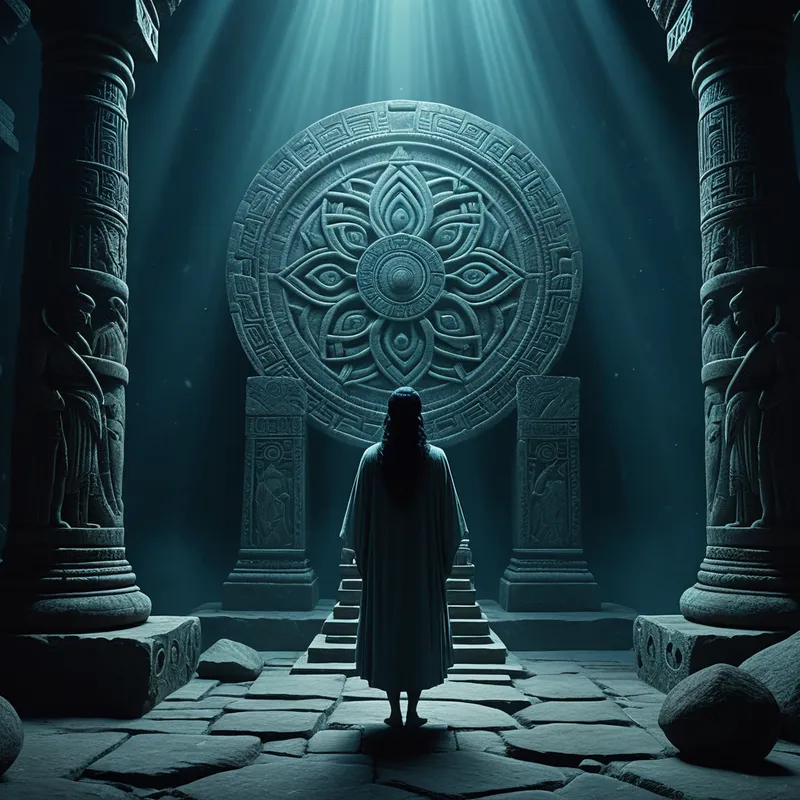
This myth, primarily known from the Sumerian poem “Inanna’s Descent to the Underworld” and related laments for Dumuzi, is not a simple allegory for seasons. It is the theological and psychological bedrock of a civilization. In the Mesopotamian worldview, the underworld was not a place of moral punishment, but a dreary, democratic destination for all souls, a “land of no return.” Fertility—of crops, herds, and people—was not a given but a precarious gift from the gods, requiring constant ritual maintenance and sacrifice.
The divine marriage of Inanna and Dumuzi was central to the [Sacred Marriage](/myths/sacred-marriage “Myth from Alchemy culture.”/) Rite (hieros gamos). The king’s identification with Dumuzi was literal; his union with the goddess (channeled through a priestess) was believed to directly channel life-force into the kingdom. Thus, Dumuzi’s fate was the king’s fate, and by extension, the land’s fate. His death was a national catastrophe ritually mourned, and his return a cause for celebration. The myth explains the inevitable: even the divine king must die, must serve the dark sister’s realm, for life to continue. It is a cosmology of necessary sacrifice.
Furthermore, the story presents a complex, non-sentimental portrait of divinity. Inanna is not a “loving wife” in a human sense; she is a force of sovereignty, desire, and ruthless transformation. Her betrayal of Dumuzi is not petty vengeance, but the execution of cosmic law. She embodies the terrifying truth that life feeds on death, that love contains the seed of loss, and that the goddess of fertility is also the goddess who condemns to the dust.
Symbolic Architecture
The myth’s power lies in its stark, resonant symbols. The descent is the ultimate [journey](/symbols/journey “Symbol: A journey in dreams typically signifies adventure, growth, or a significant life transition.”/) of transformation, a stripping away ([katabasis](/myths/katabasis “Myth from Greek culture.”/)) of all [identity](/symbols/identity “Symbol: Identity represents the sense of self, encompassing personal beliefs, cultural background, and social roles.”/) (symbolized by the seven garments) to confront the naked self in [the mirror](/myths/the-mirror “Myth from Various culture.”/) of [death](/symbols/death “Symbol: Symbolizes transformation, endings, and new beginnings; often associated with fear of the unknown.”/). Inanna’s [journey](/symbols/journey “Symbol: A journey in dreams typically signifies adventure, growth, or a significant life transition.”/) is not to conquer the [underworld](/symbols/underworld “Symbol: A symbolic journey into the unconscious, representing exploration of hidden aspects of self, transformation, or confronting repressed material.”/), but to be conquered by it, to be reduced to essence.
The hook upon which Inanna’s corpse is hung is a profound image of suspended animation, of life-in-death. It is the still point of the turning world, where all processes cease, where the goddess of connection becomes the ultimate symbol of disconnection.
Dumuzi’s [flight](/symbols/flight “Symbol: Flight symbolizes freedom, escape, and the pursuit of one’s aspirations, reflecting a desire to transcend limitations.”/) and capture mirrors the [fate](/symbols/fate “Symbol: Fate represents the belief in predetermined outcomes, suggesting that some aspects of life are beyond human control.”/) of all mortal [life](/symbols/life “Symbol: The symbol of ‘Life’ represents a journey of growth, interconnectedness, and existential meaning, encompassing both the joys and challenges that define human experience.”/): vibrant, evasive, but ultimately bound by the limits of the flesh and the inevitability of the cycle. His failure to mourn is the fatal [human](/symbols/human “Symbol: The symbol of a human represents individuality, complexity of emotions, and social relationships.”/) flaw of forgetfulness, of taking the gift of [life](/symbols/life “Symbol: The symbol of ‘Life’ represents a journey of growth, interconnectedness, and existential meaning, encompassing both the joys and challenges that define human experience.”/) for granted when the giver is absent. His [fate](/symbols/fate “Symbol: Fate represents the belief in predetermined outcomes, suggesting that some aspects of life are beyond human control.”/) is a [lesson](/symbols/lesson “Symbol: A lesson in a dream signifies a learning opportunity, often reflecting personal growth or unresolved issues requiring attention.”/) in the piety of [grief](/symbols/grief “Symbol: A profound emotional response to loss, often manifesting as deep sorrow, yearning, and a sense of emptiness.”/).
The alternation with Geshtinanna is the myth’s alchemical core. It transforms a tragedy of substitution into a [rhythm](/symbols/rhythm “Symbol: A fundamental pattern of movement or sound in time, representing life’s cycles, emotional flow, and universal order.”/) of shared burden. It introduces [the principle](/symbols/the-principle “Symbol: A fundamental truth, law, or doctrine that serves as a foundation for a system of belief, behavior, or reasoning, often representing moral or ethical standards.”/) of the double, of the compassionate other who bears the [weight](/symbols/weight “Symbol: Weight symbolizes burdens, responsibilities, and emotional loads one carries in life.”/), making the unbearable cycle sustainable. It is the [movement](/symbols/movement “Symbol: Movement symbolizes change, progress, and the dynamics of personal growth, reflecting an individual’s desire or need to transform their circumstances.”/) from a singular, catastrophic death to a perpetual, managed exchange.
The Dreamer’s Resonance
To encounter this myth in dream or active imagination is to meet the archetypal dynamics of profound relationship and personal transformation. The Inanna within is that part of the [psyche](/myths/psyche “Myth from Greek culture.”/) that must, driven by an insatiable will for wholeness, journey into its own deepest, most repressed realms (the personal underworld). This is [the ego](/myths/the-ego “Myth from Jungian culture.”/)’s necessary dissolution—the depression, the crisis, [the dark night of the soul](/myths/the-dark-night-of-the-soul “Myth from Christian Mysticism culture.”/)—where all our prized identities and achievements (our “royal robes”) are stripped away.
The Dumuzi within is the cherished aspect of life—our vitality, our creative spark, our simple joy, or a specific relationship—that feels safe and eternal. The myth warns that this too must be sacrificed when Inanna returns from the depths. The psyche’s “judgment” on Dumuzi is often experienced as a sudden loss, a betrayal by life, or a crushing depression that targets precisely what we held most dear. It feels like a cruel fate, but from the soul’s perspective, it is [the law](/myths/the-law “Myth from Biblical culture.”/): what was identified with the bright, upper world must now serve the dark, to keep the whole system of [the self](/myths/the-self “Myth from Jungian culture.”/) alive.
The dreamer may also discover their Geshtinanna—the capacity for loyal, selfless compassion that allows for rest, for a reprieve. This is the healing insight that our suffering need not be total and eternal; it can be shared, alternated, given a rhythm. The myth thus maps the path from a catastrophic, monolithic psychological death to a cyclical process of renewal, where descent and return become the very rhythm of a mature soul’s life.

Alchemical Translation
In the alchemical vessel of the soul, the myth of Dumuzi and Inanna is the formula for the [coniunctio oppositorum](/myths/coniunctio-oppositorum “Myth from Alchemical culture.”/)—[the sacred marriage](/myths/the-sacred-marriage “Myth from Various culture.”/)—and its necessary mortificatio—the killing of the united king. The initial joyous union represents the first, naive conjunction of opposites (conscious and unconscious, spirit and nature). But this unity is unstable, inflating.
Inanna’s descent is the nigredo, the blackening, the putrefaction. The glorious queen becomes materia prima, the rotting matter at the start of the work. This is the essential, humiliating reduction without which no true transformation is possible.
The revival by Enki’s creatures represents a spark of consciousness (animus) sent from the depths of instinctual wisdom (Enki) to retrieve the soul. But the returned soul is changed, carrying the cold knowledge of [the abyss](/myths/the-abyss “Myth from Kabbalistic culture.”/). The subsequent “betrayal” of Dumuzi is the [separatio](/myths/separatio “Myth from Alchemical culture.”/), the crucial and painful differentiation. The life-force (Dumuzi) that was once gloriously united with the soul-image (Inanna) must now be sacrificed, distilled, and cycled through the realm of shadow.
The final alternation is the achievement of the [circulatio](/myths/circulatio “Myth from Alchemy culture.”/), the circular process. Gold (the conscious, returned Inanna) and Silver (the soul’s vitality, Dumuzi) no longer fuse into a static, corruptible alloy, but rotate in a perpetual, life-giving exchange. The work is never finished; it is a process. The goal is not a fixed state of enlightenment, but the enduring capacity to endure the wheel of dark and light, death and rebirth, within oneself.
Associated Symbols
Explore related symbols from the CaleaDream lexicon:
- Descent — The archetypal journey into the underworld or unconscious, involving a stripping away of [persona](/myths/persona “Myth from Greek culture.”/) and a confrontation with shadow.
- Betrayal — The shattering of trust or covenant, often serving as the catalyst for a profound transformation or the enforcement of a harsh, necessary law.
- Sacrifice — The voluntary or enforced offering of something precious, required to maintain cosmic balance, ensure renewal, or appease a deeper power.
- Cycle — The eternal, rhythmic pattern of alternation, such as life and death, summer and winter, ruling the movement of souls and seasons.
- Grief — The deep, mourning response to loss, which in its authentic expression becomes a sacred duty and a connective tissue to the realm of the dead.
- Shadow — The repressed, unknown, or underworld aspect of the self or a deity, which must be integrated for wholeness.
- Rebirth — The emergence of new life from a state of death or dissolution, often conditional and part of a larger, repeating pattern.
- Fate — The impersonal, inescapable decree or law that governs existence, often experienced as a cruel or neutral force binding gods and mortals alike.
- Ritual — The prescribed, symbolic action (like mourning or sacred marriage) that enacts mythic patterns to influence reality and maintain cosmic order.
- Heart — The seat of emotion, decision, and compassion, which can turn cold in judgment or break in grief, directing the flow of destiny.