
Duat Myth Meaning & Symbolism
The perilous, starry underworld of Egyptian myth where the soul journeys through darkness to be weighed and reborn at dawn.
The Tale of Duat
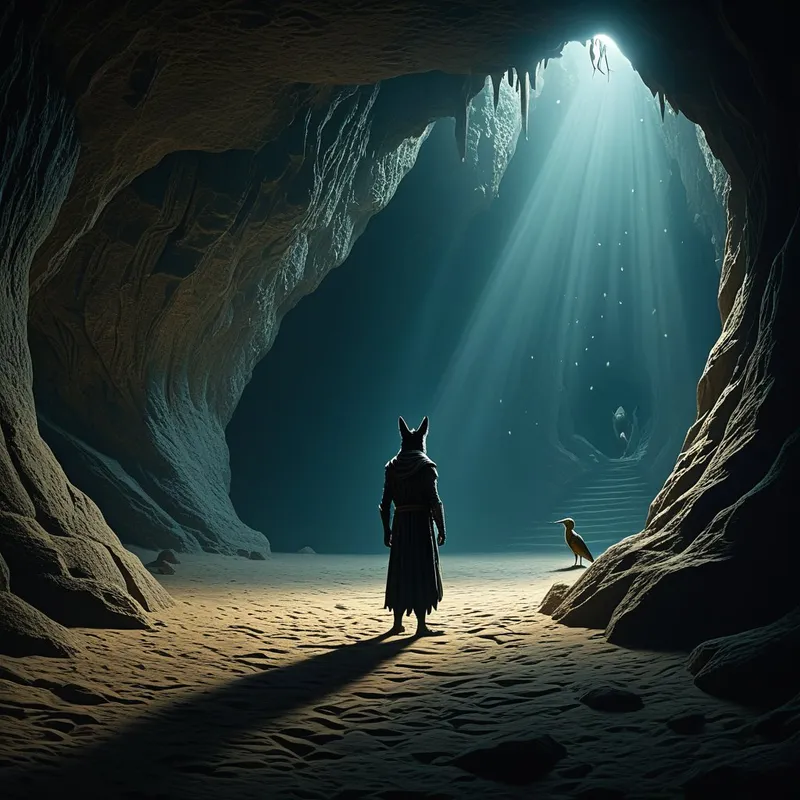
Listen, and hear of the land where the sun goes to die and be born again. This is not a place for the living. It is Duat, the belly of night, a river of black water flowing under a sky of fixed and frozen stars. Here, the sun god Ra, grown old and weary, boards his barque of a million years. He is a flame guttering in an immense darkness.
His voyage is a battle. The serpent Apep, embodiment of pure Isfet, coils in the depths, thirsting to swallow the light whole. The air is thick with the whispers of the dead and the chittering of demon guardians at each of the twelve gates of the night. Ra’s crew, gods and souls alike, row with silent desperation, their oars dipping into waters that are not water, but the substance of forgotten time.
But this is also the path of the newly dead. The ba, that bird with a human face, having fled the mummified body, now flutters through this same terrifying landscape. It must recite names and spells to pass hostile gatekeepers. It must navigate lakes of fire and fields of reeds that promise peace but may be illusion. Its goal is the Hall of Osiris, the Green God, Lord of the Silent Land.
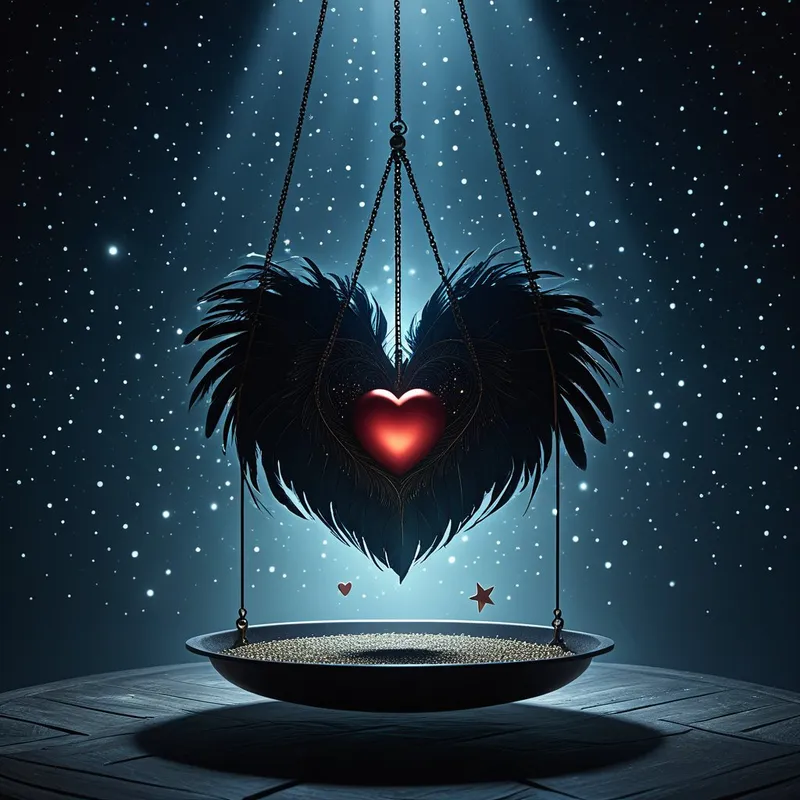
There, in that hall lit by a cold, green luminescence, the heart of the deceased is placed upon the scales of Maat. Against it, the feather of truth. The monster Ammit waits, slack-jawed. The ibis-headed Thoth records the result. If the heart is heavy with deceit, it is a final end in the beast’s maw. If it balances with the feather—light with truth—a voice, mighty yet gentle, speaks from the throne: “Your heart is true. You have spoken the declarations of innocence. You shall live forever.”
And as the justified soul joins the crew of Ra’s barque, a miracle occurs. At the deepest point of the night, in the darkest cavern of Duat, the aged Ra merges with the body of Osiris. From this union of sun and corpse, a new sun is conceived. The barque surges forward, breaking through the eastern horizon. The serpent is defeated once more. Dawn breaks. The soul, now an akh, shines with the light of the reborn day star.
Cultural Origins & Context
The myth of Duat was not a single, standardized story but a complex, evolving corpus of funerary texts spanning nearly three millennia. It began with the Pyramid Texts (c. 2400-2300 BCE), royal spells to ensure the pharaoh’s cosmic ascent. These evolved into the Book of the Dead, democratized for the elite, and further specialized into texts like the Amduat and the Book of Gates.
This mythology was the sacred technology of eternity. It was painted on tomb walls, inscribed on coffins, and written on papyrus placed with the mummy. Priests and funerary artisans were its custodians. Its societal function was paramount: to provide a map for the soul and a cosmological justification for the Egyptian state. The pharaoh’s journey through Duat mirrored Ra’s, ensuring the sun would rise and Maat—the foundation of society—would be upheld against chaos. It was a narrative that turned the terrifying mystery of death into a navigable, albeit perilous, process with a triumphant conclusion.
Symbolic Architecture
Duat is the ultimate symbolic landscape of the shadow. It is not a hell of punishment, but a realm of necessary ordeal, integration, and transformation. The journey is the core symbol.
The night sea voyage is not an escape from life, but a descent into the raw material of the self. To be weighed is to be made conscious.
The twelve gates or hours represent stages of dissolution. The demon guardians are the repressed aspects of the psyche—fears, traumas, unrecognized potentials—that must be faced and correctly named (integrated) to pass. The weighing of the heart is the moment of radical self-honesty, where the ego’s narratives are stripped away. The feather of Maat symbolizes the objective, impersonal standard of truth and integrity against which a life is measured.
Ra’s union with Osiris is the alchemical coniunctio oppositorum (union of opposites): the radiant, conscious principle (Ra/Sun) merges with the fertile, unconscious principle (Osiris/Earth/Death) to create something new and more whole. The entire myth models the psyche’s need to periodically “die” to its old, rigid structures (the setting sun) to be regenerated (the dawn).
The Dreamer's Resonance
When the architecture of Duat appears in modern dreams, it signals a profound process of psychic reorganization. Dreaming of labyrinthine tunnels, dark rivers, or being judged in a vast, solemn hall points to a soul-level audit.
The somatic experience can be one of dread, weight, or profound stillness. Psychologically, the dreamer is in the “hall of judgment.” This is not about moral failings in a religious sense, but about the alignment—or misalignment—of one’s life with one’s deepest truth. A dream of a heavy, sinking heart may reflect guilt, shame, or a life lived for others’ expectations. A dream of successfully navigating darkness or finding a light in the depths speaks to the ego courageously engaging with the unconscious, moving toward integration. The dream is the psyche’s own Thoth, documenting the state of the inner balance.
Alchemical Translation
For the modern individual, the Duat myth is a manual for individuation. The first step is the nekyia—the descent. This is the voluntary engagement with depression, loss, confusion, or shadow work in therapy. It is entering the “dark night of the soul.”
The serpent Apep is the resistance of the psyche to change, the addictive pull of old patterns. To row past it is to persist in the work of consciousness even when it feels futile.
The weighing of the heart translates to ruthless self-inquiry: Does this action, relationship, or belief align with my core truth? Is it heavy with deception (including self-deception), or light with integrity? The “declarations of innocence” are not claims of perfection, but affirmations of awareness and responsibility: I have seen my shadow. I own my mistakes. I act with intention.
The rebirth at dawn is the outcome. It is not a return to the old self, but the emergence of a new psychological structure—the Self as the inner akh. The individual who has navigated their inner Duat carries a quiet authority. They have faced their chaos, integrated their shadows, and their life is now more authentically their own. They understand that light is born from a conscious engagement with darkness, and that every ending, every “death” of an outworn way of being, contains the seed of a truer dawn.
Associated Symbols
Explore related symbols from the CaleaDream lexicon: