Druid's Staff Myth Meaning & Symbolism
A tale where a druid's quest for a staff of ultimate wisdom demands a harrowing sacrifice, forging a bond between mortal spirit and the world's soul.
The Tale of Druid's Staff
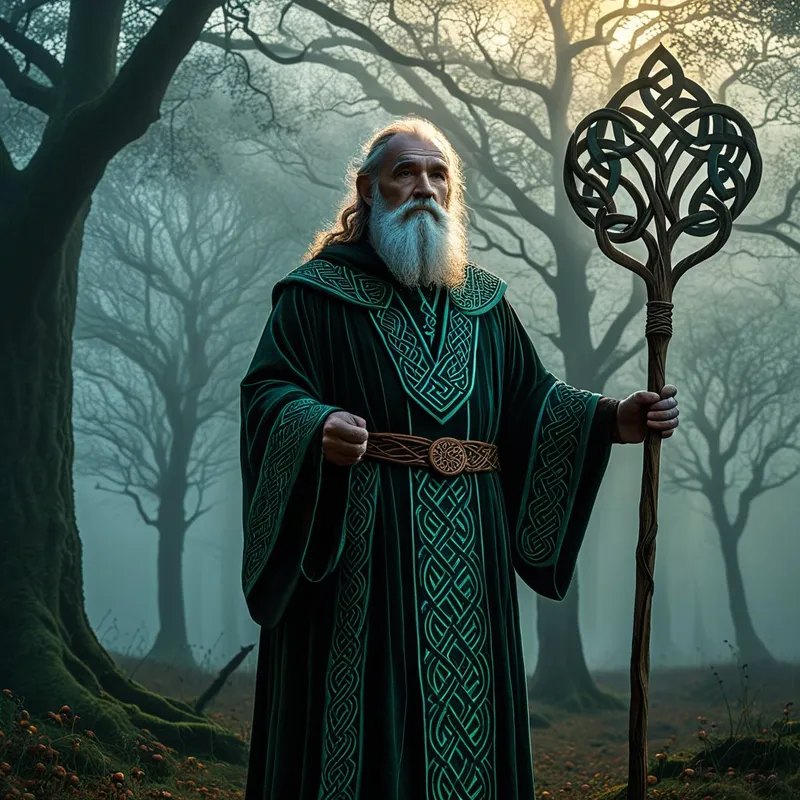
Listen. The wind in the high oaks carries more than the scent of rain. It carries a whisper of a time when the world was a conversation, and the druids were its translators. This is not a story of a king, but of a seeker. His name is lost to the moss and the mist, but we know him as Fíth, the one who listens.
Fíth walked the land, his feet knowing the song of every stone, his ears tuned to the arguments of the rivers and the gossip of the leaves. Yet, a hollow place grew within his chest. He had knowledge, yes—the names of stars, the healing properties of yew, the laws that bound tribe to tribe. But he lacked imbas, the fire of true, flowing wisdom that comes not from learning, but from being remade by the source itself. For this, he needed a staff. Not a crutch for walking, but a conduit for walking between.
The elders told him of the Sídhe-mound of Ériu, where a spring, black as a raven’s eye, bubbled from the roots of the World Tree. There, he must find the branch that was both ash and oak, rowan and yew—a branch that contained the essence of all woods, and thus, all states of being. “To claim it,” they warned, their voices like dry leaves, “you must pay a price the water will name.”
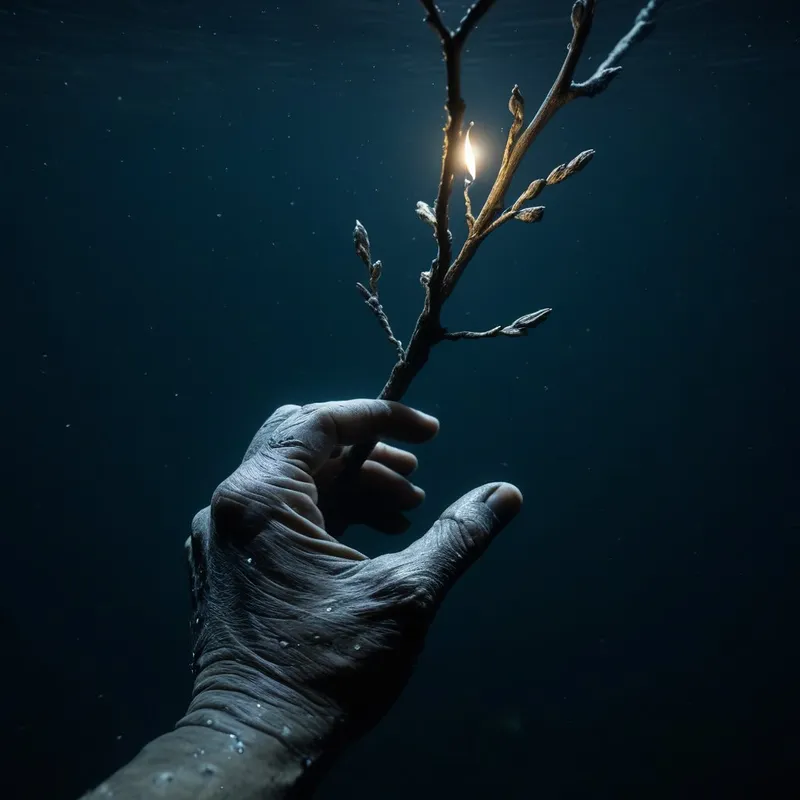
For nine days and nights, Fíth fasted, letting the hunger scrape his mind clean. On the tenth dawn, he stood before the pool. The water did not reflect the sky, but a swirling, starless depth. He saw the branch, a twisted, beautiful thing half-submerged in the silt. He reached. The water, cold as a forgotten grave, seized his arm. Not with force, but with a presence. A voice, liquid and ancient, spoke not to his ears but to his bones.
“You seek the bridge between earth and sky, mortal and divine. To hold it, you must leave a part of yourself here, in the dark. What will you give?”
Fíth thought of his knowledge, his strength, his years. The pool rejected each offer with a silent, profound disinterest. Despair crept in. Then, he understood. He spoke his truth into the stillness. “I give my certainty. I give the solid ground from which I judge the world. I will walk forever on shifting soil, if I may carry the staff that knows the roots.”
The water sighed. A searing pain, cold and bright, shot through his offering hand. He watched, transfixed, as the lines of his palm—the map of his fate—bled away, leaving skin as smooth as a newborn’s. In that moment of terrifying emptiness, his other hand closed around the branch. It did not come free. It grew free, extending from the pool’s heart, its wood warm and alive, thrumming with a silent song.
He lifted the Druin-slait. The grove held its breath. Where he pointed, mist coiled into shapes of forgotten beasts. Where he planted it, the earth bloomed with flowers out of season. He was no longer just a man who knew things. He had become a man through whom the world spoke. His certainty was gone, replaced by a vast, humming vulnerability—the true price, and the true power.
Cultural Origins & Context
This tale, in its myriad local forms, belongs not to parchment but to the oral tradition of the insular Celtic world, particularly Ireland and Wales. It was not a single, canonical myth but a narrative pattern, a teaching story recited by filidh and learned by apprentice druids. Its function was multifaceted: it was a dindshenchas (a lore of place) explaining the sanctity of certain groves or springs; an initiatory parable for those entering the druidic orders; and a deep political metaphor.
In a culture where sovereignty was not merely a political office but a sacred marriage to the land goddess, the druid’s staff represented a parallel authority. If the king’s spear upheld the law of the tribe, the druid’s staff upheld the law of the cosmos. The story encoded the terrifying responsibility of that role. The druid’s power was not for personal gain but for tribal balance—mediating with the Tuatha Dé Danann, ensuring fertile harvests, and speaking judgments that resonated with cosmic truth. The sacrifice in the story mirrors the druid’s required detachment from ordinary human attachments and biases, a theme echoed in historical accounts of their lengthy, isolated training.
Symbolic Architecture
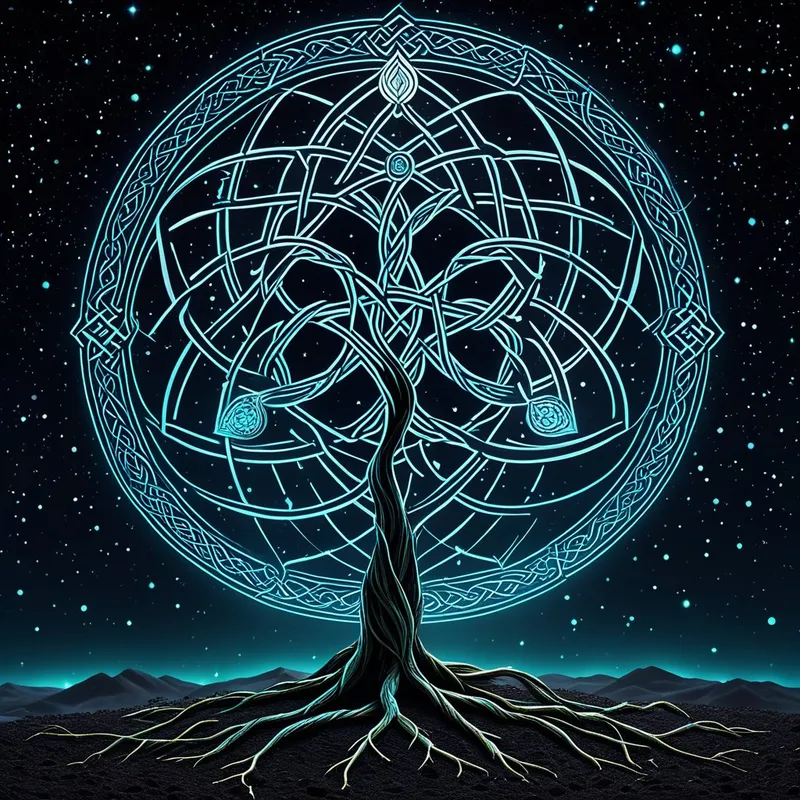
The myth’s power lies in its stark symbolic architecture. The staff is the axis mundi in microcosm, a physical embodiment of the World Tree. It is the vertical connector between the three realms: its roots in the watery underworld of the pool (the unconscious, ancestry, potential), its shaft in the middle world of human affairs (the conscious ego, society), and its crown in the upper world of birds and sky (spirit, inspiration, the gods).
The sacrifice is never of what you have, but of what you are. The pool does not want your possessions; it demands the very lens through which you perceive reality.
Fíth’s sacrifice of the “lines of his palm”—his certainty, his predetermined fate—is the core psychological transaction. He trades a defined, limited identity for a fluid, participatory one. His smooth palm signifies he is no longer merely reading a pre-written fate; he is now co-authoring reality with the world-soul. The staff is not a tool he wields, but an organ of perception he has grown. His authority is born not from rigidity, but from this radical openness to the unknown.
The Dreamer's Resonance
When this myth stirs in the modern psyche, it often manifests in dreams of pivotal choice or profound loss of identity. You may dream of standing before a dark body of water, knowing you must surrender something precious to cross. You may dream your hands are changing—becoming translucent, wooden, or map-less. You may find a simple, powerful stick in a dream and feel an overwhelming sense of responsibility upon picking it up.
These are not nightmares of lack, but somatic signals of a psyche undergoing a necessary deconstruction. The “pool” is the deep unconscious, the “staff” is a nascent, integrating Self, and the “sacrifice” is the ego’s terrified but necessary relinquishment of control. The dreamer is in the liminal space between who they were and who they are becoming, a process that always feels, at first, like a terrifying erasure. The body registers this as anxiety, a sense of groundlessness, or a profound feeling of being “between stories.”

Alchemical Translation
The myth of the Druid’s Staff is a perfect map for the alchemical process of individuation. The first stage, nigredo (the blackening), is Fíth’s hollow despair and his confrontation with the black pool—the descent into the shadow, the acknowledgment of the ego’s insufficiency.
The transaction at the pool is the albedo (the whitening)—the purification. Here, the base metal of the ego (certainty, a fixed self-image) is dissolved in the aqua permanens of the unconscious. His smooth palm is the tabula rasa, the clean slate. This is not destruction, but liberation from a limiting form.
The staff is the philosopher’s stone, forged not in a fire of ambition, but in the waters of surrender. It is the integrated psyche, where unconscious instinct (the roots) and conscious direction (the shaft) are one living wood.
Finally, the staff’s animation is the rubedo (the reddening)—the embodiment of the new consciousness. The druid does not “get” power; he becomes a vessel for a larger life. For the modern individual, this translates to the moment when a profound loss or sacrifice—of a career, a relationship, a long-held belief—ceases to be merely a wound and becomes the very aperture through which a more authentic, creative, and grounded life begins to flow. You do not find your authority; you surrender to the process that makes you authoritative. The myth tells us that true wisdom, the staff we all seek, is grown in the dark water of our most profound letting-go.
Associated Symbols
Explore related symbols from the CaleaDream lexicon: