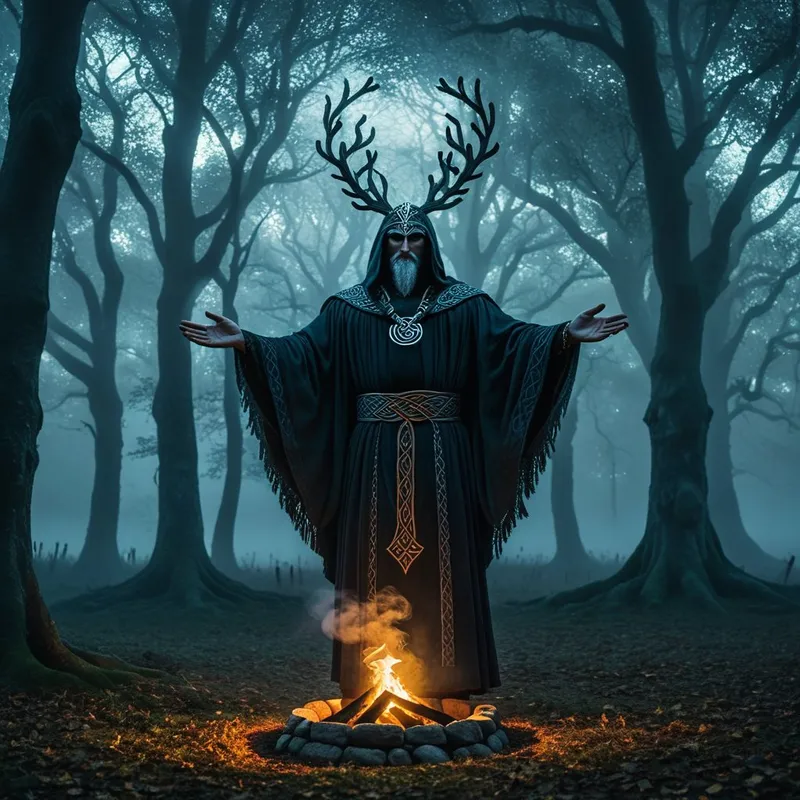
Druidic Smoke Divination Myth Meaning & Symbolism
An ancient Druid, guided by the Morrígan, reads fate in sacred smoke, learning that true vision requires embracing the shadow within the light.
The Tale of Druidic Smoke Divination
Listen. The wind does not speak in words, but in sighs through the ancient oaks of Nemeton. In the time when the world was younger and the veil between the realms was thin as morning mist, there lived a Druid named Dairgné. He was a seeker of patterns, a reader of the stars in their courses and the flight of birds. Yet, a great stillness had settled upon his spirit. The omens had grown silent; the future was a closed book.
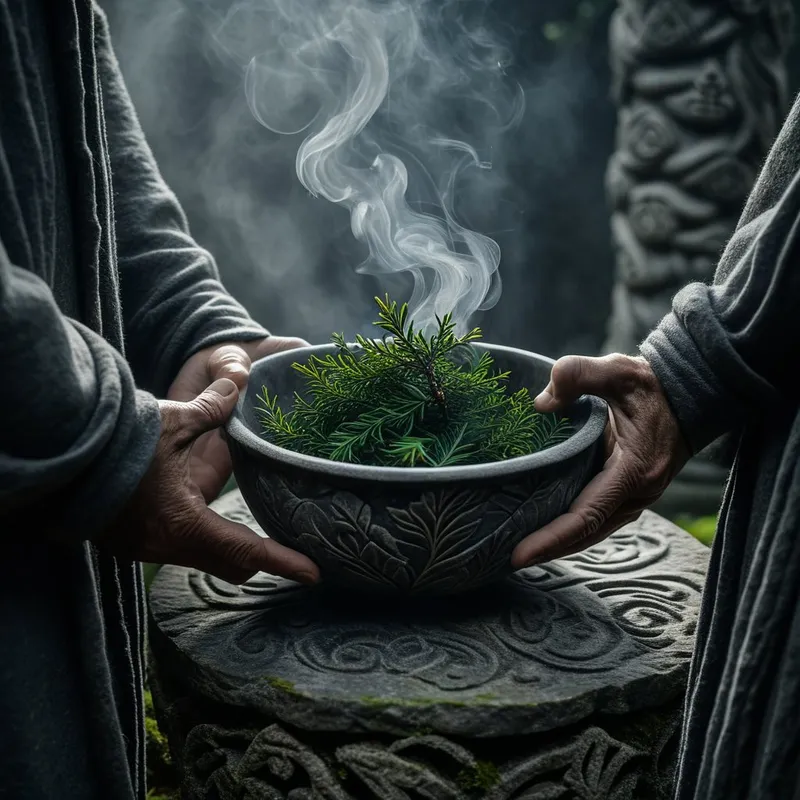
The people of the tuath looked to him for guidance as the harvest waned and the long, dark months of Samhain drew near. A chieftain sought counsel on war, a mother on a sick child, a farmer on the next sowing. Dairgné’s heart was heavy with their unspoken fears, and his own. He climbed to the high place, a clearing among the grandfather oaks where a single, moss-covered standing stone kept watch. He built a small fire of sacred woods—oak for strength, yew for death and rebirth, apple for the otherworld. Upon the flames, he cast dried herbs: mugwort for vision, and rowan for protection.
He did not seek a blazing fire, but the soul of the fire—the smoke. Kneeling, he began the slow, rhythmic chant, a lorica to open the ways. The smoke, white and pure at first, rose in a straight column to the heavens. Then, as dusk bled into the world, the column shuddered. A cold wind, born of no natural gust, snaked through the grove. The smoke coiled upon itself, thickening into a grey, formless mass that blotted out the emerging stars.
From within that gloom, shapes began to writhe. He saw the chieftain’s hall consumed by flames of discord. He saw the mother’s child lying still. He saw blight upon the fields. These were not mere possibilities; they were certainties written in ash and air. Despair gripped him. This was not divination; it was a pronouncement of doom. In his anguish, he cried out to the Genius Loci of the place.
And the smoke answered.
It did not speak, but it showed. The formless grey began to swirl with a dark, iridescent sheen, like a raven’s wing. It coalesced into a towering, feminine shape—a presence of immense power and terrifying grace. It was the Morrígan, the Phantom Queen. Her eyes in the smoke were pools of starless night. She did not bring comfort. With a gesture that was the turning of a season, she swept a wing of smoke across the visions of despair. The images shattered like ice, but they did not vanish. Instead, each fragment—each flame, each still form, each withered stalk—drifted down not as ash, but as dark, fertile soil around the roots of the great oak beside him.
Then, from the heart of the soil, from the heart of the darkness he feared, a single, slender shoot of green broke forth. It grew with impossible speed, not to overshadow the oak, but to twine around its mighty trunk, a living embrace of ivy. The final vision was not of an end, but of a union: the enduring strength of the oak and the resilient, clinging life of the ivy, each sustaining the other. The smoke thinned. The shape of the Morrígan dissolved into the night air, leaving behind only the scent of damp earth and ozone. Dairgné was left alone in the grove, the true message etched upon his soul: to see the future, one must first see the shadow that fertilizes it.
Cultural Origins & Context
The practice of imbasing—divination by observing smoke, clouds, or the embers of a fire—was one of the many arcane arts attributed to the Druids. Our knowledge of it is fragmentary, gleaned from cryptic references in later Irish and Welsh manuscripts, and from the cautious, often disapproving, observations of Roman commentators like Pliny. It was never a mere parlor trick. It existed within a cosmological framework where the material world was continuously breathed into being by an Otherworld, and where communication between these realms was possible through specific, sanctified mediums.
Smoke, occupying the liminal space between fire (a transformative element) and air (the element of intellect and spirit), was the perfect vehicle. The Druid, as a fáith, acted as an intermediary. The ritual was likely performed at twilight or dawn—threshold times—and at liminal places: forest clearings, hilltops, or shores. The myth of Dairgné serves a crucial societal function: it legitimizes the terrifying ambiguity of prophecy. It teaches that the Druid’s role is not to deliver pleasant, certain futures, but to interpret the complex, often frightening dialogue between order and chaos, blessing and curse, which the smoke reveals. The story transforms the diviner from a simple messenger into one who must undergo a psychological ordeal to understand the message.
Symbolic Architecture
At its core, the myth is a profound map of the psyche encountering its own depths. The sacred fire represents the conscious mind—focused, intentional, and seeking illumination. The smoke is the symbolic content of the unconscious, rising unbidden from that fire. Its initial straight column signifies the ego’s desire for clear, unambiguous answers from the divine.
The first truth the smoke teaches is that pure, untainted vision is an illusion. True sight emerges from the confrontation with the formless grey.
The terrifying visions of disaster are the personal and collective shadow—all that we fear, reject, or deny. They are the inevitable consequences of unacknowledged conflicts, repressed desires, or communal imbalances. The appearance of the Morrígan is pivotal. She is not the cause of the shadow, but its personification and ruler. She is the archetypal force that demands we look at what we would rather ignore.
Her action—shattering the visions into fertile soil—is the alchemical key. It symbolizes the necessary dissolution of our fixed, fearful interpretations. The shadow, when faced and broken down, loses its power as a harbinger of doom and becomes instead the humus, the nourishing ground, for new growth. The oak and ivy represent the ultimate symbolic integration: the enduring structure of the conscious self (the oak) now supported and enriched by the resilient, adaptive wisdom of the once-feared unconscious (the ivy).
The Dreamer's Resonance
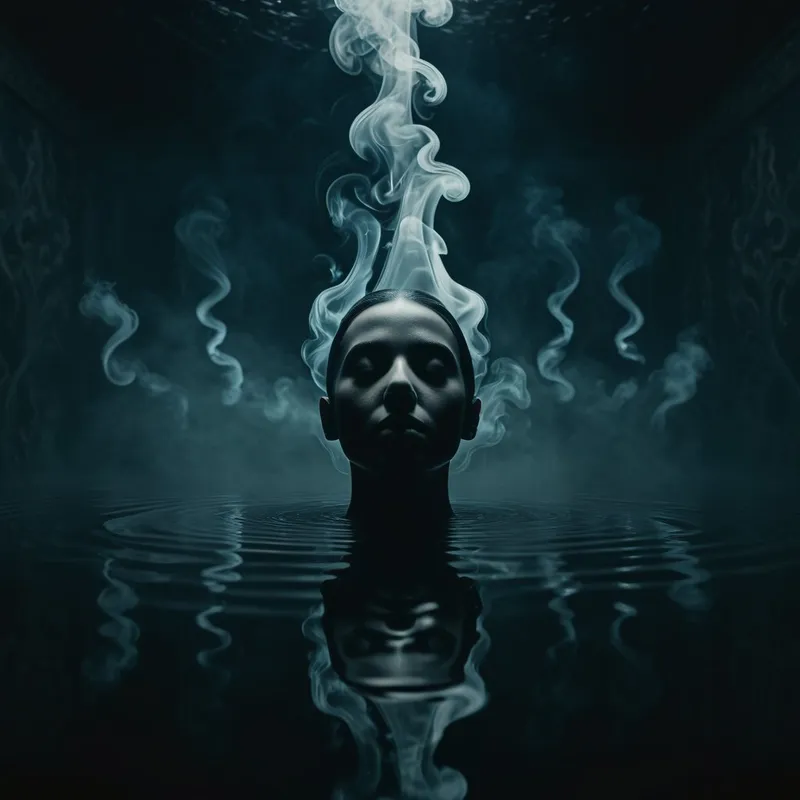
When this mythic pattern stirs in the modern dreamer, it often manifests as dreams of obscured vision or enigmatic messages. You may dream of fog or smoke obscuring a crucial path, of trying to read text that dissolves, or of hearing warnings in a forgotten language. Somatic sensations might accompany this—a tightness in the chest, a literal feeling of being "smothered" or unable to breathe clearly. This is the psyche’s equivalent of Dairgné’s formless grey smoke.
The psychological process underway is the initial, often distressing, upwelling of unconscious material that the conscious mind cannot yet parse. The dream ego, like the Druid, is positioned at the threshold, receiving data it feels compelled to understand but which currently appears as chaos or threat. The presence of a powerful, ambiguous figure (like the Morrígan) in such dreams signals that the content is archetypal—it pertains to fundamental life patterns around power, fate, or transformation that the dreamer is being called to confront. The dream is not a prediction of literal disaster, but an invitation to begin the work of turning feared outcomes into fertile ground for insight.
Alchemical Translation
The journey of Dairgné is a perfect model for the individuation process. It begins with the nigredo, the blackening: the despair and confusion when our conscious plans meet the resistant, shadowy material of the unconscious (the grim smoke-visions). This is a necessary death of naive certainty.
The intervention of the Morrígan represents the archetypal catalyst that forces the solutio, the dissolution. Our rigid ego-structures and fearful narratives must be broken apart. This is the most perilous part of the work—allowing oneself to be shattered by the truth of what one has seen.
The alchemical fire does not destroy; it separates. The smoke does not obscure; it carries what has been separated to a new place of assembly.
The final stage is the coniunctio, the sacred marriage symbolized by the oak and ivy. This is the integration achieved when the conscious mind (the Druid returning to his people) no longer wars with the unconscious but learns its language. The insights gained from the shadow are not paraded as absolute truth, but are woven into practical wisdom, resilience, and a more profound, compassionate capacity to guide oneself and others. The modern individual performing this alchemy learns to divine meaning not from external smoke, but from the internal swirl of emotion, memory, and impulse, understanding that even the darkest thought can be compost for the soul's growth. The goal is not to become an oracle who sees a fixed future, but a sage who can navigate the eternal, creative tension between what is and what could be.
Associated Symbols
Explore related symbols from the CaleaDream lexicon: