
Druid Herb Lore Myth Meaning & Symbolism
A tale of how the Druids gained their sacred plant wisdom through a perilous journey into the Otherworld, guided by the spirit of the land.
The Tale of Druid Herb Lore
Listen. The wind in the oaks carries more than the scent of damp earth and coming rain. It carries a whisper of the first knowing, a story woven into the very sap of the trees. Before the stone circles were raised, before the kings were crowned, the people walked the green world in awe and terror. They knew the wolf’s tooth and the bear’s claw, the chill of fever and the wasting sickness. They had no names for these afflictions, only the pain.
In those mist-shrouded days, there was one among them, a seeker named Dairinn. While others hunted or tilled, Dairinn would sit for days at the foot of the great Bile, watching the play of light on leaves, the busy life of beetle and bee. He felt a longing, a pull not of the belly, but of the spirit—a hunger to understand the silent speech of the green world.
One night, under a moon so full it seemed to drip silver, the longing became a voice. It came not from the air, but from the ground, a resonant hum that traveled up through the roots and into his bones. It spoke of a place where the veil between worlds was thin as a spider’s silk: a certain pool, black and still, hidden in the heart of the forest where no bird sang. “Seek the Lady of the Pool,” the voice murmured. “She holds the Ainm of all that grows. But the price of her gaze is your certainty.”
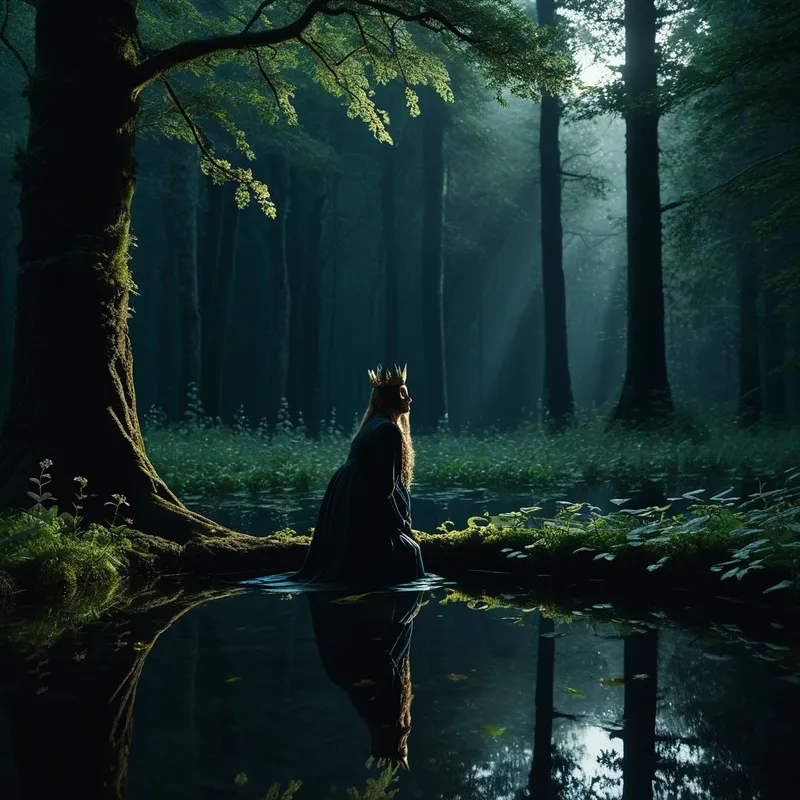
Driven by a fire he could not quench, Dairinn journeyed for nine days and nights. He passed through forests that grew stranger, where trees seemed to watch and flowers glowed with a faint, inner light. Finally, he found it: a circular pool so dark it appeared as a hole in the world, reflecting only the cold stars. He knelt, as the voice had instructed, and looked into the water.
His own reflection dissolved. In its place appeared a face of impossible beauty and profound sorrow, a woman with hair of woven willow and eyes the deep green of forest shadows. She was Cailleach and Brigid as one, crowned with foxglove and oak. “You seek the tongue of the green,” she said, her voice the sound of water over stone. “To learn it, you must lose your own. You must drink of this pool and journey into Annwn. You may return with wisdom, or you may remain, a root in the dark earth.”
Without hesitation, Dairinn cupped the icy water in his hands and drank. The world upended. He fell not down, but through—through the pool and into a twilight realm where the sky was a perpetual dusk and the plants pulsed with their own light. Here, he was not a man, but a awareness drifting. He felt the sharp joy of nettle, the drowsy sigh of poppy, the fierce, cleansing burn of wormwood. He experienced the slow, patient agony of yew as it grew around a grave, and the ecstatic, sun-seeking rush of honeysuckle. He knew them from the inside, their spirit, their purpose, their secret names.
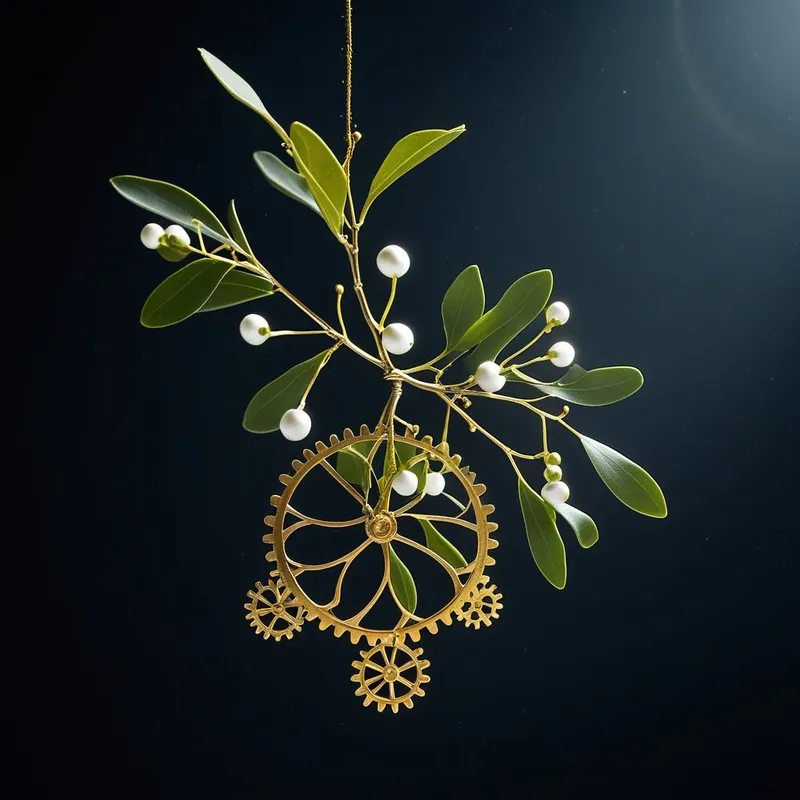
But the knowledge was not given; it was exchanged. As he learned the language of the herbs, he felt his own human speech, his simple names for things, unravel and fade. He was becoming a silent vessel. When he could bear no more, the vision of the Lady appeared before him. In her hand was a single, perfect berry from the Mistletoe that grew on the oak of this Otherworld. “This is the key,” she said. “The plant between heaven and earth, that touches both but is rooted in neither. Carry its memory back. It will be your anchor and your voice.”
He took the berry, and it burned like cold fire in his mind. The twilight realm rushed away, and he surged upward, breaking the surface of the black pool, gasping under the familiar moon. He was on the cold ground, himself again, yet utterly changed. He opened his mouth, and no human word came out. But when he touched the forehead of a child burning with fever, his fingers sought out a humble plant growing nearby—meadowsweet. As he prepared it, a song, not in his tongue but in the tongue of the plant itself, hummed in his mind. The child’s fever broke. Dairinn, the silent man, had become the first Druid. He could not speak of men, but he could listen to the earth, and translate its healing wisdom for all who would listen.
Cultural Origins & Context
The myth of the Druid’s herbal knowledge is not a single, codified story from a ancient text, but a tapestry woven from fragments of lore, medieval Irish and Welsh manuscripts, and the meticulous observations of classical commentators like Pliny the Elder. The Druids themselves were the living libraries of their culture, and their knowledge—especially of Lughnasa—was considered a sacred science, transmitted orally over decades of rigorous training. This mythic narrative serves as an etiological story, a “how it came to be” tale that sacralizes their profound ecological expertise.
It was likely told not to the common folk as entertainment, but within the Druidic orders themselves as a foundational initiatory narrative. Its function was multifaceted: it established the divine, Otherworldly source of their authority, it encoded the psychological perils of the quest for hidden knowledge (the loss of self, the encounter with the sovereign spirit of the land), and it underscored that true healing wisdom comes not from domination, but from a perilous, self-sacrificial communion with the non-human world. The story frames the Druid not as a wizard commanding nature, but as a translator who has paid a profound price to serve as a bridge.
Symbolic Architecture
At its heart, this is a myth of the birth of consciousness through symbolic thinking. Dairinn begins in a state of undifferentiated participation with nature—he feels its pull but cannot decipher it. The journey represents the necessary descent of the ego into the unconscious (the black pool, Annwn) to retrieve a new form of knowledge. The Lady of the Pool is the archetypal Anima Mundi, the soul of the world itself. She is the ultimate source, but she is ambivalent; her gift requires a sacrifice.
The first true knowing is always an un-knowing. To gain the language of the soul, one must first surrender the chatter of the persona.
The loss of human speech is the critical symbol. It represents the death of the old, literal, ego-centric mode of perception. He does not simply learn about herbs; he experiences their essential nature. This is knowledge by identification, a shamanistic incorporation of the spirit of the thing. The mistletoe berry, the “key,” is the perfect symbol of the attained symbolic function itself—a thing that exists in the borderland (between oak and sky, between worlds), enabling the traveler to move between realms of meaning (the literal and the symbolic, the human and the natural) without being trapped in either.
The Dreamer's Resonance
When this mythic pattern stirs in the modern psyche, it often manifests in dreams of potent, enigmatic plants; of finding overgrown, secret gardens in urban spaces; or of being unable to speak while surrounded by urgent, whispering greenery. The somatic sensation is often one of a deep, resonant humming in the body, or a feeling of roots spreading from one’s feet.
Psychologically, this signals a process where instinctual, somatic intelligence is seeking to break through a crust of over-intellectualization or sterile ego-identity. The dreamer is being called to a deeper, more embodied way of knowing. The frustration of being mute in the dream mirrors the ego’s helplessness when faced with the raw, non-verbal intelligence of the body or the unconscious. It is an invitation to stop interpreting from a distance and to begin listening from within—to one’s own symptoms, intuitions, and the subtle patterns of one’s life as if they were a language waiting to be deciphered.
Alchemical Translation
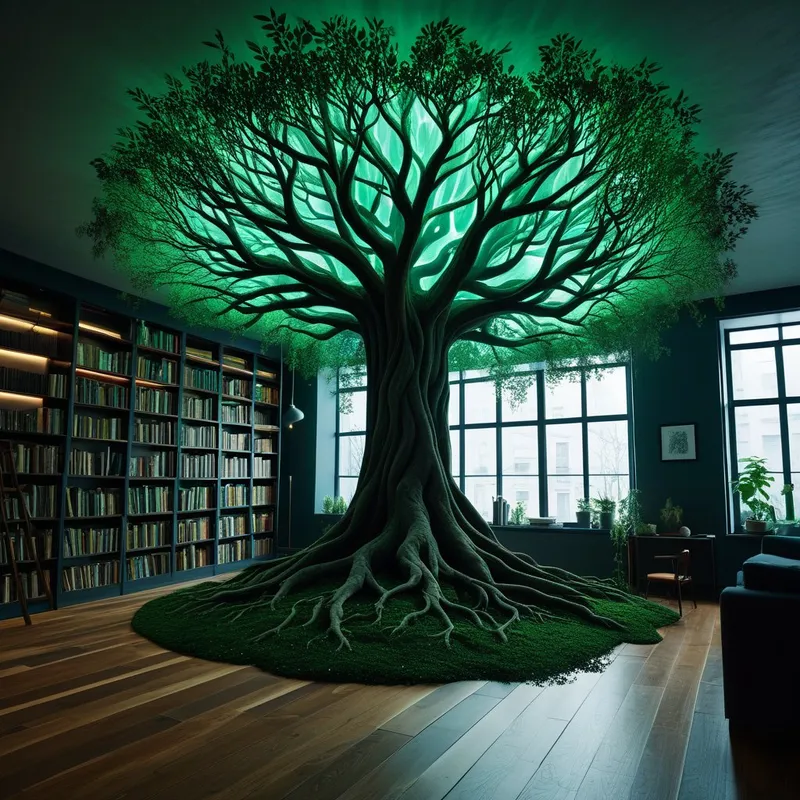
The alchemical process mirrored here is the Nigredo and Albedo—the blackening and whitening. The descent into the black pool is the Nigredo, the dissolution of the conscious personality into the primal, chaotic waters of the unconscious. It is a necessary, terrifying disintegration. The acquisition of plant-knowledge is the beginning of the Albedo, the washing clean: the extraction of a new, purer principle from the black mass.
For the modern individual, the myth models the path of Individuation through specialization of a deep, often neglected function. The “herb lore” is one’s own unique, innate wisdom—a talent, a creative spark, a way of perceiving that feels instinctual and connected to something greater than the social self. To gain it, one must willingly enter a period of confusion and sacrifice (the loss of “common speech,” perhaps social approval or a conventional career path). One must commune with the inner Anima/Animus (the Lady) who guards this treasure.
The healing one brings back to the community is always first a poison swallowed in the solitude of the self.
The returned Druid is silent because his wisdom now operates on a symbolic, experiential level. He has transmuted raw experience (the plant’s spirit) into applied, healing art (the remedy). The individuated person does not just have a skill; they are a conduit for a specific form of life-energy that serves to re-balance and heal both themselves and their world. Their authority comes not from credentials, but from the palpable integrity of having made the round-trip journey to the source and back, bearing the cold, bright berry of hard-won truth.
Associated Symbols
Explore related symbols from the CaleaDream lexicon: