Dream Yoga Myth Meaning & Symbolism
A mythic journey where the dream state is not an escape, but a sacred training ground for mastering perception and awakening to the luminous nature of all reality.
The Tale of Dream Yoga
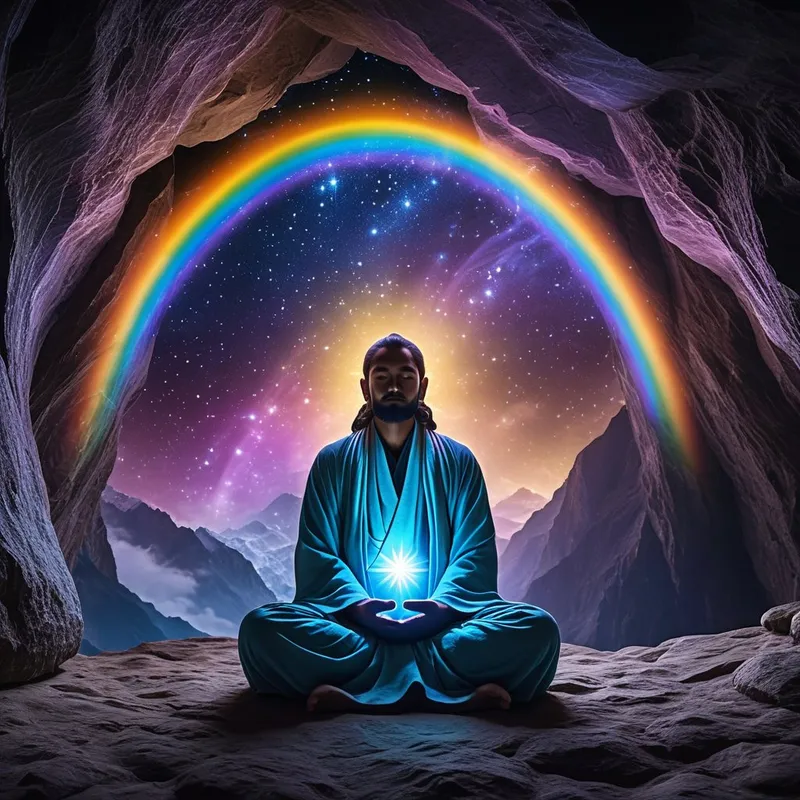
Listen, and let the tale unfold not in the bright sun, but in the deep blue twilight between day and night, between waking and sleep. In the high, silent reaches where the air is thin and the stars are close enough to touch, there lived a seeker. He was not a king or a warrior, but a yogin, his heart a vessel of one burning question: What is real?
By day, he practiced with fierce discipline, taming the wild horse of his mind. Yet each night, as he surrendered to sleep, he was swept away into a phantom kingdom. Here, he fled from dream tigers with teeth of fear, chased pleasures that dissolved like mist, and wandered landscapes built from the forgotten clay of his own day. He would awaken, heart pounding, a stranger in his own life. The solid world of sun and stone felt like just another layer of the dream, and the question gnawed at him: Where does the dream end and the dreamer begin?
His master, a figure as ancient and still as the mountain itself, saw his torment. One evening, as the last light bled from the sky, the master spoke, his voice the sound of a distant river. "You seek reality in the waking state, but you are a slave in the dream state. To know one, you must master the other. The night is not your enemy; it is your most profound teacher."
He gave the seeker the secret instructions, the lung, of Dream Yoga. The seeker began a vigil at the threshold. As he lay down to sleep, he did not seek rest, but a fierce, gentle awareness. He held a single intention, a tiny flame in the vast dark: "I will know I am dreaming."
For countless nights, he failed. The dream would seize him, and he would forget. He was a leaf in a torrent. But the flame of intention did not die. Then, one night, amidst a dream of climbing a staircase that spiraled into nothing, he saw his own hand. And he knew. The shock of recognition was electric. "This is a dream!" The phantom world shuddered, its illusions suddenly transparent.
This was not the end, but the true beginning. Now the real training commenced. With the lucidity of a Buddha, he learned to stabilize the dreamscape, to keep it from collapsing into waking or dissolving into unconsciousness. He practiced transformation: turning fear into a dancing light, melting solid mountains into pools of light, walking through walls of his own belief. He confronted dream figures, understanding they were none other than the luminous, empty play of his own mind.
The final instruction was the most subtle. He was to seek the source of the dream itself. In the radiant clarity of lucid dreaming, he turned his awareness inward, searching for the dreamer. He looked for the mind that projected the dream… and found only vast, open, luminous space. The dream arose from nowhere, danced nowhere, and dissolved into nowhere. In that moment of supreme recognition, the boundary shattered. The luminous, empty nature of the dream and the luminous, empty nature of the waking world were revealed as one taste, one inseparable reality. The seeker awoke—truly awoke—not from the dream, but within the great dream of reality itself, forever free.
Cultural Origins & Context
The mythos of Dream Yoga, or Milam, is not a single story with a fixed protagonist, but a living transmission woven into the fabric of Vajrayana Buddhism. Its roots are traced to the Mahasiddhas, the great adepts of India like Padmasambhava and the sage Naropa, from whom it flowed into the Tibetan lineages, particularly the Kagyu and Nyingma traditions.
It was passed down not as a public parable, but as a secret oral instruction, a menngag, from master to qualified disciple in an unbroken chain. Its societal function was esoteric and profound: to serve as a direct path to enlightenment. In a culture that views cyclic existence (samsara) as a shared dream from which we must awaken, Dream Yoga provided a potent, accelerated method. By training in the illusory reality of the dream, the practitioner could directly realize the illusory nature of all perceived reality, thereby cutting through delusion at its root.
Symbolic Architecture
The myth maps the entire journey of consciousness. The dream state is not merely a psychological playground; it is a symbolic mirror of our waking delusion. The dream tigers and chases represent our uncontrolled emotions and karmic propensities, which hold us in thrall when we are "asleep" to our true nature.
The dream is the perfect metaphor, for in it we experience a reality that is utterly convincing yet utterly fabricated by our own mind. To become lucid is to perform the ultimate act of introspection.
The act of achieving lucidity symbolizes the dawn of spiritual awareness (bodhicitta). Stabilizing the dream is the discipline of samadhi, learning to abide in awareness without distraction. The transformative practices within the dream—flying, shifting forms—represent the mastery over primal psychic energies and the deconstruction of a fixed, solid sense of self. Finally, seeking the dreamer who cannot be found points directly to the ultimate insight of shunyata: the realization that there is no separate, solid "self" at the center of experience, only an ever-unfolding, aware emptiness from which all phenomena arise, like images from a mirror.
The Dreamer's Resonance
When a modern dreamer experiences the archetypal pattern of the Dream Yoga myth—perhaps a sudden, shocking moment of lucidity, or a dream of trying to control a shifting environment—it signals a profound psychological process. Somatically, it may accompany a sensation of vibration, lightness, or expansion in the dream body. Psychologically, it marks a moment where the unconscious is no longer a hidden dictator but becomes transparent to the conscious ego.
This is the psyche's innate movement toward integration. The dream ego is beginning to recognize its own authorship of the psychic drama. To dream of becoming lucid and then facing a dream figure is to engage in spontaneous shadow-work; the "other" in the dream is revealed as an aspect of oneself, inviting dialogue and reconciliation rather than projection and fear. Such dreams indicate a readiness to take responsibility for one's inner world and to see through the apparent solidity of one's problems and identities.

Alchemical Translation
The myth of Dream Yoga is a precise alchemical manual for psychic transmutation, or individuation. The base metal is our ordinary, passive consciousness, tossed about by the contents of the unconscious (the nightly dream) and the complexes of the waking world. The nigredo, or dark night, is the initial phase of suffering in the dream, the feeling of being lost in one's own psyche.
The alchemical fire is the flame of lucid awareness. It does not destroy the dream, but transmutes it, revealing the gold of pure, non-dual perception hidden within the lead of delusion.
Achieving lucidity is the albedo, the whitening, where the material becomes purified and conscious. The transformative practices within the lucid dream represent the citrinitas, the yellowing, where the conscious ego actively engages with and integrates symbolic content from the unconscious, gaining flexibility and power. The final dissolution, seeking and not finding the dreamer, is the rubedo, the reddening or completion. It is the death of the ego's claim to central authorship and the birth of the Self—the realization that one's fundamental identity is the boundless, creative space of awareness itself, from which both personal psyche and external world co-arise. For the modern individual, this models the journey from being a victim of circumstance and internal narrative to becoming the sovereign, compassionate witness of the entire, luminous play of existence.
Associated Symbols
Explore related symbols from the CaleaDream lexicon: