
Dream-Inducing Plants Myth Meaning & Symbolism
A myth of a mortal who steals the seeds of divine sleep from a slumbering god, gifting humanity the power to dream and commune with the unseen.
The Tale of Dream-Inducing Plants
In the time before memory, when the world was raw clay and the sky a canvas of first light, the gods walked openly. Among them was Hypnos Megas, not a god of gentle rest, but of the fathomless, generative slumber from which reality itself was dreamed. His sleep was not an absence, but a profound presence—a creative coma. Where he lay down to dream, the earth would soften, and from the soil around his divine head would sprout the Oneiroi Botanoi. These were no ordinary plants. Their leaves were the color of twilight, their stems threaded with veins of liquid silver, and from their blossoms fell a pollen that was condensed starlight and shadow.
Humanity in that age lived wakeful, literal lives. Their nights were black and empty, a mere pause. They saw the god’s resting places as cursed ground, for to approach was to be overcome by a sleep so deep some never stirred. They called him the Bathys Koimomenos and kept their distance.
But one mortal, a woman named Alke, watched from a high cliff. She did not see a curse. She saw the plants pulse in rhythm with her own heart. She saw creatures that drank from dew on their leaves enter trances of beautiful, silent movement. A hunger awoke in her—not for food, but for the experience of that other world touching the god. She did not want to steal his rest, but to taste the source.
For seven nights, she inched closer to the valley where Hypnos Megas lay, a mountain range of a being breathing clouds into the sky. The air grew thick and sweet, heavy with the scent of ozone and forgotten memories. Each step was a battle against a tidal pull of drowsiness. She tied stones to her feet to feel the ground, sang sharp songs to keep her mind anchored.
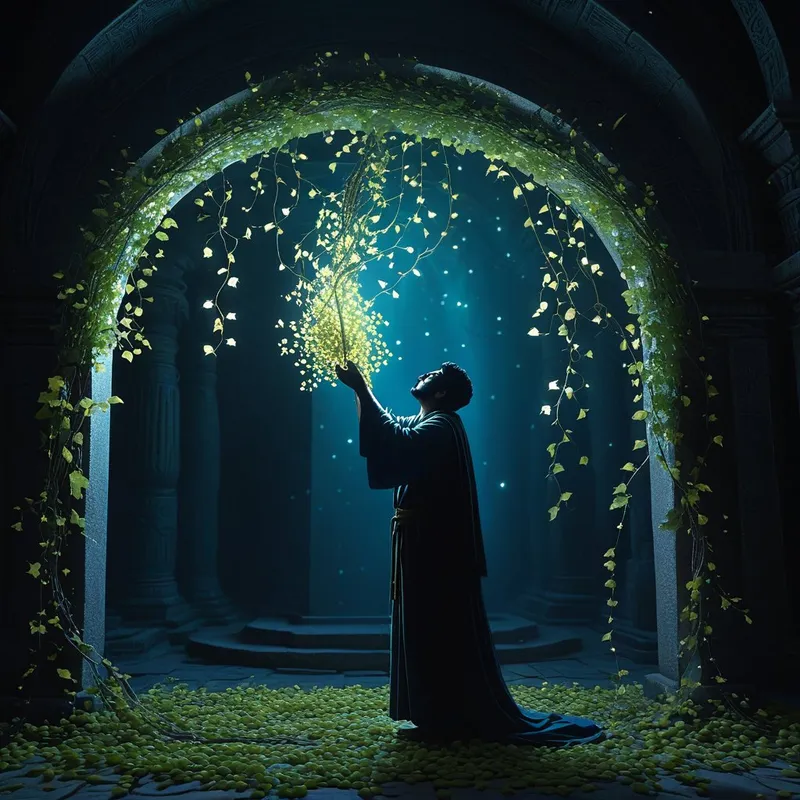
On the seventh night, she reached the grove of Oneiroi Botanoi. They hummed with a low, magnetic frequency. At their center, from the god’s own temple, grew the Mother Vine, from which hung pods like encapsulated nebulae. This was the source. To touch it was to risk being swallowed into the god’s dream forever.
Alke’s hands trembled not from fear, but from resonance. As she reached for a pod, the ground shuddered—not an awakening, but a sigh from the depths of the god’s dream. The sigh was a wave of pure, unmediated unconsciousness. It washed over her, and the world dissolved into a kaleidoscope of archetypal forms and primal emotions. She was drowning in the raw sea of Psyche’s Ocean.
Yet, within that drowning, a fragment of her waking will—the stone in her shoe, the memory of the cliff—flashed like a flint spark. She grasped it. She did not fight the dream; she focused it. She imagined her hand, solid and real, closing around the pod. With a sound like a breaking constellation, she pulled it free.
The universe held its breath. Hypnos Megas did not wake. But his eyelid, a plateau of dark rock, flickered. From that flicker, a new kind of plant burst forth—not silver and blue, but a vibrant, resilient green, with smaller, hardy seeds. It was a hybrid: divine potential tempered by mortal courage.
Alke stumbled back to her people, not with stolen treasure, but with a sacred contagion. She planted the seeds. Those who ingested them, with reverence and intent, did not fall into a stupor. They journeyed. They met aspects of themselves in the dreamlands, spoke with ancestors, and glimpsed the weaving of fate. The empty night had been filled with a gateway. The Oneiroi Botanoi were no longer solely the god’s ornament; they had become humanity’s first sacrament.
Cultural Origins & Context
The myth of the Dream-Inducing Plants is the foundational narrative of the Oneirocritica, a culture that historically inhabited the river valleys and high plateaus, known for their sophisticated oneiromancy—the art and science of dream interpretation. For them, dreaming was not a passive biological function but an active, sacred technology of consciousness. This myth was not merely a story; it was the charter for their entire spiritual and social practice.
It was traditionally recited during the Hekatebesia, the festival at the year’s turning point. The recitation was performed by the Oneirophantes, who would enter a light trance state themselves, often using a mild infusion of the very plants described in the tale. This was not seen as recreation, but as a ritual re-enactment of Alke’s journey, making the listeners participants in the primordial theft of divine insight. The myth served to legitimize the controlled, ritual use of psychoactive botanicals, framing it not as hedonism, but as a perilous, sacred dialogue with the foundational layers of reality. It established a crucial cultural concept: that direct experience of the numinous requires both daring (the theft) and discipline (the return).
Symbolic Architecture
At its heart, this myth maps the human psyche’s audacious reach for its own depths. Hypnos Megas represents the vast, autonomous, and potentially overwhelming realm of the collective unconscious. He is not evil, but impersonal; his sleep creates worlds, but it can also dissolve individual identity.
The god does not grant dreams; he is the Dreaming. The theft is the necessary act of consciousness seeking to know its own source.
Alke, the Seeker, embodies the nascent ego or conscious mind. Her journey is the perilous "night sea journey" of the soul into the unconscious. The stones tied to her feet symbolize the anchoring function of the body and sensory reality—the sine qua non for any journeyer who wishes to return. Her song is the thread of intention, the focused will that prevents total dissolution.
The Oneiroi Botanoi are potent symbols of the psychopomp—the mediator between realms. They are the living bridge between divine, unformed potential (the god) and human, structured experience. The act of stealing the seed is the archetypal act of differentiation: seizing a fragment of the infinite and giving it finite form, thus creating culture, art, and symbolic understanding from raw, unconscious content.

The Dreamer's Resonance
When this myth pattern activates in a modern dream, it signals a profound somatic and psychological process: the ego’s confrontation with a potentially transformative but overwhelming content from the deep unconscious. You may dream of discovering a strange, glowing plant; of stealing a precious gem or book from a sleeping giant; of venturing into a forbidden, eerily beautiful place that feels both terrifying and deeply familiar.
The somatic experience often involves sensations of heavy drowsiness, magnetic pull, or vibrational humming—a direct echo of Alke’s approach to the god’s field. This is the psyche’s literal feeling of being "drawn in" by a complex, an insight, or a repressed memory that is ripe for integration. The conflict in the dream—the fear of being caught, of the giant waking—mirrors the conscious mind’s resistance to this deep material. To dream of successfully retrieving the object and returning, even if frightened, indicates the psyche is ready to undertake the hard work of bringing this content to light, of "planting the seed" in one’s waking life.

Alchemical Translation
The myth models the complete arc of psychic transmutation, or individuation. The prima materia is the sterile, wakeful, literal consciousness of early humanity (and the modern ego-centric state). The nigredo, or blackening, is Alke’s journey into the valley of sleep, her dissolution in the god’s sigh—the necessary despair and confusion of facing the shadow.
The theft is the albedo, the whitening. It is the moment of extraction, where a coherent insight, a symbol, or a new attitude is consciously seized from the chaotic depths.
The hybrid plant that sprouts from the god’s flickering eyelid is the symbol of the coniunctio oppositorum—the union of opposites. Divine potential (the god’s dream) is now wedded to mortal agency and form (Alke’s courage). This is the birth of the transcendent function, the new psychic entity that resolves a previously irreconcilable tension.
Finally, the planting and sharing of the seeds represent the rubedo, the reddening, and the return to the world. The gold of the philosophical stone is not hoarded; it is disseminated. The individual’s hard-won insight must be integrated into communal life, becoming a tool for others. For the modern individual, this translates to the process of taking a profound, often disruptive personal revelation—born from therapy, crisis, art, or deep reflection—and slowly, carefully, learning to embody it and allow it to fruitfully influence one’s relationships and work in the world. One does not just have a transformative experience; one becomes a cultivator of transformation.
Associated Symbols
Explore related symbols from the CaleaDream lexicon: