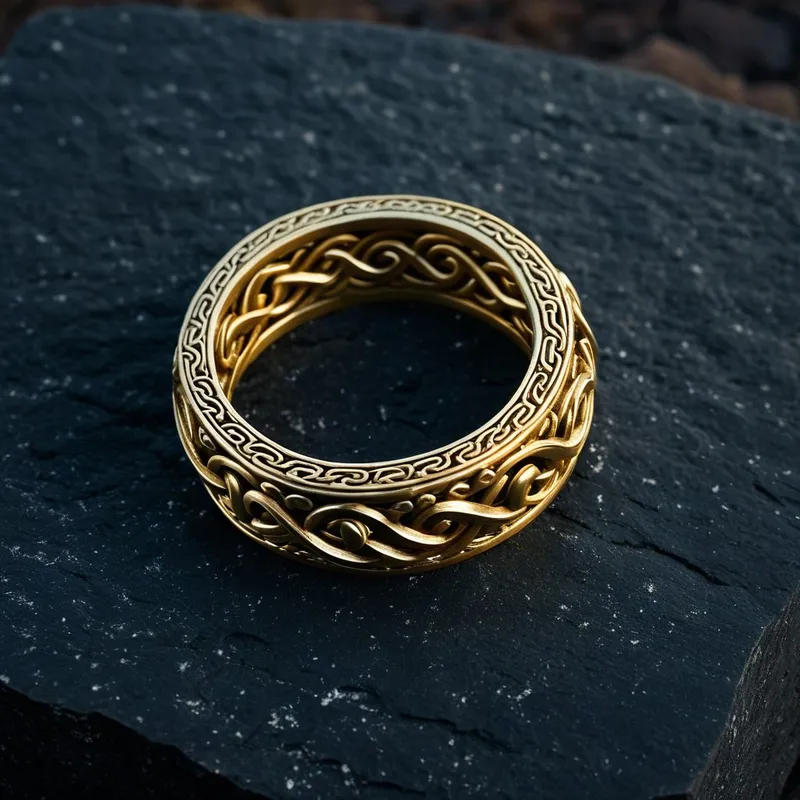
Draupnir Myth Meaning & Symbolism
A magical ring forged in sacrifice, Draupnir symbolizes the paradox of loss as the source of endless, self-renewing wealth and connection.
The Tale of Draupnir
Listen, and hear the tale of a ring that was not merely gold, but a promise made solid. The air in Asgard was thick with pride, and with the scent of burning hair. The trickster Loki, his silver tongue now a liability, had wagered his own head. To save it, he had pledged to bring the gods treasures beyond compare, crafted by the hands of the master smiths—the sons of Ivaldi, and the brothers Brokkr and Eitri.
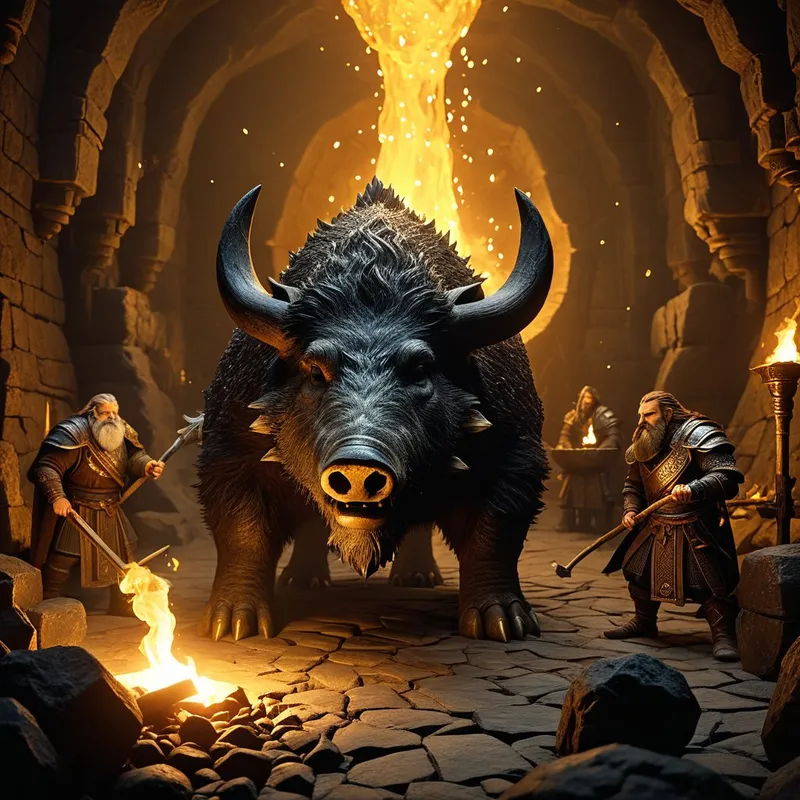
The challenge was set in the very heart of the mountain, in a forge where the earth’s blood ran as fire. Brokkr worked the bellows, a rhythmic, gasping roar, while Eitri’s hands moved like shadows in the hellish glow. Into the crucible went gold, not just ore, but the essence of sunlight trapped in stone. Eitri spoke a spell, a guttural chant that vibrated in the chest, and laid the first form in the fire. "Work the bellows without cease," he commanded, "until I return."
A fly—a persistent, biting gadfly—landed on Brokkr’s hand. It stung, a sharp, burning pain, but the dwarf did not flinch. The bellows roared. The gold swam. Eitri drew out a wonder: Gullinbursti, a boar of living gold, whose bristles shone like the dawn and who could run across sky and sea.
Again, Eitri cast gold into the flames. Again, the chant. Again, the command. The fly returned, this time landing on Brokkr’s neck, driving its bite deep into the flesh. A tremor ran through the dwarf, but his arms pumped on. From the fire, Eitri drew Draupnir. A ring of perfect, seamless gold, heavy with a destiny not yet known. It lay in his soot-blackened palm, cool and inert, holding its secret close.
For the third and final working, Eitri threw iron into the heart of the fire. This was the greatest work. "Now, brother," he hissed, "do not fail. The breath of the world must not stop." The fly came again, this time landing on Brokkr’s eyelid. The pain was blinding, a white-hot needle piercing the very window of his sight. Blood and sweat mingled. For one terrible instant, the rhythm faltered. The bellows gasped. Then, with a roar of agony and will, Brokkr forced them on.
Eitri returned, his face grim. From the forge he pulled a mighty hammer, its handle shortened by that single faltering breath. This was Mjölnir. The treasures were presented in the glittering hall of the gods. Loki presented the gifts of Ivaldi’s sons: Skidbladnir and Gungnir. But all fell silent for the works of Brokkr and Eitri.
The golden boar, the mighty hammer… and the ring. Odin took Draupnir onto his finger. It was then that Eitri spoke its nature: "Every ninth night, from its band, eight new rings of equal weight and worth will drip forth." A silence, deeper than before, filled the hall. Here was not just wealth, but wealth that bred itself, a river of gold from a single source. The wager was won by the dwarves, by the sting of the fly and the unbreaking will at the bellows. Loki escaped with his head, but not without the sealing of his lips. And Odin walked away, a circle of endless becoming now binding his finger, a quiet, ticking heart of gold.
Cultural Origins & Context
The myth of Draupnir is preserved primarily in the Poetic Edda, specifically in the poem Skáldskaparmál (The Language of Poetry), and in the later Prose Edda by Snorri Sturluson. It is a myth deeply embedded in the complex web of Norse cosmological narratives, functioning as an etiological tale—a story explaining the origin of divine artifacts.
Its tellers were the skalds, the poet-historians of the Viking Age and medieval Iceland. For them, Draupnir was not just a plot device; it was a kenning—a poetic metaphor. "Draupnir’s dew" became a standard kenning for gold. This tells us the myth was alive in the language, a shared cultural code. The story served multiple societal functions: it underscored the value of craft and sacrifice, it explained the divine provenance of the gods’ powers (Odin’s ring, Thor’s hammer), and it reinforced a worldview where immense power was always born from immense risk, pain, and cunning. It was a narrative exchanged in halls, a reminder that the most enduring treasures are forged in the most trying fires.
Symbolic Architecture
Draupnir is an artifact of profound paradox. It is a symbol of static perfection—a complete circle—that contains within it the principle of dynamic, endless generation. Its magic is not in attack or defense, but in silent, rhythmic creation.
The greatest abundance is not hoarded, but is found in the willingness to be a vessel for perpetual giving.
Psychologically, Draupnir represents the fertile core of the Self. The eight rings that "drip" forth every ninth night mirror the cyclical processes of nature and the psyche: birth, death, and rebirth. The number nine is sacred in Norse cosmology, tying the ring to the structure of the cosmos itself (the nine worlds of Yggdrasil). The ring’s creation, born from the near-failure at the bellows caused by Loki’s interference, is critical. The flaw (the shortened handle of Mjölnir) and the perfection (the endless generativity of Draupnir) are siblings from the same forge. This suggests that our most generative capacities are often born from our moments of struggle, imperfection, or distraction—the "bites" we endure in the process of creation.
Odin, the god of wisdom gained through sacrifice, is its rightful bearer. The ring becomes an extension of his sovereignty—not a sovereignty of control, but of generative, circulating influence. It is a symbol of kingship that gives itself away to sustain connection and legacy.
The Dreamer's Resonance
When the pattern of Draupnir emerges in modern dreams, it speaks to a process of psychic integration and the discovery of inner resources. To dream of a ring that multiplies is to encounter the unconscious signaling a shift from a psychology of scarcity to one of self-sustaining abundance.
The dreamer may be undergoing a period of felt depletion—emotionally, creatively, or spiritually. The appearance of the multiplying ring is the somatic counterpoint to this depletion; it is the psyche’s reassurance. The "dripping" of the new rings often correlates with a release of tension, a feeling of unexpected fullness or a sudden insight that seems to generate further insights. The dream may carry a tactile sensation of something cool and heavy (the ring) becoming warm and light as it multiplies.
Conversely, dreaming of losing Draupnir, or of it multiplying uncontrollably into a suffocating heap, points to a shadow aspect. This is the fear of one’s own generative power, an anxiety about the responsibilities of creativity, or a disordered relationship with giving and receiving. The dream asks: What part of you is refusing to be the vessel through which life wishes to flow?
Alchemical Translation
The journey of Draupnir models the alchemical process of multiplicatio—the multiplication of the perfected substance. For the modern individual navigating individuation, the myth charts the path from a leaden sense of lack to the golden realization of self-renewing potential.
The first stage is the Sacrificial Fire (The Forge). The raw material of the psyche—our talents, wounds, and experiences—must be thrown into the crucible of conscious effort and often painful introspection (Brokkr’s stings). This is the hard, sweaty work of therapy, artistic discipline, or spiritual practice, where we "work the bellows" of attention despite distractions and suffering.
The second stage is Formation and Flaw (The Artifacts). From this fire, our "artifacts" emerge: our matured skills, our hard-won wisdom (Mjölnir, with its short handle), and the core, generative pattern of our unique being (Draupnir). Crucially, the flaw (Mjölnir’s handle) and the perfect gift (Draupnir) are accepted together. Individuation requires embracing our limitations as the very shape of our power.
The ring does not ask to be worn; it asks to be a conduit. The Self is not an end point, but a beginning that endlessly begins.
The final stage is Circulation (The Ninth Night). This is the alchemical gold. To own Draupnir is to enter a covenant of circulation. Odin does not hoard the ring; its nature is to give itself away. Psychologically, this translates to the mature individual who, having integrated their core, finds that their authentic action, creativity, or love naturally nourishes and generates connections. Their "wealth" is not for possession, but for relationship—bequeathing a ring to Baldr on his funeral pyre, as the myth later recounts. The individuated Self becomes like Draupnir: a centered, complete circle that, by its very nature, blesses the world with its ongoing, rhythmic becoming.
Associated Symbols
Explore related symbols from the CaleaDream lexicon: