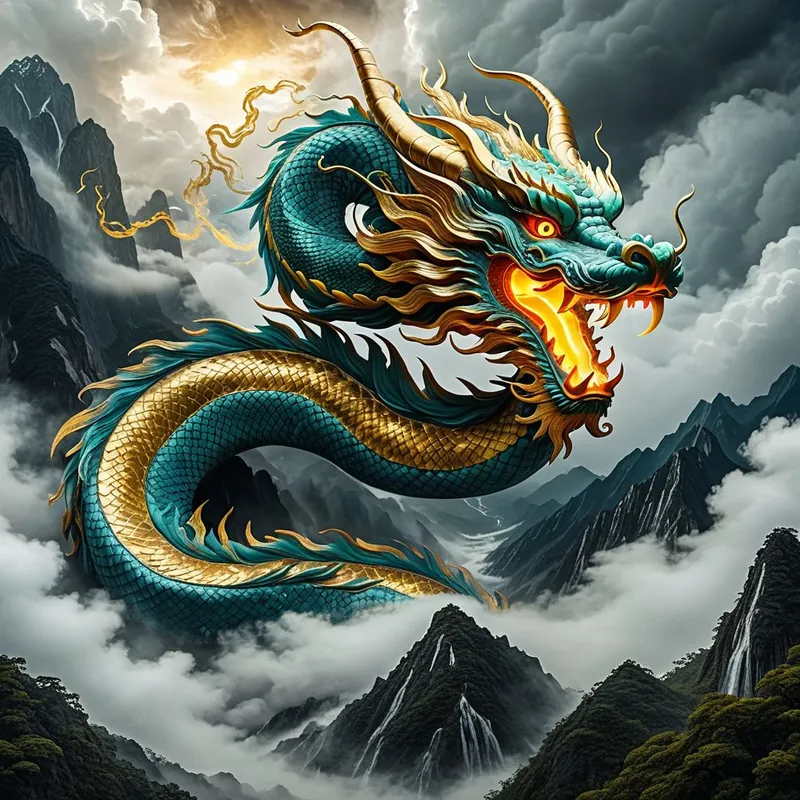
Dragon's Breath Myth Meaning & Symbolism
A myth where the dragon's fiery breath, a force of chaos and creation, is tempered by celestial wisdom, forging the world's elemental harmony.
The Tale of Dragon's Breath
In the time before time, when the sky was a membrane of soft, dark silk and the earth a formless, dreaming clay, there existed only the great Yuanlong, the Primal Dragon. It slept in the womb of the void, and its breath was the only rhythm in the stillness—a slow, tidal exhalation of shimmering mist that held the seeds of all things yet to be.
But within the Yuanlong's deep slumber, a dream turned turbulent. It dreamt of separation, of distinction, of heat and cold, of mountain and valley. This psychic storm agitated its spirit. With a convulsive shudder that was the first quake, the dragon awoke. Its awakening was not gentle. A roar, silent and profound as space itself, tore from its throat, and with it came the Breath.
This was not the gentle mist of its sleep. This was Dragon's Breath—a cataclysmic exhalation of raw, undifferentiated potential. It was fire that was also water, lightning that was also stone, wind that was also metal. A chaotic, beautiful, and terrifying maelstrom erupted from the dragon's maw, flooding the void. Stars were spat forth like embers, lands heaved and buckled into being only to be melted away by the next wave of elemental fury. The Yuanlong, now fully conscious, beheld the chaos of its own making. It felt not malice, but a profound and terrifying creativity it could not control. Its breath, the essence of its life force, was destroying as it created, a boundless power without a vessel, without a law.
The celestial order, the Dao itself, resonated with this discord. From the highest heaven descended the Yu Huang, not as a warrior, but as a sage of cosmic patience. He did not raise a sword against the dragon, for the dragon was not an enemy, but a force of nature lost in its own potency. Instead, the Yu Huang began to sing. His song was the melody of the Wuxing, the five phases. It was the sound of a tree growing, a river finding its bed, a mountain settling into stillness, metal cooling into form, and fire contained within a hearth.
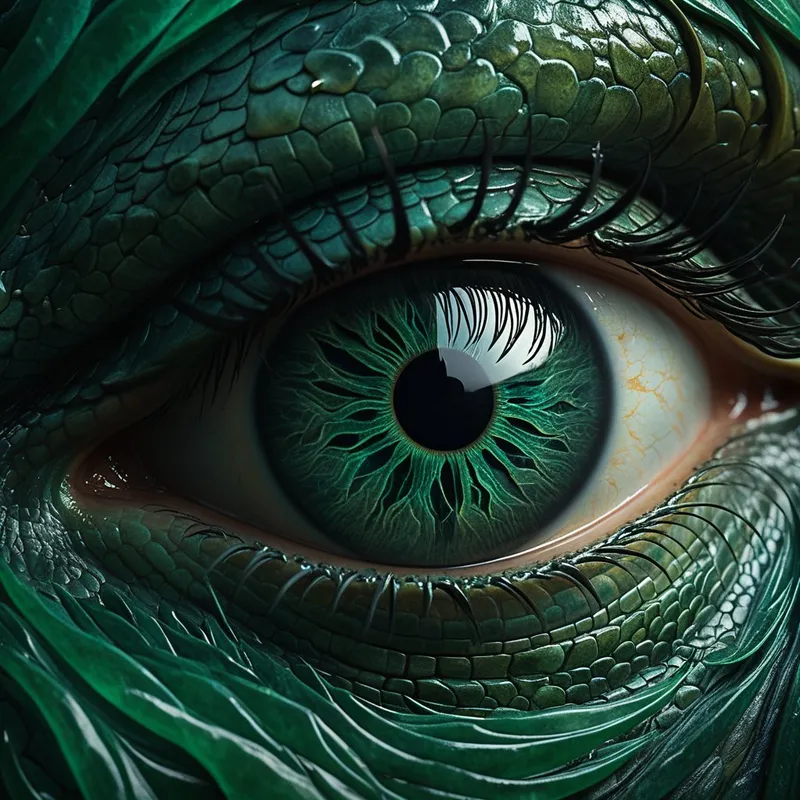
The song wove through the chaos of the Dragon's Breath. At first, the Yuanlong roared against this constraint, its breath flaring hotter. But the song was insistent, a pattern offered, not imposed. Slowly, the dragon's immense eye, a pool of molten sun, focused on the Yu Huang. It saw not a threat, but a mirror showing a possibility of form. A great internal struggle commenced within the dragon. It drew in a shuddering inhalation, pulling the raging chaos back towards itself.
Then, with a will that forged the first law of nature, the Yuanlong exhaled anew. This breath was different. The undifferentiated fury began to separate, to spin and settle according to the celestial song. The fiery core rose to become the sun and the heat of the earth's heart. The watery mist cooled and fell as rain, gathering in rivers and seas. The stony elements grounded themselves as mountains and plains. The metallic sparks solidified into veins of ore deep within the world. The woody, growing essence sprouted as the first forests. The Dragon's Breath, once pure chaos, was now the ordered, living breath of the world itself—the very medium through which Qi flows and the Wuxing transform. The dragon, its great work done, did not depart. It became the spirit within the wind, the pulse in the tectonic plates, the fire in the volcano—no longer a solitary creator, but the embodied principle of dynamic, balanced transformation.
Cultural Origins & Context
The concept of the dragon's breath is not a singular myth from one text, but a pervasive archetypal motif woven through Chinese cosmology, folklore, and alchemical tradition. It finds expression in the creation narratives where Pangu separates heaven and earth, his breath becoming the wind and clouds. It is present in the <abbr title=""Classic of Mountains and Seas," an ancient Chinese text of mythic geography">Shanhaijing, where dragons control weather, their exhalations bringing rain or drought.
This mythic idea was passed down not just by bards, but by Fangshi and philosophers. In Daoist natural philosophy, the dragon (Long) represents the ascending, active, fiery Yang force. Its "breath" is the literal and metaphorical Qi—the fundamental energy of the universe. The story served a crucial societal function: it explained the natural world's volatility and beneficence through a framework of inherent intelligence and balance. It taught that creation is not a neat, divine command, but a turbulent process requiring the reconciliation of raw power (Long) with ordering wisdom (Dao). For farmers, the dragon's breath was the storm and the life-giving rain. For emperors, it was the Mandate of Heaven, a potent force they must channel with virtue, lest it become destructive.
Symbolic Architecture
At its core, the myth of the Dragon's Breath is a profound allegory for the psyche's relationship with its own creative and destructive power.
The Yuanlong represents the unconscious Self in its primordial state—a vast reservoir of instinct, potential, and raw life force. Its breath is the unmediated output of this Self: our passions, our impulses, our explosive creativity, and our primal rage. Untempered, this force is chaos; it creates and destroys without discrimination, leaving the individual (or the world) in a state of perpetual, exhausting upheaval.
The unmediated Self is a universe in birth throes, magnificent in its power and terrifying in its lack of form.
The Yu Huang symbolizes the emerging principle of consciousness, or the Ego, not as a repressive ruler, but as the faculty that listens for and articulates patterns. His song of the Wuxing represents the innate, archetypal structures of the psyche—the fundamental patterns (thinking, feeling, sensation, intuition) through which raw experience can be differentiated and understood. The dragon's eventual integration of this song is the moment the unconscious agrees to collaborate with consciousness.
The final, ordered breath is the achievement of psychological integration. It is the moment raw talent becomes disciplined art, blind anger becomes focused conviction, and chaotic emotion becomes nuanced feeling. The dragon does not cease to breathe fire; it learns to breathe life.
The Dreamer's Resonance
When this mythic pattern stirs in the modern dreamer, it often signals a profound encounter with one's own unintegrated power. To dream of uncontrollable fire, erupting volcanoes, or being caught in a magnificent but terrifying storm may be the psyche's depiction of the Dragon's Breath.
Somatically, the dreamer may report feeling overheated, restless, or experiencing a surge of energy with no clear outlet upon waking. Psychologically, this corresponds to a period where a great potential—a new idea, a deep passion, a long-suppressed truth—is demanding expression. The conflict in the dream mirrors the internal struggle: part of the self (the dragon) wants to unleash this force without restraint, while another part (the celestial singer) fears the consequences of such an eruption. The dream is not a warning to suppress, but a call to the arduous, alchemical work of finding the "song"—the right form, the right timing, the right vessel—for this powerful new content seeking to enter the dreamer's life.

Alchemical Translation
The myth models the individuation process—the Jungian journey toward psychic wholeness—with stunning clarity. The initial state is one of identification with the unconscious dragon; we are at the mercy of our moods, complexes, and impulses. The awakening of the dragon is the often-painful emergence of a new content from the Self, disrupting our comfortable, formless stagnation.
The central alchemical operation is not slaying the dragon, but educating its breath. This is the translation of the prima materia—the chaotic, leaden stuff of our unexamined lives—into the philosophical gold of a realized personality.
Individuation is the art of breathing chaos into cosmos, of becoming the crucible where the dragon's fire forges not destruction, but discernment.
The Yu Huang's role is internalized as the observing ego, which must learn to "sing the song" of structure through reflection, discipline, and engaging with the outer world's forms (culture, relationships, work). The triumphant resolution is the birth of the Transcendent Function. The dragon, now integrated, becomes the aligned Self. Its breath is no longer a threat but the vital, creative expression of a person who has mastered the art of containing and directing their own immense power. They do not avoid their inner fire; they have learned to breathe it with intention, warming rather than burning, illuminating rather than blinding, creating a world within and around them that is vibrantly, dynamically alive.
Associated Symbols
Explore related symbols from the CaleaDream lexicon: