
Dragon's Blood Myth Meaning & Symbolism
A wounded dragon's lifeblood, spilled upon the earth, transmutes into a sacred, potent resin, symbolizing the alchemy of suffering into power.
The Tale of Dragon's Blood
Listen, and I will tell you of the last sigh of the wyrm, and the first breath of the sacred grove.
The world was younger, and shadows were deeper. In the heart of a forgotten wood, where the trees were pillars holding up the sky and the moss drank only starlight, there coiled the last of the great dragons. It was not a beast of mere fire and scale, but a creature of the earth’s deep memory, a guardian of the ley-lines that pulsed beneath the roots. Its hide was the color of tarnished armor and old volcanic stone; its eyes were pools of molten gold, holding the patience of mountains.
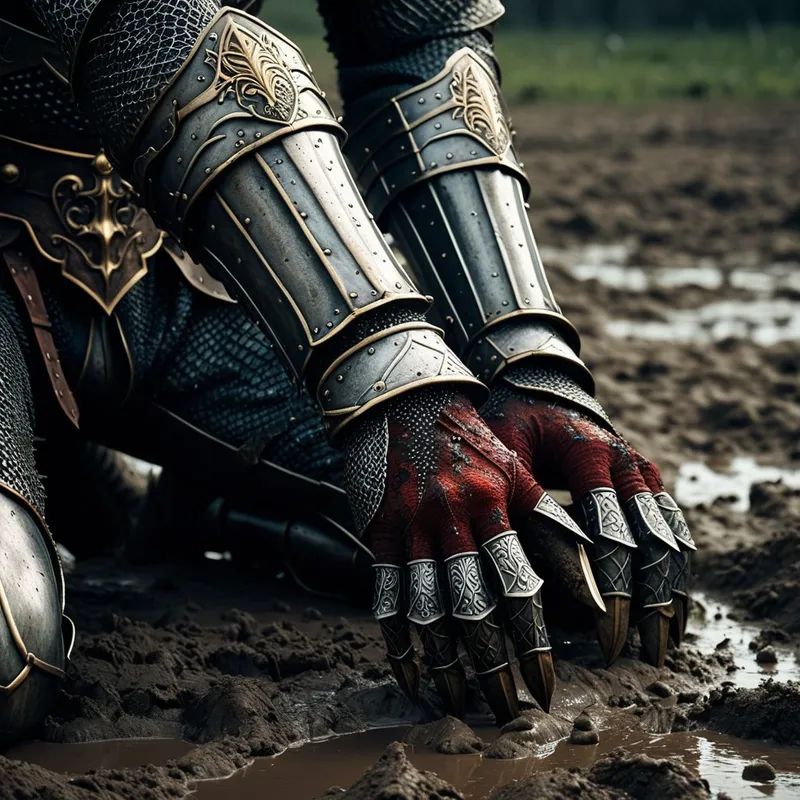
A knight came, not of shining glory, but of a grim and heavy purpose. His king had heard tales of the dragon’s hoard—a treasure that could buy empires. But the knight, as he pushed through the whispering bracken, felt no greed. He felt the weight of the forest’s gaze, the ancient silence that judged his steel and his soul. When he found the dragon, it was not coiled upon gold, but around the base of a colossal, silver-barked tree, its breath a warm mist that smelled of damp soil and lightning.
They did not fight for sport, but for destiny. The dragon, bound by its nature to defend its sanctum, rose with a sound like grinding continents. The knight, bound by his oath, raised his shield. It was a terrible, beautiful dance. Fire lit the canopy; steel rang against scale. The knight’s lance found a gap in the ancient armor, not through skill alone, but because the dragon, in a moment of timeless understanding, turned its heart toward the blow.
The dragon fell, not with a roar, but with a sigh that shook the leaves from the trees. It lay its great head upon the roots of the silver tree. The knight, wounded and breathless, dropped his weapon and approached, not as a victor, but as a witness. From the grievous wound in the dragon’s flank, its lifeblood began to flow. But this was no common blood. It was dark as wine, thick as honey, and it steamed where it touched the cool earth.
As the knight watched, a miracle of sorrow unfolded. Where the dragon’s blood soaked into the roots of the great tree, the tree itself began to weep. From its bark, a rich, red resin oozed forth, hardening in the air into tear-shaped gems of deep crimson. The scent that rose was overwhelming—sweet and spicy, like incense and memory, like a forest remembering its king. The dragon’s eye met the knight’s one last time, and in that gold-flecked depth, there was no accusation, only a profound transfer. Then, the light faded. The great body began to sink into the loam, becoming one with the grove it had guarded.
The knight gathered the hardened, blood-red tears. He knew he held no mere trophy, but a covenant. He left the forest, and the legend was born: that the blood of the last dragon, spilled in sacrifice, had become the world’s most potent substance—Dragon’s Blood.
Cultural Origins & Context
The myth of Dragon’s Blood does not belong to a single text, but to the collective breath of the Medieval imagination. It is a folkloric amalgam, emerging from the crossroads of Christianized hero-tales, lingering pagan reverence for natural sites, and the practical mysteries of the cunning-man or apothecary.
It was passed down in the smoky warmth of taverns, whispered by herbalists at market stalls selling the actual, earthly resin (from the Dracaena tree or Daemonorops palm, often called by the same name), and hinted at in the marginalia of illuminated bestiaries. The story served a crucial societal function: it acted as a psychic container for the profound ambivalence toward the wild, the primal, and the concept of sacred violence. The dragon was the ultimate symbol of the untamed, chaotic world that needed to be conquered for civilization to exist. Yet, its death was not a clean victory, but a necessary tragedy that yielded a sacred, healing gift. The myth thus mediated the trauma of conquering nature, transforming a act of destruction into one of paradoxical creation, ensuring the wild’s power was not lost but transmuted into a form society could use.
Symbolic Architecture
At its core, the myth is a profound alchemical parable of transmutation. The dragon represents the primal, instinctual psyche—the shadow in its most potent and formidable form. It is not evil, but vast, ancient, and dangerously potent. It hoards not gold, but the raw, undifferentiated energy of life and the deep wisdom of the unconscious.
The greatest power is not seized from the monster; it is released through the monster's sacred wound.
The knight represents the conscious ego, tasked with the necessary, painful work of engaging this immense inner force. The battle is the conflict inherent in individuation—the ego must confront and be wounded by the shadow to initiate transformation. The dragon’s willing turn into the blow is critical; it signifies that the deepest Self (the Self) collaborates in its own seeming defeat for a higher purpose.
The resulting Dragon’s Blood is the Philosopher's Stone of this psychic drama. It is the concrete symbol of the elixir produced when conscious suffering (the knight’s quest and wound) meets unconscious sacrifice (the dragon’s death). The blood, the very essence of life-force, does not merely stain the earth; it catalyzes a new creation from the living world (the tree). This is the symbol of integrated power—the raw instinctual energy, now refined into a resin that can heal, protect, and dye things permanently (i.e., transform them).
The Dreamer's Resonance
When this myth stirs in the modern dreamscape, it often manifests not as a literal dragon, but as an encounter with a formidable, wounded, or dying source of immense personal power. You may dream of a vast, ancient machine shutting down, its final oil leak forming a precious gem. You may find a dying animal in a sacred place, and from its wound emerges a healing balm. The somatic feeling is one of profound, aching poignancy mixed with awe—a deep chest tightness, tears that feel both sorrowful and cleansing.
Psychologically, this dream pattern signals that the dreamer is in the crucible of a major transformation. An old, powerful structure of the psyche—a long-held identity, a defensive complex, a primal talent that has become a burden—is being consciously engaged and is undergoing a necessary "death." The dream confirms that this process, though painful, is sacred and generative. The appearance of the "elixir" (the Dragon’s Blood) is the unconscious assuring the dreamer that this suffering is not in vain; it is actively creating a new, potent resource within them. The dream is an invitation to collect this inner resin, to acknowledge the gift born of the struggle.
Alchemical Translation
For the individual on the path of individuation, the myth of Dragon’s Blood provides a complete map of psychic transmutation.
The Nigredo (Blackening): This is the forest and the dragon—the confrontation with the shadow. The individual must venture into the neglected, wild parts of themselves (the forest) and face the daunting, coiled power of their own repressed instincts, rage, or primal creativity (the dragon). This stage is dark, chaotic, and full of conflict.
The Mortificatio (Putrefaction/Making Sacred): This is the fatal wounding. The old form of this psychic energy must "die." In life, this feels like a crushing defeat, a depression, the dissolution of a long-held attitude. The knight’s remorse and the dragon’s sigh capture the essential bittersweetness of this phase. It is not a clean kill, but a sacred sacrifice.
The elixir is always found at the site of the wound, where the deepest life bleeds into the waiting world.
The Albedo (Whitening) & Rubedo (Reddening): This is the transmutation itself—the blood becoming resin. The Albedo is the weeping tree, the receptive, feminine principle that receives the sacrifice and begins the work of distillation. The Rubedo is the final, crimson resin—the achieved goal. Psychologically, this is the integration. The raw power of the complex is not eradicated; it is refined. The fiery temper becomes unwavering courage. The possessive hoarding becomes the ability to hold sacred space. The instinctual drive becomes a source of healing and authentic creative power (the true Dragon’s Blood).
The individual who completes this cycle does not simply slay their demons. They befriend the dragon within, undergo the mutual wounding, and learn to harvest the sacred, life-giving resin that forms at the junction of their conscious striving and their unconscious sacrifice. They become, in essence, both the knight and the tree—the agent of engagement and the vessel of transmutation—holding the elixir of their own hard-won wholeness.
Associated Symbols
Explore related symbols from the CaleaDream lexicon: